Arizona Lawmaker Calls for Pausing Advanced AI, Banning Superintelligence

An Arizona Democratic congressman urges pausing advanced AI, regulating the industry, and banning superintelligence on day one, as AI governance accelerates into U.S. partisan politics.
An Arizona Democratic congressman publicly argued that if Democrats win the election, pausing advanced AI development, regulating the "out-of-control" AI industry, and banning artificial superintelligence should be top priorities on day one. After spreading on Reddit, the remarks drew widespread attention in the tech community, marking AI regulation's acceleration from academic and think-tank discussion into the practical realm of U.S. partisan politics. The article notes that the three positions escalate in intensity, but "pausing advanced development" and "banning superintelligence" face fundamental obstacles such as vague definitions and difficult international coordination. Even if legislation is unlikely in the short term, such radical statements widen the policy discussion range, making moderate regulation more acceptable and pushing AI companies to factor regulatory risk into mid-term planning. The current information comes only from a single lawmaker and does not represent the Democratic Party's overall stance.
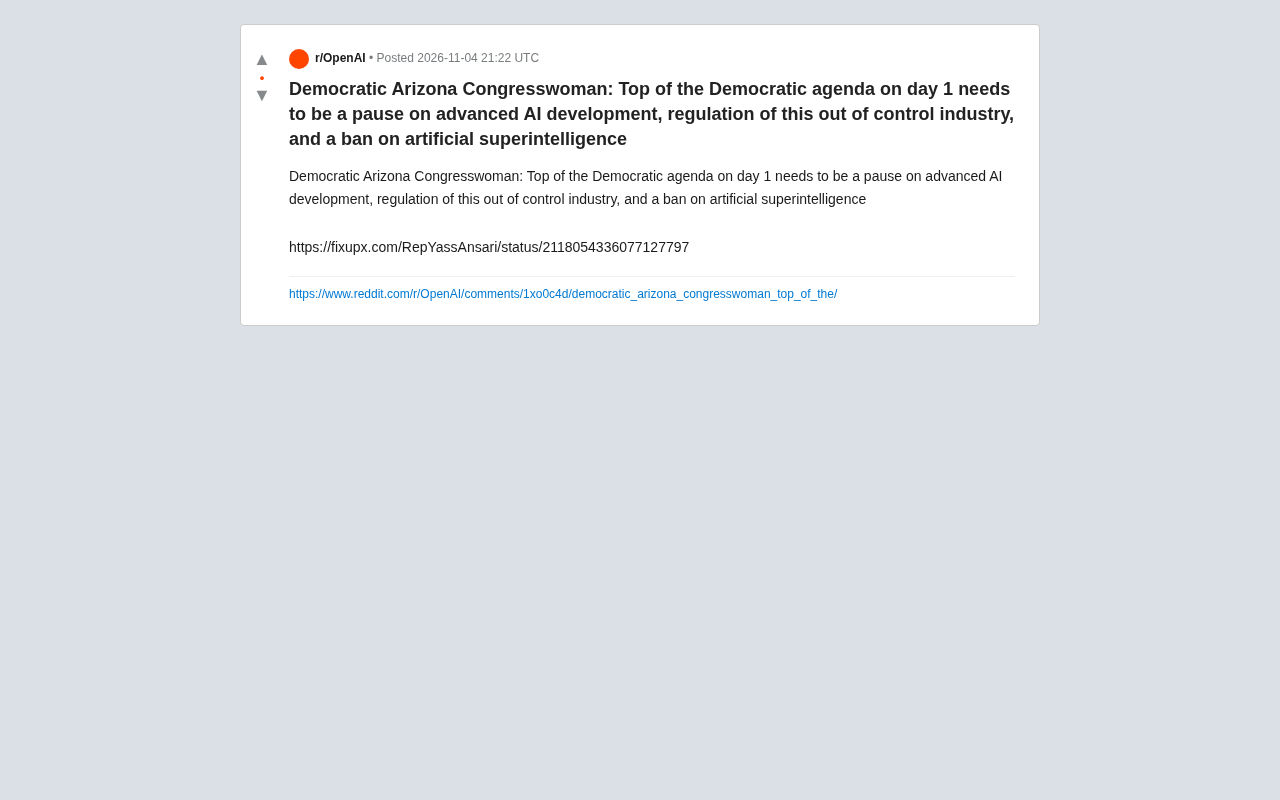
An Arizona Democratic congressman recently called publicly on social media for the Democratic Party, should it win the election, to make pausing advanced AI development, regulating the "out-of-control" AI industry, and banning artificial superintelligence top priorities on day one. After spreading through a Reddit discussion thread, these remarks drew widespread attention in the tech community—marking the acceleration of AI regulation from academic and think-tank circles into the practical realm of American partisan politics.
The Lawmaker's Three Core Demands
According to the post circulating on Reddit, the lawmaker's policy positions can be broken down into three levels.
The first is pausing advanced AI development. This does not refer to all AI applications broadly, but rather pressing pause on the pace of research into frontier capabilities to leave a window of time for building a regulatory framework. The second is regulating the "out-of-control" AI industry, with the phrase "out of control" carrying a clear negative characterization, implying that the industry's self-regulation has already failed. The third is banning artificial superintelligence—that is, drawing a red line through legislation before superintelligence emerges.
The three positions progress from "pause" to "regulate" to "ban," with escalating intensity, forming a complete set of restrictions spanning from the R&D side to the application side.
Artificial Superintelligence (ASI) is a hypothetical AI system that comprehensively surpasses human intelligence, far exceeding today's "narrow AI" and "artificial general intelligence (AGI)" in capability. AGI refers to systems that reach human level on most cognitive tasks, while ASI is an intelligence that significantly surpasses the smartest humans in all domains (including scientific innovation, social intelligence, and more). Currently, ASI is purely a theoretical construct, with no recognized technical path or definitional boundaries—which is also the core difficulty in legislating a ban on it: the prohibited object cannot be precisely defined. Academic discussion of ASI risk centers mainly on the "alignment problem" (how to ensure a superintelligence's goals are consistent with human values) and the "control problem" (how humans can maintain control over a more powerful intelligence). These discussions form an important backdrop to current AI safety research.
Why It Is Entering the Political Agenda Now
AI regulation is not a new topic, but placing it at the priority level of "day one in office" sends an unusual signal.
Over the past few years, public discussion around AI has focused mainly on specific issues such as transparency, copyright, and employment impacts, while positions like pausing advanced R&D and banning superintelligence have generally been seen as more radical stances. That a member of Congress is now publicly proposing them as a partisan agenda shows two things: first, the visibility of AI safety issues on the American political spectrum is rising; second, some Democrats are trying to shape AI regulation into a recognizable policy label.
This statement also echoes ongoing international debate over frontier AI governance. It should be noted, however, that the current information comes only from a single lawmaker's social media remarks and Reddit discussion, and is not sufficient to determine whether this represents the Democratic Party's overall position.
AI Safety, as a research field, focuses on how to ensure AI systems operate as intended and avoid accidental harm, with particular emphasis on catastrophic risks that frontier models may pose. It differs from "AI ethics" (which leans toward application-level issues such as fairness, privacy, and transparency) in that it stresses existential risk and loss-of-control risk. In recent years, as large models' capabilities have advanced rapidly, AI safety has gradually moved from a niche academic topic into the public policy spotlight, with international governance efforts such as the UK AI Safety Summit and the EU AI Act. The U.S. Congress has also held multiple related hearings, but no systematic federal legislation has yet taken shape. The lawmaker's elevation of AI safety positions to "day one" priority is precisely a manifestation of this trend in partisan politics.
Practical Obstacles to Policy Implementation
From calls to legislation, there is a considerable distance.
"Pausing advanced AI development" faces fundamental difficulties at the implementation level: How is "advanced" defined? Who determines whether a given R&D effort crosses the threshold? How can a pause be coordinated globally to avoid unilateral restrictions causing technological competitiveness to flow abroad? None of these questions has a clear answer in existing public discussion.
"Banning artificial superintelligence" likewise faces definitional dilemmas. Superintelligence remains a theoretical concept with no recognized technical boundaries. Legislating a ban on something that does not yet exist is legally feasible, but implementation requires a supporting capability-assessment mechanism—and that mechanism itself is still in the research stage.
The phrase regulating an "out-of-control industry" is closer to a traditional legislative path, but exactly what to regulate, which agency should lead, and how to balance innovation and safety remain issues requiring extensive negotiation.
"Pausing advanced AI development" is often referred to in policy discussion as an "AI moratorium," whose intellectual origins trace back to the 2023 open letter "Pause Giant AI Experiments," which called on all AI labs to pause training systems more powerful than GPT-4 for six months. However, such positions face fundamental challenges in implementation: first, the threshold for "advanced" is difficult to define objectively, usually measured by training compute (such as FLOPs) or model capability benchmarks, but the latter itself changes as technology evolves; second, a unilateral pause cannot constrain global competitors and may trigger "regulatory arbitrage"—R&D shifting to more lightly regulated regions; third, a pause directly conflicts with the commercial interests of existing companies, creating enormous legislative resistance. These factors keep "pause" largely at the advocacy level rather than as operable regulation.
Potential Impact on the AI Industry
Even if these positions are unlikely to become law in the short term, their political significance should not be underestimated.
For AI companies, such statements mean regulatory risk is shifting from "long-term uncertainty" to "a factor that must be incorporated into mid-term planning." Compliance costs, public communication about R&D pace, and interaction with policymakers may all become higher-weighted parts of corporate operations.
For the tech community, the heated discussion on Reddit shows that public anxiety about the pace of AI development is real. This anxiety may translate into support for strict regulation, but it may also trigger a counter-argument over whether "regulation will stifle innovation." The tug-of-war between these two forces will shape the direction of AI policy for some time to come.
It is worth noting that radical positions from legislators often widen the range of policy discussion—even if the regulations ultimately enacted are not so strict, they make moderate regulatory proposals previously seen as "excessive" appear more acceptable.
Conclusion
One lawmaker's social media remarks are not enough to define the Democratic Party's overall AI policy, but they clearly convey a trend: AI governance is shifting from a technical issue to a political one. The entry of once-marginal positions like pausing advanced R&D and banning superintelligence into mainstream political discourse itself shows that social consensus around AI remains in dramatic flux. For those following the AI industry, what matters next is not the post itself, but whether similar statements coalesce into dense policy signals—and how the tech industry will respond.
Related articles

AI Coding Enters the Team Collaboration Era: Interpreting Three Major Moves from Meta, GitHub, and Mistral
Meta acquires Conductor, GitHub Copilot Fusion becomes available, Mistral opens Large 4 weights—three moves show AI coding shifting from code generation to organizing development workflows. This article explains task orchestration, model collaboration, and cost control for developers.

Building a RAG Assistant with Dify: A Practical Guide to Knowledge Bases, Workflows, and Agent Nodes
How should knowledge bases, workflows, and Agent nodes connect in a Dify RAG assistant? We break down the division of labor and wiring logic for a shippable app.
 Tech Frontiers
The AI Industry Doesn't Lack Marketing—It Lacks Good Products
AI faces market selloffs and public skepticism—is marketing really the problem? This analysis of market signals and product experience argues the core困境 is incomplete products and a gap between promises and experience; the only way to change perceptions is to ship better products.