Artificial: A Go-Based Framework for Orchestrating Claude Code and Multiple AI Coding Assistants

Artificial is a Go-based open-source multi-agent framework for orchestrating multiple AI coding assistants.
This article introduces Artificial, an open-source multi-agent orchestration framework written in Go, designed to unify scheduling of Claude Code, OpenAI Codex, Cursor Agent, and local models. Through unified interface abstraction, plugin architecture, and Go's concurrency model, it enables task decomposition, parallel execution, and result aggregation, suitable for large-scale parallel development, AI tool evaluation, and CI/CD automation integration.
Why We Need a Multi-Agent Orchestration Framework
In today's flourishing landscape of AI coding assistants, developers often need to use multiple AI tools simultaneously to accomplish different tasks. Claude Code excels at complex reasoning, OpenAI Codex is great for code generation, Cursor Agent provides an integrated IDE experience, and local models meet privacy requirements. However, frequently switching between multiple tools is not only inefficient but also lacks a unified task management mechanism.
Multi-Agent Systems (MAS) represent a classic research direction in distributed artificial intelligence, dating back to distributed problem-solving research in the 1980s. In traditional MAS, each Agent is a computational entity with autonomy, reactivity, and social ability, capable of perceiving its environment and taking actions to achieve goals. Orchestration borrows from the service orchestration concept in microservices architecture, referring to a central coordinator that manages the interaction sequence and data flow between multiple services. Combining these two concepts in the AI programming domain means treating each AI coding tool as an agent with specific capabilities, while the orchestration framework handles task decomposition, assignment, monitoring, and result aggregation.
The open-source GitHub project Artificial was created to solve exactly this pain point. It's a multi-agent harness written in Go, specifically designed to coordinate and manage multiple AI coding workers, providing developers with a unified scheduling layer.
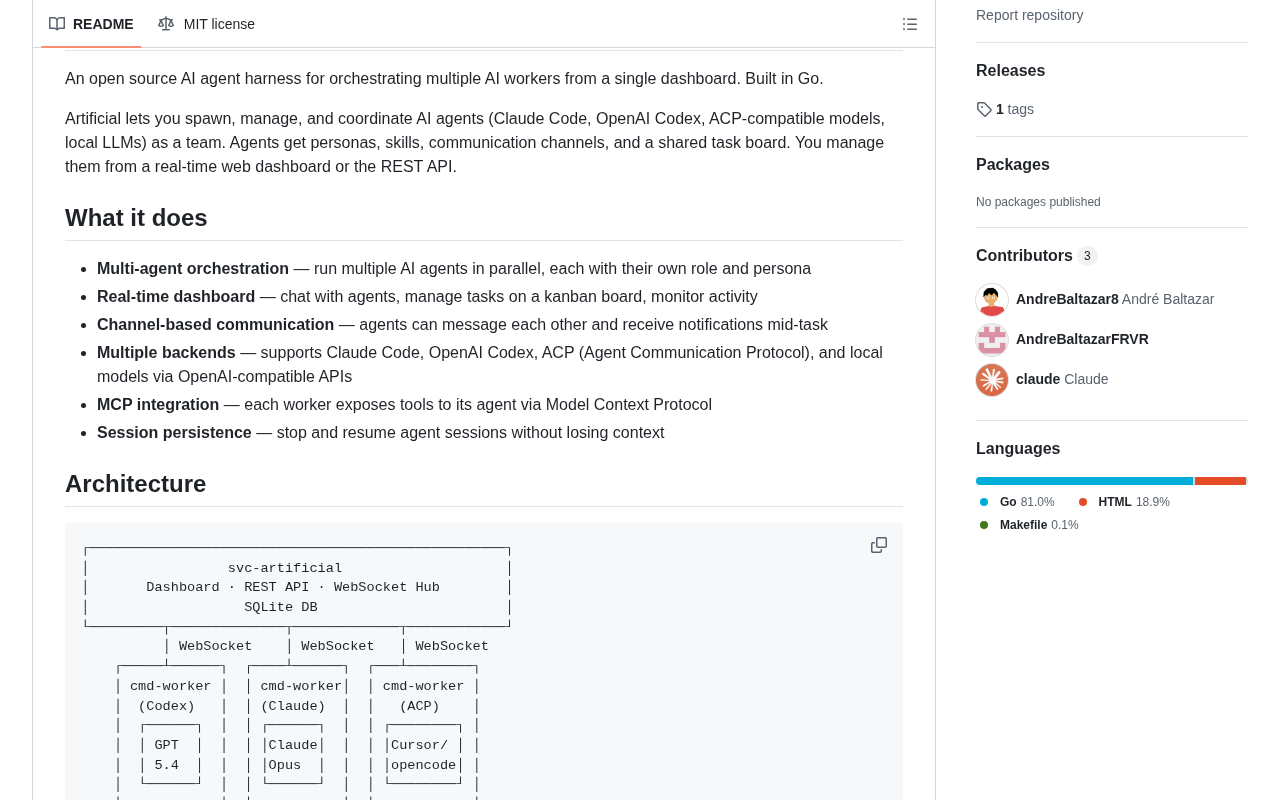
Core Design Philosophy of Artificial
Multi-Agent Collaboration Model
Traditional AI coding assistants typically operate in a single-model, single-task mode. Artificial breaks this limitation by introducing the concept of "orchestration" — you can decompose a complex development task into multiple subtasks and assign them to different AI workers for parallel or sequential execution.
This design is similar to the microservices architecture philosophy in software engineering: each AI agent handles what it does best, coordinated by a central scheduler. Here's a practical example: let Claude Code handle architecture design and code review, let Codex handle batch code generation, and let local models handle sensitive code completion — each fulfilling its role while collaborating to complete the entire development workflow.
Unified Interface Abstraction Layer
Another core value of the project lies in providing a unified interface abstraction. Regardless of which AI service is used underneath, developers can issue tasks, monitor status, and collect results in the same way. This greatly reduces the cognitive burden of switching between multiple AI tools and standardizes workflow configuration.
This unified abstraction design follows the Dependency Inversion Principle from SOLID: high-level orchestration logic doesn't depend on specific AI tool implementations, but rather on abstract interfaces. When new AI coding tools emerge, they can be seamlessly integrated by implementing the predefined interface contract, without modifying any upper-level scheduling code.
Technical Architecture and Implementation Details
Why Go?
Choosing Go as the implementation language was a deliberate technical decision. Go's concurrency model (goroutine + channel) is naturally suited for multi-agent parallel scheduling scenarios, efficiently managing the lifecycle of multiple AI workers. Additionally, Go's ability to compile into a single binary makes deployment extremely simple — no runtime environment configuration needed, just download and run.
Go's concurrency model is based on CSP (Communicating Sequential Processes) theory, proposed by computer scientist Tony Hoare in 1978. Goroutines are Go's lightweight coroutines with an initial stack space of only about 2-8KB (compared to OS threads which typically require 1-8MB), allowing a single process to easily create hundreds of thousands of goroutines. Channels provide type-safe communication between goroutines, avoiding the lock contention problems of traditional shared-memory concurrency models. In multi-agent scheduling scenarios, each AI worker can run in an independent goroutine, with channels handling task distribution and result collection, while Go's runtime M:N scheduler automatically maps goroutines to OS threads for efficient CPU utilization.
Compared to similar orchestration tools in the Python ecosystem (such as LangChain's Agent module), the Go implementation has clear advantages in performance overhead and memory usage, making it more suitable as a long-running background scheduling service. LangChain is the most popular LLM application development framework in the Python ecosystem, and its Agent module allows LLMs to dynamically select tools and perform multi-step reasoning based on user input. However, LangChain's Agent design primarily targets single-LLM tool-calling scenarios rather than coordinating multiple independent AI systems. Furthermore, Python's GIL (Global Interpreter Lock) limits true multi-threaded parallel execution. While asyncio can achieve asynchronous IO, for CPU-intensive scheduling logic and managing large numbers of concurrent connections, performance falls short of Go's native concurrency model.
Supported AI Coding Backends
Currently, Artificial supports four types of AI workers:
-
Claude Code: Anthropic's command-line AI coding tool, excelling at complex reasoning and multi-step tasks. Claude Code is based on the Claude series of large language models, with core advantages including an ultra-long context window (supporting 200K tokens) and powerful multi-step reasoning capabilities, able to understand entire codebase structures and execute complex cross-file refactoring tasks. It runs directly in the terminal, can read the file system, execute shell commands, and autonomously plan and execute multi-step development tasks through an agentic loop. Its "extended thinking" feature allows the model to engage in deep reasoning before responding, making it particularly suitable for architecture design and complex bug diagnosis scenarios.
-
OpenAI Codex: OpenAI's code generation CLI tool, suitable for rapid batch code generation. Codex CLI is an open-source command-line coding agent released by OpenAI in 2025, running in a local sandbox environment based on the codex-mini model optimized for low-latency code tasks. A notable feature is its multi-level autonomy design: suggest mode only recommends changes, auto-edit mode automatically applies file changes but requires confirmation for command execution, and full-auto mode runs completely autonomously, allowing developers to flexibly control AI autonomy based on task risk level.
-
Cursor Agent: Cursor IDE's AI agent mode, providing rich IDE context information. Cursor is an AI-first code editor based on VS Code, and its Agent mode can leverage the rich context provided by the IDE — including syntax trees, type information, and project structure — to perform cross-file editing and project-level code modifications. Compared to pure command-line tools, IDE integration offers the advantage of accessing more precise code semantic information.
-
Local Models: Support for locally deployed open-source models, meeting offline development and data privacy needs. This includes open-source models (such as CodeLlama, DeepSeek Coder, StarCoder, etc.) running through tools like Ollama and llama.cpp, where code never leaves the local environment — particularly suitable for handling codebases involving trade secrets or compliance requirements.
Plugin-Based Extension Architecture
As an open-source project, Artificial adopts a plugin-based architecture design, allowing developers to extend support for new AI backends based on their needs. This means that when new AI coding tools emerge in the future, the community can quickly write adapters to integrate them into the orchestration system.
Plugin Architecture defines standard interfaces and extension points, allowing third parties to add new functionality without modifying core code. In Go, this is typically implemented through interface types — the core framework defines a set of interface method signatures, and each AI backend adapter only needs to implement these interfaces to be recognized and invoked by the framework. This design follows the Open-Closed Principle: open for extension, closed for modification. Similar successful examples include Terraform's Provider plugin system and Docker's storage driver plugin mechanism, both achieving rapid ecosystem expansion through standardized interfaces.
Practical Use Cases
Parallel Development for Large Projects
For large projects that require simultaneous work on multiple modules, Artificial can assign development tasks for frontend, backend, testing, and other modules to different AI workers, achieving true parallel development and significantly shortening overall development cycles.
The theoretical foundation of this parallel development model comes from a generalization of Amdahl's Law: the more parallelizable portions a development task contains, the greater the speedup ratio achieved by adding parallel workers. In real software projects, inter-module dependencies can typically be represented as a Directed Acyclic Graph (DAG), and the orchestration framework can determine the optimal execution order through topological sorting, maximizing parallelism while satisfying dependency constraints.
Horizontal Evaluation of AI Coding Tools
When teams are evaluating different AI coding tools, they can use Artificial to simultaneously dispatch the same coding task to multiple AIs, comparing output quality, response speed, and code style to make data-driven tool selection decisions.
This methodology is similar to Model Evaluation practices in machine learning: running different models on the same test set and using unified evaluation metrics (such as code correctness, test pass rate, code complexity, etc.) for objective comparison. Artificial can automate this evaluation process, generating structured comparison reports to help teams choose the most suitable AI tool combination for different scenarios.
CI/CD Automation Workflow Integration
Combined with CI/CD pipelines, Artificial can serve as a core component of automated development workflows. For example, automatically triggering after a code commit: one AI generates unit tests, another AI performs code review, and a third AI updates documentation — the entire process requires no manual intervention.
This integration model elevates AI coding tools from "developer's interactive assistant" to "first-class citizen in automation pipelines." Similar to workflow definitions in GitHub Actions, developers can use declarative configuration to describe AI workflow trigger conditions, execution steps, and result handling logic, making AI-driven code quality assurance a standard part of continuous integration.
Project Status and Future Prospects
The project is currently in its early development stage on GitHub, with the community gradually growing. Although still small in scale, the problem it solves — unified orchestration of multiple AI tools — is a real and increasingly urgent need.
As the AI coding assistant market continues to fragment, no single tool can perform optimally in all scenarios. Orchestration layer tools like Artificial are likely to become indispensable infrastructure in future AI-assisted development workflows, much like Kubernetes is to container orchestration. This analogy deserves deeper understanding: the core problem Kubernetes solves is how to automate scheduling, scaling, health checking, and failure recovery when you have numerous containers to run. Similarly, when developers have multiple AI coding tools, they need a unified control plane to manage task assignment, monitor execution status, and handle timeouts and failure retries. Kubernetes uses declarative configuration (YAML) to describe desired state, with the scheduler responsible for converging actual state to desired state; Artificial may adopt a similar declarative workflow definition, letting developers describe "what to do" rather than "how to do it," with the framework automatically selecting the most suitable AI worker for execution.
Conclusion: From Single Tools to Multi-Agent Collaboration
Artificial represents an important trend in AI coding tool development: moving from reliance on a single tool to multi-agent collaboration. It doesn't attempt to replace any existing AI coding assistant, but rather enables Claude Code, Codex, Cursor, and other tools to work together more effectively.
This trend is highly consistent with the historical evolution of software engineering: from monolithic applications to microservices, from single-machine deployment to distributed systems, from manual operations to automated orchestration. The core driver of each evolution has been complexity growth exceeding the capacity of any single solution. As the number and capabilities of AI coding tools continue to grow, the emergence of an orchestration layer becomes inevitable.
For developers and teams already using multiple AI coding tools in their daily development, Artificial offers a more systematic management approach. If you're looking for a lightweight multi-AI orchestration solution, this Go open-source project is worth watching and trying out.
Related articles
 Product Reviews
The Programmer's Desk Setup Guide: Building a Workspace That Feels Like Home
Discover how programmers build productive, comfortable workspaces. From multi-monitor setups to ergonomic design, explore the desk philosophy that drives focus and flow.
 Product Reviews
Qoder vs Cursor Real-World Comparison: Which $20/Month AI IDE Is Better?
Hands-on comparison of Qoder vs Cursor AI IDEs: Agent autonomy, human interaction count, and architecture decisions. Qoder needed only 2 interactions vs Cursor's 8.
 Product Reviews
Cursor Cloud Agent Demo: Eliminating Bottlenecks Across the Entire Software Development Lifecycle
Deep analysis of Cursor's Cloud Agent demo showing how cloud VMs, automated test artifacts, and a full-chain control plane systematically eliminate human bottlenecks across the software development lifecycle.