ArXiv Preprints and ICLR Double-Blind Review: Should You Disclose a Year-Old Draft?

Cite your old arXiv draft in the third person at ICLR — no need to disclose, but clarify your new contributions.
This article systematically addresses the common dilemma of arXiv preprints meeting double-blind review. The key takeaway: ICLR permits preprint posting before submission and does not require authors to declare it in the paper body. Anonymity risk comes from self-referential phrasing like "Our previous work" — simply cite the older draft in the third person as any other reference. Novelty hinges not on whether the old draft exists, but on whether the new submission makes substantive incremental contributions, which should be clearly articulated. The article also notes that the tension between preprint culture and double-blind review is a structural challenge across AI research.
Background: When Preprints Meet Double-Blind Review
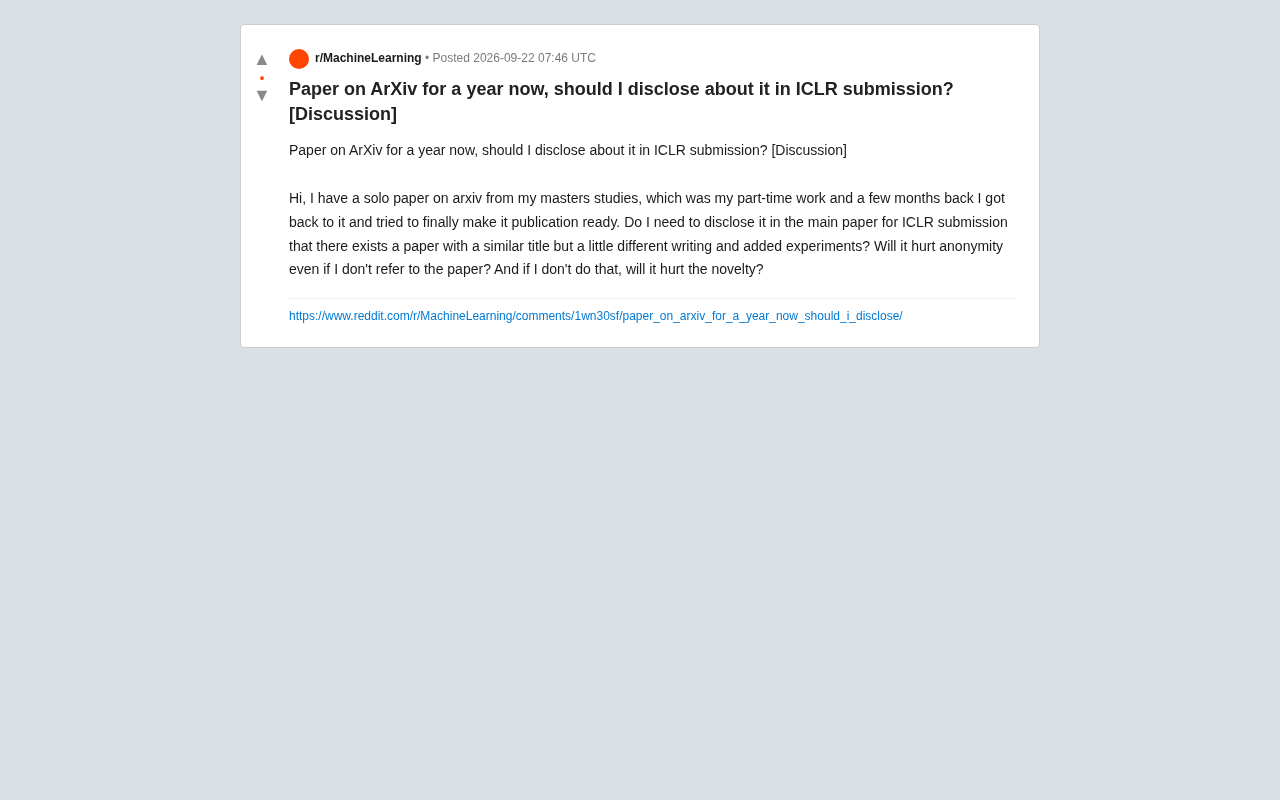
A researcher posted a question on the Reddit machine learning community that many academic newcomers encounter: during their master's program, they completed a solo-authored paper, posted it to arXiv a year ago, and have since polished the work with additional experiments and revised writing for an ICLR submission. The question naturally followed — does the submission need to disclose this older draft with a similar title and slightly different content? Would disclosing it break the anonymity of double-blind review? And if not disclosed, could it affect the novelty assessment?
This seemingly minor question actually touches on a longstanding tension in top-conference review systems: the inherent conflict between preprint culture and double-blind anonymous review.
What ICLR's Double-Blind Policy Actually Says
To answer this, we first need to understand ICLR's position. ICLR uses double-blind review, but takes a relatively permissive stance on arXiv preprints — authors are allowed to post their papers to arXiv before submission, which sets it apart from conferences that strictly prohibit preprints.
The key distinction lies between the "obligation to disclose" and "anonymity protection":
- ICLR generally does not require authors to proactively note in the submission that a preprint already exists.
- Review rules typically prohibit authors from revealing their own identity in the paper body — for example, writing phrases like "as shown in our previous work on arXiv."
- Reviewers are expected not to actively search for the paper to identify its authors; part of the double-blind responsibility falls on the reviewer's side.
In other words, the original poster's concern that "disclosure would break anonymity" is valid — directly citing your own same-titled older draft in the paper body essentially leaves a trail pointing back to yourself during double-blind review.
Double-blind review means reviewers don't know the authors' identities, and authors don't know the reviewers' identities, with the goal of reducing identity-based bias (e.g., institutional prestige, celebrity researcher effects). In contrast, single-blind review only hides reviewer identities from authors, while author identities remain visible to reviewers. ICLR adopted full double-blind review in 2018, and its tolerant stance on arXiv preprints is fairly representative among top venues — NeurIPS, ICML, and other major conferences hold similar positions: posting a preprint before submission is not a violation, but submission materials themselves must not contain identifiable information. This compromise acknowledges the established preprint culture in AI while attempting to formally maintain review anonymity.
How to Handle This "Predecessor" Paper
Drawing on community discussion and ICLR conventions, there are a few actionable principles for handling situations like this.
Cite the Old Draft as a Third-Party Reference
If the new submission methodologically or experimentally builds on the older draft, the right approach is not to "disclose that it's yours," but to cite it neutrally in the third person, just as you would cite any other relevant work. Write "Prior work [X] proposed..." rather than "Our previous work...". This maintains academic honesty (acknowledging the prior work's existence) without breaking anonymity.
Clearly Distinguish Old and New Contributions
The core of the novelty question isn't "does the older draft exist" but rather what the new submission adds beyond the older one. If it's merely rewritten with a few extra experiments, the novelty may not be sufficient to support a new conference paper. But if there are substantial new methods, analyses, or conclusions, the incremental contributions should be clearly defined in the paper. Reviewers assess novelty based on what the submission adds relative to all existing literature — and the arXiv draft counts as existing literature.
Self-plagiarism refers to an author reusing their own previously published or publicly available text, data, or experimental results in a new work without acknowledgment, creating the false impression that it is entirely new content. In academic publishing, this is considered a form of research misconduct, even if the author holds the copyright. Unlike ordinary plagiarism, the core issue with self-plagiarism is not intellectual property but rather the misleading impression it creates for readers and reviewers — suggesting a contribution is novel when it already exists in prior work. In the preprint context, since arXiv manuscripts are part of the public academic record, copying large passages or directly reusing experimental data without citation or clarification can also raise self-plagiarism concerns. The correct approach is to clearly cite the source of reused content and explicitly articulate the incremental contributions beyond the prior work.
No Need to "Prove Your Innocence" in the Paper Body
The original poster agonized over whether to clarify that both papers were written by the same person. The answer is typically no. ICLR does not require you to declare in the submission that a preprint exists or identify the authorship relationship. What you actually need is to avoid self-plagiarism through proper citation — not to proactively break your anonymity.
The Deeper Issue: Review Challenges in the Preprint Era
This individual case reflects a broader industry-wide problem. As arXiv has become the default publishing channel for AI research, "double-blind" is practically a formality in many popular research areas — reviewers can often locate a preprint and its authors with a simple title or keyword search. This has generated ongoing debate: some argue for abandoning double-blind entirely in favor of single-blind or open review, while others maintain that double-blind still provides value in reducing prestige bias.
For individual researchers, the practical strategies are:
- Be deliberate about when you post to arXiv. If you care deeply about fair anonymous review, consider waiting until after the submission deadline to post your preprint.
- Maintain third-person citation habits in your writing and avoid any phrasing that could reveal your identity.
- Proactively articulate your novelty — dedicate a passage to explaining the new contributions relative to existing work, including your own preprints.
Prestige bias refers to reviewers' tendency to rate papers from well-known institutions, prominent authors, or trending research areas more favorably, rather than evaluating solely based on the work's quality. Multiple empirical studies (including the NIPS 2014 dual-track experiment) have shown that even top-conference review processes involve considerable randomness and subjectivity, and double-blind mechanisms are considered an important tool for mitigating such bias. However, in AI, since virtually all influential work is posted to arXiv immediately, reviewers can often identify authors with a simple keyword search, substantially undermining the anonymity protection of double-blind review in practice. This is part of the context for the rise of open review models in recent years — such as the OpenReview platform used by ICLR, which publishes review comments publicly. The reasoning is that since anonymity can never be fully achieved, it may be better to make the review process itself transparent so the community can hold it accountable.
Summary: Advice for the Original Poster
Circling back to the original question, here's a fairly clear set of answers:
- No need to proactively disclose in the paper body that the older draft is your own work.
- If the new submission relies on results from the older draft, cite it in the third person as you would any other reference, to avoid self-plagiarism concerns.
- The anonymity risk comes primarily from self-referential phrasing like "Our previous work" — simply avoid this kind of language.
- What actually determines success or failure is the substantive incremental contribution of the new paper over the old one — articulating this clearly in the paper matters far more than worrying about disclosure.
The tension between preprints and double-blind review isn't going away anytime soon. Learning to handle prior work honestly and gracefully within the boundaries of the rules is an essential skill for every submitting researcher.
Related articles

Workbuddy for Absolute Beginners: How a Desktop AI Agent Fits Into Real Workflows
A beginner's guide to the Workbuddy desktop AI agent: installation, claiming credits, file management, and building automated workflows—compared with CodeX for fit and cost, helping professionals shift from AI question-askers to AI managers.

OpenAI's New Agent Stack: Computer Use, Decisions API, and Ultra-Fast Workflows
OpenAI Dev Day unveiled a new agent stack: Computer Use outperforms humans, Decisions API delivers ultra-low-latency classification via Luna, Agents API opens the same Computer Use capabilities, and GPT-6.1 Sol costs only one-seventh of Astra. Core updates, benchmark data, and developer insights.

Liang Wenfeng Open-Sources DeepInfo Inference Framework, Takes On U.S. Ban
DeepSeek open-sources its DeepInfo inference framework after its models, featuring GPU/CPU cross-pipelining, small-model prediction with large-model verification, and full Huawei Ascend and NVIDIA chip support—facing the U.S. federal ban head-on. This article analyzes its significance for AI deployment and open-source strategy.