arXiv Secures Multi-Year Funding Commitment, Transitions to Independent Nonprofit

arXiv secures multi-year funding to operate as an independent nonprofit, safeguarding global academic preprint infrastructure.
arXiv, the world's leading academic preprint platform covering physics, math, CS, and nearly every major AI paper, has secured multi-year funding and will operate as an independent nonprofit. Long hosted by Cornell University, its financial stability was a persistent concern. The new arrangement reduces short-term budget pressure and creates room to address structural challenges like surging submissions and content moderation. The tech community welcomes the news while watching closely whether funding conditions could affect the platform's neutrality — a critical question for open science globally.
A Pivotal Turning Point for arXiv
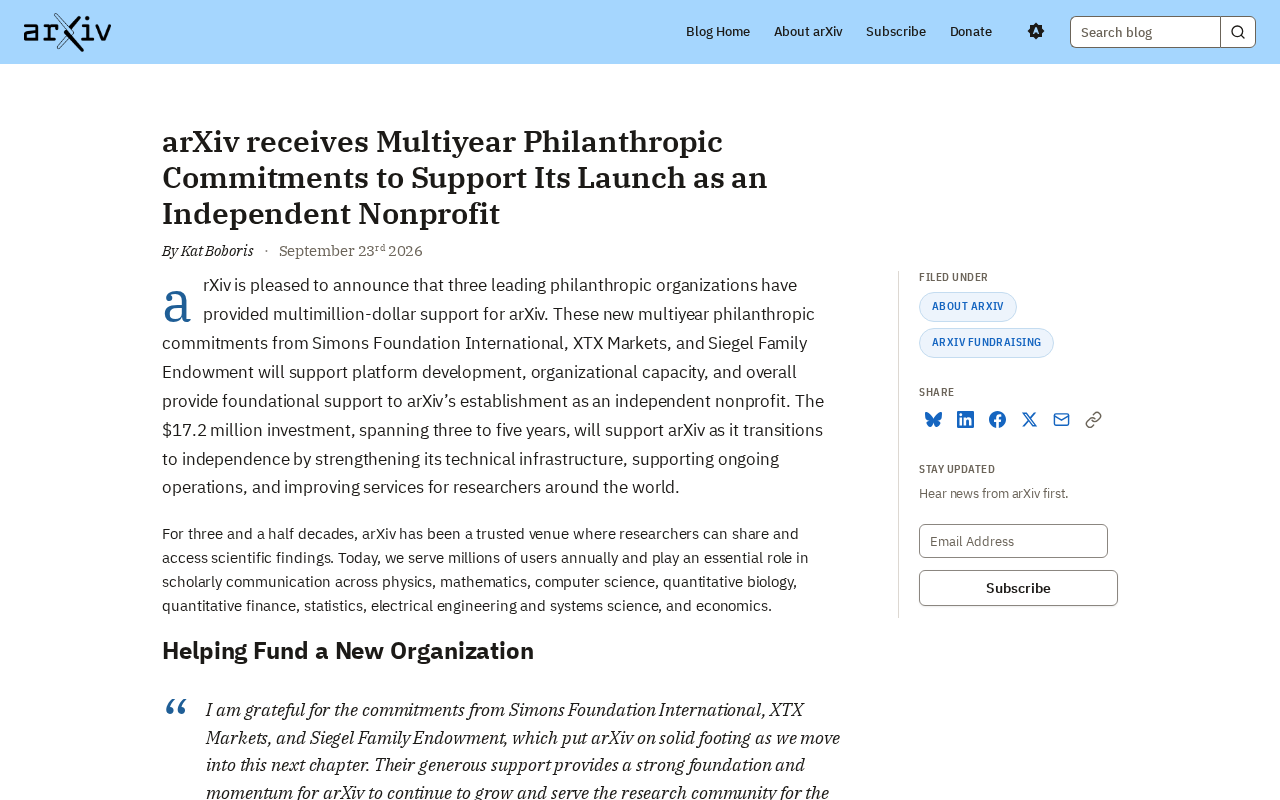
ArXiv, the world's most important academic preprint platform for researchers, has announced a multi-year funding commitment that will support its long-term operation as an independent nonprofit organization. The news sparked lively discussion on Hacker News, drawing 276 upvotes and dozens of comments — a clear reflection of how closely the academic community watches the fate of this platform.
Since its founding, arXiv has become a core piece of infrastructure for disseminating research across physics, mathematics, computer science, biology, and more. Before formally publishing in journals, researchers routinely upload preprints to arXiv so peers can access their latest findings immediately. This is especially true in AI — virtually every significant machine learning and deep learning paper appears on arXiv first, making it the go-to destination for anyone tracking the cutting edge.
What the Shift from Institutional Host to Independent Operation Means
For years, arXiv's operations were anchored to academic institutions like Cornell University, and its long-term sustainability was a persistent community concern. A platform serving millions of researchers worldwide and hosting an enormous volume of papers risks compromising its independence and neutrality without stable funding.
The multi-year commitment signals several things: first, the platform now has clearer financial footing without scrambling for funding year to year; second, operating as an independent nonprofit allows it to maintain greater academic neutrality, free from the influence of any single commercial or institutional interest; and third, the long-term commitment creates room for technical upgrades, improved content moderation, and other structural improvements.
As open access increasingly becomes the academic norm, arXiv's independent status carries particular weight. It embodies a model of scholarly communication driven by the free flow of knowledge rather than profit — a sharp contrast to traditional academic publishers, whose steep subscription fees and copyright barriers have long drawn criticism.
Open Access is a scholarly publishing reform movement that emerged in the late 1990s. Its central argument: research produced with public funding should be freely available to the public, not locked behind paywalls by commercial publishers. In the traditional journal model, researchers contribute papers and peer review for free, while publishers claim copyright and charge university libraries tens or even hundreds of thousands of dollars in annual subscription fees. arXiv is one of the earliest practitioners of this movement — founded in 1991 by physicist Paul Ginsparg, initially hosted at Los Alamos National Laboratory and later at Cornell University, it has always offered free, unrestricted global access. Its very existence is a structural challenge to commercial publishing monopolies.
Community Reaction and Underlying Concerns
The Hacker News discussion was broadly welcoming, though tempered by some careful scrutiny. Commenters raised questions about the specific composition of the funding — who is providing the commitment and under what conditions — since those details will ultimately determine the platform's true independence.
For AI researchers who depend on arXiv daily, platform stability matters directly. As submission volumes grow year over year, arXiv faces challenges beyond funding: maintaining paper quality standards, managing content categorization and moderation, and combating misuse such as low-quality or AI-generated bulk submissions. Multi-year financial support lays the groundwork for addressing these structural issues, but whether improvements actually reach end users remains to be seen.
Implications for the AI Research Ecosystem
It's hard to overstate arXiv's importance to the AI field. From the landmark paper introducing the Transformer architecture to the steady stream of large language model technical reports in recent years, the vast majority of results that have shaped the current AI landscape were first made public through arXiv. It lowers the barrier to knowledge access, giving researchers anywhere in the world — regardless of institution — equal access to the latest developments.
A financially sound, independently operated arXiv is a long-term positive for the entire AI research ecosystem. It ensures this vital channel of knowledge dissemination won't be interrupted by funding crises, and provides an institutional foundation for open science to continue flourishing. In an era of rapid AI iteration and exponentially growing paper volumes, a reliable public infrastructure like this carries value far beyond what money can measure.
ArXiv's influence on AI can be understood through a few concrete milestones. In 2017, the Google Brain team published Attention Is All You Need on arXiv, introducing the Transformer architecture. The paper circulated widely through arXiv before its official conference appearance, accelerating the field's adoption and replication of the new architecture. Around 2020, technical reports from OpenAI, DeepMind, Meta AI, and others all chose arXiv as their first publication venue without exception. This "preprint-first" culture has made knowledge diffusion in AI far faster than in most other fields — within hours of a paper being uploaded, researchers worldwide can read it and begin reproducing experiments. This is precisely why arXiv's stability has a direct, foundational impact on the pace of AI research.
Closing Thoughts
ArXiv's transition to an independent nonprofit with a multi-year funding commitment is an encouraging signal for the open access movement in academia. It not only secures the platform's own sustainability, but also safeguards the free flow of knowledge that the global research community depends on. For every researcher, student, and technology enthusiast who has benefited from arXiv, this is a development worth paying attention to.
Related articles

Python 3.15 New Feature: Is the sentinel Type Better Than None?
Python 3.15 adds the sentinel type, using named unique sentinel objects to replace None and bare object(), resolving confusion among missing values, explicit emptiness, and invalid input while avoiding type hint failures.

Deep Learning's Three Architectures and the Universal Approximation Theorem: A Complete Guide to MLPs, CNNs, and Transformers
Explaining the inductive bias differences among MLP, CNN, and Transformer, the existence meaning of the Universal Approximation Theorem (UAT), and the role of Taylor expansion in approximation analysis, while clearing up common misconceptions.

GitLab Emergency Patch Release: Analysis of Critical Security Fixes
GitLab releases critical patch 19.5.1, sparking 355 points of discussion on Hacker News. This article analyzes the background, upgrade steps for self-hosted instances, and verification points to help DevOps teams respond quickly to security updates.