ASR Hallucination Explained: Why Speech Recognition Produces False Outputs
Research reveals the encoder's final stage as the critical bottleneck behind ASR hallucinations.
A new study dissects ASR hallucination as a grounding failure where transcription loses its anchor to audio input. Through bypass experiments on Conformer-Large models with both CTC and RNN-T decoders, researchers found the encoder's terminal stage is the critical point where acoustic representations transform into linguistic ones. Grounding failure is identified as a necessary but not sufficient condition for hallucination, offering new directions for building more reliable speech recognition systems.
When Speech Recognition Starts "Making Things Up"
Automatic Speech Recognition (ASR) systems are quite mature in everyday applications, but they occasionally produce a baffling type of error: output that is fluent, grammatically correct, yet completely unrelated to the actual spoken input. Researchers call this phenomenon "hallucination" — similar to the hallucination problem in large language models, ASR systems can also "confidently spout nonsense."
Notably, hallucinations in ASR share deep structural similarities with those in large language models (LLMs). In the LLM domain, hallucination typically refers to models generating content that appears plausible but is factually incorrect or entirely fabricated, rooted in the model's over-reliance on statistical patterns in training data rather than actual factual grounding. In ASR, hallucination manifests as model output that is disconnected from the actual audio content while remaining fluent and coherent at the linguistic level. This cross-modal commonality suggests that hallucination may not be a defect unique to any one type of AI system, but rather a shared failure mode of deep learning-based generative models when input signals are ambiguous or degraded.
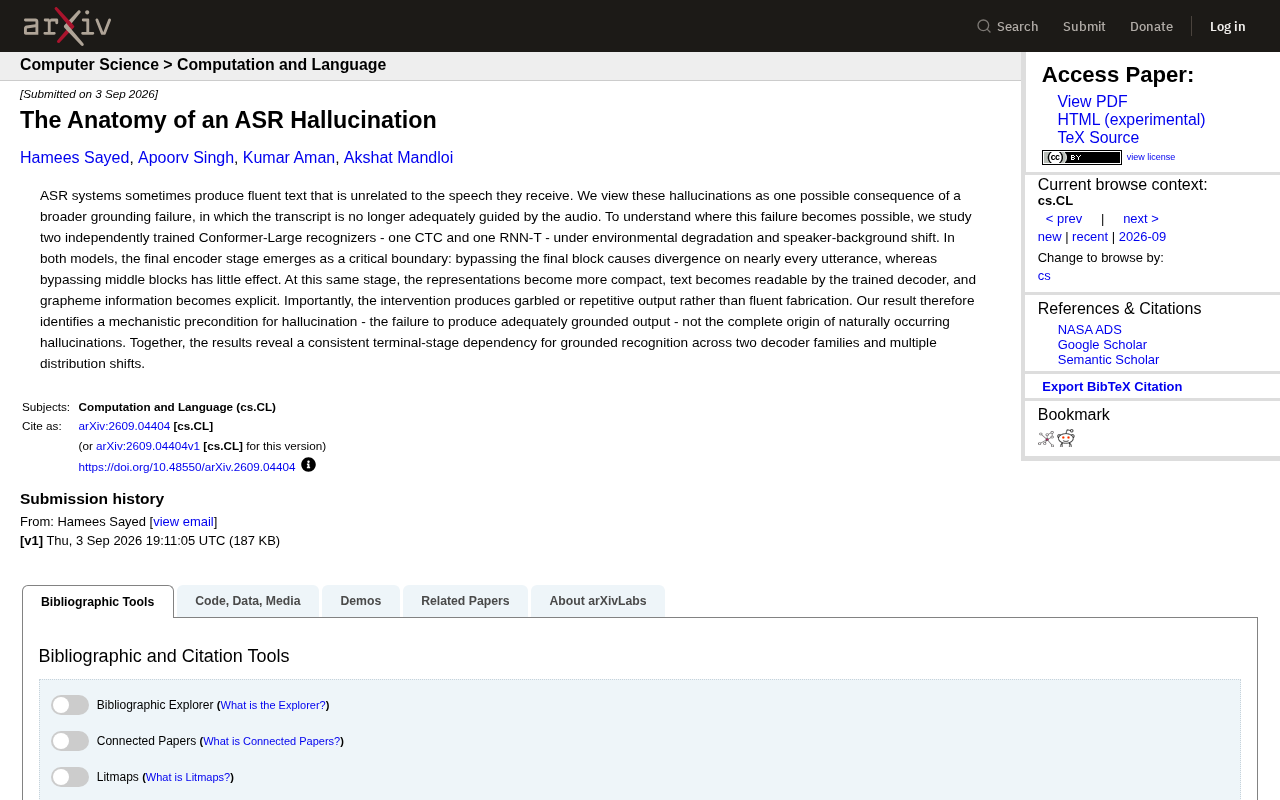
A recent paper published on arXiv, The Anatomy of an ASR Hallucination, attempts to dissect this phenomenon at the mechanistic level. The researchers propose a core argument: ASR hallucination is essentially a possible consequence of a broader "grounding failure" — where the transcribed text is no longer sufficiently guided by the audio signal, and the "anchoring" relationship between the model's output and input has broken down.
This perspective is quite illuminating. It redefines ASR hallucination from an isolated "failure" into a manifestation of information flow disruption within the model. Understanding where and how this disruption occurs is crucial for building more reliable speech systems.
Experimental Design: Comparing Two Decoder Architectures
To pinpoint where the problem occurs, the researchers employed a controlled experimental approach. They selected two independently trained Conformer-Large recognizers as their research subjects. Conformer is a hybrid neural network architecture proposed by Google in 2020, specifically designed for speech recognition tasks. It combines the strengths of convolutional neural networks (CNNs) in capturing local features with the Transformer's ability to model long-range dependencies. Specifically, each Conformer block contains feed-forward layers, multi-head self-attention layers, convolutional layers, and another feed-forward layer, forming a "sandwich" structure. Conformer-Large is the large-scale version of this architecture, with more layers and larger hidden dimensions, capable of learning richer acoustic representations. It has achieved excellent results on multiple speech recognition benchmarks and is one of the mainstream architectures widely adopted in both industry and academia.
The two models use different decoders respectively:
- One based on a CTC (Connectionist Temporal Classification) decoder
- One based on an RNN-T (RNN Transducer) decoder
CTC and RNN-T represent two fundamentally different decoding paradigms in speech recognition. CTC, proposed by Alex Graves in 2006, introduces a "blank" token between input and output sequences, allowing end-to-end training without requiring precise alignment. CTC assumes that output labels are conditionally independent given the input, meaning it does not directly model dependencies between output labels. RNN-T, also proposed by Graves, adds a prediction network on top of CTC. This network functions similarly to a language model, leveraging previously emitted labels to predict the next one, thereby capturing dependencies within the output sequence. The essential difference is that CTC is an alignment-free discriminative model, while RNN-T introduces an autoregressive mechanism that considers both acoustic information and linguistic context.
The choice of two different decoder architectures was deliberate — if conclusions hold under both of these fundamentally different decoding paradigms, they likely reflect universal patterns in ASR systems rather than incidental properties of a specific architecture. In particular, if a phenomenon appears in both CTC and RNN-T, it is not a side effect unique to the autoregressive mechanism.
Creating a "Stress Test" Environment
The researchers tested the models under two types of distribution shift conditions:
- Environmental degradation: Simulating noise, distortion, and other real-world audio quality deterioration
- Speaker-background shift: Altering speaker characteristics and background environments
Distribution shift is one of the core challenges in machine learning, referring to discrepancies between the data distribution encountered during deployment and that during training. In speech recognition scenarios, this shift is extremely common: training data may be collected in quiet recording studios, while actual use may involve noisy streets, subway cars, or echoey conference rooms. Environmental degradation simulates decreased signal-to-noise ratios, frequency distortion, increased reverberation, and similar conditions; speaker-background shift involves accent variation, speech rate differences, non-native pronunciation, and background sources not covered in the training data.
The purpose of these perturbations is to push the model to its capability boundaries, making "grounding failure" easier to expose, thereby observing under what conditions the system begins to "go off the rails." Distribution shift can expose hallucination issues because when the model faces out-of-distribution data, the confidence of its internal representations decreases, and the acoustic features extracted by the encoder may no longer provide sufficient "anchoring" information for the decoder, thereby increasing the risk of grounding failure.
Key Finding: The Final Encoder Stage Is the Grounding Bottleneck
The most striking finding of the study is that in both models, the final encoder stage emerges as a critical boundary.
The researchers employed a "bypassing" intervention technique to test the role of specific network layers. This bypassing method is a causal intervention technique commonly used in mechanistic interpretability research. The specific operation involves passing a layer's input directly as its output, effectively replacing that layer with an identity mapping, and then observing the impact on the final output. Unlike simple ablation studies, bypassing experiments preserve the network's overall structure and parameters, changing only the information flow path, thus enabling more precise measurement of a specific layer's functional contribution. This approach draws from causal inference thinking: if bypassing a layer causes dramatic changes in system behavior, it indicates that the layer is critical to system functionality; otherwise, it suggests the layer's function can be compensated by other layers or its contribution is minimal.
The experimental results were stark:
- Bypassing the final module: Caused output divergence on nearly every utterance — the system completely broke down
- Bypassing intermediate modules: Had almost no effect — the model continued to function normally
This sharp contrast demonstrates that ASR's "grounding capability" is highly concentrated in the terminal stage of the encoder, while intermediate layers possess considerable redundancy and robustness.
Three Key Transformations at the Terminal Stage
The researchers further analyzed internal representation changes at this critical stage and found that several important things happen simultaneously:
- Representations become more compact: Information is compressed and consolidated
- Text becomes readable by the decoder: A trained decoder can extract meaningful text from the representations at this layer
- Grapheme information becomes explicit: The critical transformation from "sound" to "text" occurs precisely at this terminal stage
Graphemes are the smallest meaningful units in a writing system — in English, they roughly correspond to letters and their combinations. The corresponding concept is the phoneme, the smallest distinctive sound unit in a phonological system. Traditional speech recognition pipelines typically involve multi-stage mapping from acoustic features to phonemes, and then from phonemes to graphemes. In end-to-end ASR systems, these stages are compressed into a single neural network. The finding that grapheme information becomes "explicit" at the terminal encoder stage means that in the network's earlier and middle layers, information primarily exists in acoustic and phonological form — encoding frequency, energy, temporal characteristics, and phoneme-level pronunciation patterns. At the final stage, this information is transformed into representations that directly correspond to specific written characters. This finding reveals that although end-to-end models do not explicitly partition acoustic models and language models in their architecture, they still spontaneously form similar functional divisions at the internal representation level.
In other words, the final stage of the encoder is the "tipping point" where acoustic representations transform into linguistic representations — the hub of information grounding across the entire recognition pipeline.
Grounding Failure Is a Necessary but Not Sufficient Condition for Hallucination
This study arrives at a very careful and important conclusion. When researchers induced "grounding failure" through intervention, the model produced garbled or repetitive output, not the kind of fluent, seemingly plausible fabricated text (fluent fabrication).
This detail deserves careful reflection. It means:
What the study identified is a mechanistic precondition for hallucination — the failure state of "being unable to produce sufficiently grounded output" — not the complete origin of naturally occurring hallucination.
In other words, grounding failure opens the door to hallucination, but the mechanism that causes the model to "fabricate fluently" rather than "collapse into gibberish" requires additional factors to explain. This clear-eyed delineation of the research's boundaries reflects a rigorous scientific attitude: not overstating conclusions, and explicitly identifying both what has been resolved and what remains to be explored.
Implications for ASR System Design
Taken together, this research reveals a pattern that holds consistently across two decoder families and multiple distribution shift conditions: grounding recognition has a stable dependency on the terminal encoder stage (terminal-stage dependency).
This finding offers value in several areas:
Identifying Breakthroughs in Interpretability Research
It localizes ASR reliability issues to specific network layers, providing a clear foothold for "mechanistic interpretability." Mechanistic interpretability is an important direction in recent AI safety and reliability research. Unlike traditional post-hoc explanation methods (such as attention visualization and feature attribution), it attempts to fundamentally understand the computational processes within neural networks — how information flows between layers, which components carry specific functions, and the complete causal chain behind a model's decisions. Representative work in this field includes Anthropic's research on features and circuits in large language models, and Chris Olah's early work on feature visualization in vision models. Applying mechanistic interpretability to the ASR domain is relatively new but highly significant: speech recognition systems are widely deployed in high-stakes scenarios such as medical records, legal transcription, and autonomous driving voice commands. Understanding their internal mechanisms is crucial for building user trust and meeting regulatory requirements.
Design Directions for Enhancing System Robustness
Since grounding capability is concentrated at the terminal stage, future design of more robust ASR systems could specifically reinforce the stability of this stage, or introduce monitoring mechanisms here to detect early signs of "grounding failure," enabling intervention before hallucination actually occurs. For example, a confidence estimation module could be added to the terminal stage output, triggering alerts or falling back to more conservative decoding strategies when representations are detected to deviate from normal distributions.
Connecting Cross-Modal AI Hallucination Research
Linking ASR hallucination to the "grounding failure" framework also provides insights for cross-modal understanding of AI hallucination. Whether in speech recognition or large language models, the common problem of "output becoming decoupled from input constraints" may share transferable mechanistic explanations. In multimodal large models (such as vision-language models), similar "grounding" issues also exist — models may generate descriptions that don't match image content. These cross-modal similarities suggest that "grounding" may be a fundamental challenge faced by all conditional generative models, and understanding its failure mechanisms can be mutually informative across different modalities.
Conclusion
The Anatomy of an ASR Hallucination does not solve all the challenges of ASR hallucination in one stroke, but it takes a solid and important step forward: pinpointing a clear critical network stage, validating cross-architecture consistency, and honestly delineating the boundaries of the research. As AI systems increasingly penetrate real-world applications, understanding "when and why models fail" is just as important as improving their average performance. This kind of deep investigation into the internals of networks is an essential path toward building trustworthy AI systems.
Related articles

10 Free AI API Platforms Tested: Zero-Cost Guide to Calling GPT/Claude/Gemini
Hands-on review of 10 platforms offering free API keys for GPT, Claude, Gemini, DeepSeek, Grok & more. Covers signup, free quotas, and Codex integration.

RawY2K: A Chrome Retro Theme Extension That Sends Any Webpage Back to the 90s with One Click
RawY2K is a Chrome extension that transforms any modern webpage into 90s Windows 98 and GeoCities retro style. Explore its features, the Y2K aesthetic revival, and product analysis.

Claude's Default Behavior of Appending Session Links to Git Commits Sparks Controversy
Claude AI appends Session URLs to Git commits and PRs by default, sparking developer debate over privacy, commit history pollution, and the power of defaults.