AstraPixels: A Pixel-Art Real-Time Solar System Map Powered by Actual Orbital Data

A pixel-art solar system map using real orbital data to track 171 celestial bodies in real time.
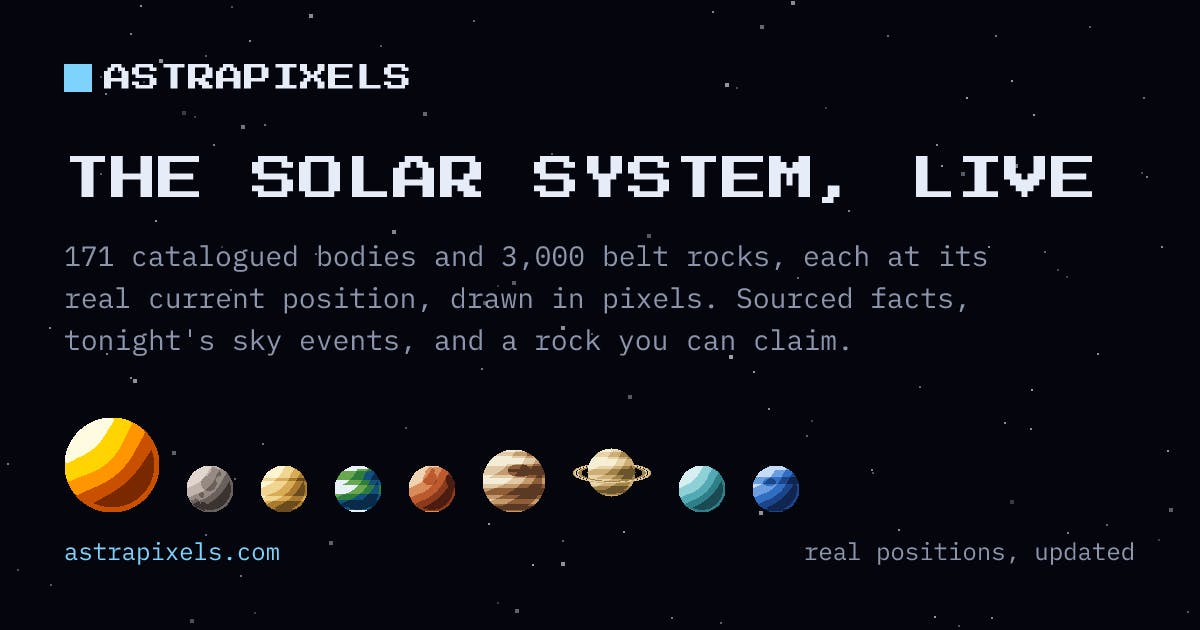
AstraPixels is a web application that combines retro pixel art aesthetics with rigorous astronomical calculations to create a real-time solar system map. It tracks 171 celestial bodies using actual orbital elements, offers continuous zoom from the inner solar system to the Kuiper Belt, previews astronomical events six months ahead, and monetizes through a $5 asteroid-naming feature. It ranked #2 on Product Hunt with 137 upvotes.
When Astronomy Meets Pixel Art
Among the many astronomical visualization tools available, AstraPixels has carved out a unique path. This web application, which reached #2 on Product Hunt's daily ranking (earning 137 upvotes), reimagines the solar system in retro pixel art style — but it's far more than just an artistic exercise. It's a dynamic star map driven by real astronomical data calculations.
Product Hunt is one of the world's most influential tech product launch platforms, founded by Ryan Hoover in 2013. Dozens of new products "launch" on the platform daily, with community upvoting determining rankings. For indie developers and small teams, achieving a high ranking means massive exposure, an influx of early users, and potential media attention — it's essentially a cold-start accelerator for tech products. AstraPixels standing out in this competitive environment shows that its "astronomy + pixel art" combination genuinely struck a chord with the community.
Unlike most "static image" galaxy maps on the market, AstraPixels' core selling point is authenticity. Every celestial body's position isn't copied from a preset list — it's calculated in real time from publicly available orbital elements. In other words, the planets, asteroids, and Kuiper Belt objects you see on screen accurately reflect their actual positions in space at this very moment.
Orbital elements are a set of mathematical parameters needed to describe a celestial body's orbit, typically comprising six classical elements: semi-major axis (determining orbit size), eccentricity (determining orbit shape), orbital inclination (tilt relative to the reference plane), longitude of the ascending node, argument of perihelion, and true anomaly. Using these six parameters, combined with Kepler's laws and time variables, you can precisely calculate a celestial body's position in three-dimensional space at any given moment. NASA's JPL (Jet Propulsion Laboratory) and the International Astronomical Union's Minor Planet Center (MPC) both publicly release this data, and AstraPixels leverages these open datasets to power its real-time calculation engine.
Exploring from the Sun to the Kuiper Belt
Zoomable Cosmic Scales
AstraPixels offers continuous zoom capability from the Sun all the way to the Kuiper Belt. Users can start from the familiar inner solar system (Mercury, Venus, Earth, Mars) and pull back through the asteroid belt, past the gas giants, out to the distant Kuiper Belt. This scale traversal gives an intuitive sense of the solar system's vastness — balancing Earth's orbit and the Kuiper Belt's distance within the same view is itself a significant design challenge.
The Kuiper Belt is a ring-shaped region of the solar system extending from beyond Neptune's orbit (about 30 astronomical units) to approximately 50 astronomical units, filled with frozen small bodies. It's named after Dutch-American astronomer Gerard Kuiper, even though he actually predicted the region should be empty. In 1992, astronomers discovered the first Kuiper Belt object (aside from Pluto), and more than 2,000 Kuiper Belt objects have since been cataloged. Pluto itself, after being reclassified as a dwarf planet in 2006, is also considered one of the largest objects in the Kuiper Belt. Accommodating both the 1 AU distance from Earth to the Sun and the Kuiper Belt's 50 AU distance in a single interactive interface means spanning a 50x scale difference — which explains why continuous zoom functionality is crucial for user experience.
Detailed Profiles of 171 Celestial Bodies
The application catalogs 171 celestial bodies, each accompanied by sourced facts. In an internet environment where information authenticity is often questionable, AstraPixels emphasizes the traceability of its data sources rather than piling on unverified popular science content. Users can browse these celestial profiles to learn about their physical characteristics and orbital parameters.
Six-Month Astronomical Event Preview
Beyond displaying the current state, AstraPixels can predict astronomical events up to six months into the future. This holds real practical value for astronomy enthusiasts and stargazing planners — you can know in advance what planetary alignments or special astronomical phenomena the night sky will showcase over the next half year. This prediction is feasible precisely because the mathematical model of orbital elements allows forward extrapolation: as long as you know the current orbital parameters and perturbation corrections, you can calculate celestial positions months ahead with considerable accuracy.
The Creative Monetization Model: "Buy an Asteroid"
AstraPixels' most talked-about feature is its monetization design: every rock is for sale. For just $5, users can "claim" an asteroid, permanently own it, and give it any name they choose.
Creator Nick Launches honestly included an important disclaimer: the naming only displays within the AstraPixels platform and is not an official International Astronomical Union (IAU) designation. This candid disclosure both avoids misleading users and cleverly positions the product as a fun collectible experience rather than a serious celestial naming service.
It's worth noting that the IAU, established in 1919, is the only globally recognized scientific authority for celestial body naming. Official asteroid naming follows a strict process: the discoverer proposes a name, which is then reviewed and approved by the IAU's Committee on Small Body Nomenclature, with rules including a 16-character limit and prohibition of commercial names. The internet is full of commercial "star naming" services (some costing hundreds of dollars), but none of these names are recognized by the IAU. AstraPixels' clever approach is that it doesn't pretend to offer official naming — instead, it transparently positions it as an in-platform fun experience. This transparency actually enhances user trust.
From a business perspective, this is a lightweight yet clever design. The low $5 threshold, the emotionally charged "permanent ownership" promise, plus the nostalgic collectible quality that pixel art brings, give an astronomical visualization tool a natural monetization path.
Pixel Art: From Technical Limitation to Aesthetic Choice
AstraPixels' choice of pixel art as its visual language is no accident. Pixel art originated from the hardware constraints of 1970s-80s video games — display devices had extremely low resolution at the time, forcing designers to create recognizable images within limited pixel grids. As technology advanced, pixel art evolved from a technical necessity into a deliberate aesthetic choice, experiencing a notable revival in indie games, digital art, and the NFT space.
For scientific visualization products, pixel style has an often-overlooked practical advantage: it reduces visual complexity, making it easier for users to focus on the data itself rather than rendering details. When you don't need to process visual noise like lighting, textures, and reflections, the orbital relationships, relative positions, and motion patterns of celestial bodies actually become clearer. The "expressiveness within simplicity" of pixel art forms a natural fit with astronomical data visualization's goal of "finding order within complexity."
A Model of Data-Driven and Artistic Expression Fusion
AstraPixels' value lies in demonstrating a product fusion approach: rigorous astronomical calculation as the skeleton, approachable pixel art as the skin, layered with a low-barrier emotionally-driven business model.
For regular users, it's a fun, visually appealing solar system exploration tool where you can actually learn real knowledge. For developers and product professionals, it offers a reference case worth studying — how to package hardcore data into an experience the general public is willing to consume. As more and more science communication products fall into the trap of being either "technically impressive but boring" or "entertaining but inaccurate," AstraPixels has found a delicate balance point.
It may not be the most powerful astronomy software out there, but it proves that a good product doesn't need to be the most professional — it needs to find just the right intersection of accuracy, aesthetics, and engagement.
Key Takeaways
Related articles

Chain of Thought Isn't Just for AI: How Humans Can Use CoT to Improve Thinking Quality
Chain of Thought isn't just a prompt trick for large models. Starting from a Hacker News discussion, this article analyzes why CoT works for human thinking too, breaks down actionable ways to transfer it, and highlights the key differences between human CoT and machine CoT.
Cloudflare Teams Up with OpenAI: Closi…
Cloudflare Teams Up with OpenAI: Closing the Loop from Vulnerability Discovery to Defense with AI
Cloudflare uses OpenAI Daybreak to investigate security vulnerabilities and generate reviewable remediation plans, while developers use Codex to boost coding efficiency and quality.

Orca Multi-Agent Orchestration in Practice: A Guide to Parallel Collaboration with Claude and Codex
Orca is Stable AI's free open-source agent workbench supporting 34 agents like Claude Code and Codex in parallel. Learn its Git worktree isolation, multi-model orchestration, and mobile management.