AstroHelm: A Fresh Approach to Telescope Alignment Using Your Phone Camera

AstroHelm replaces pricey motorized GoTo mounts with smartphone plate-solving for telescope alignment.
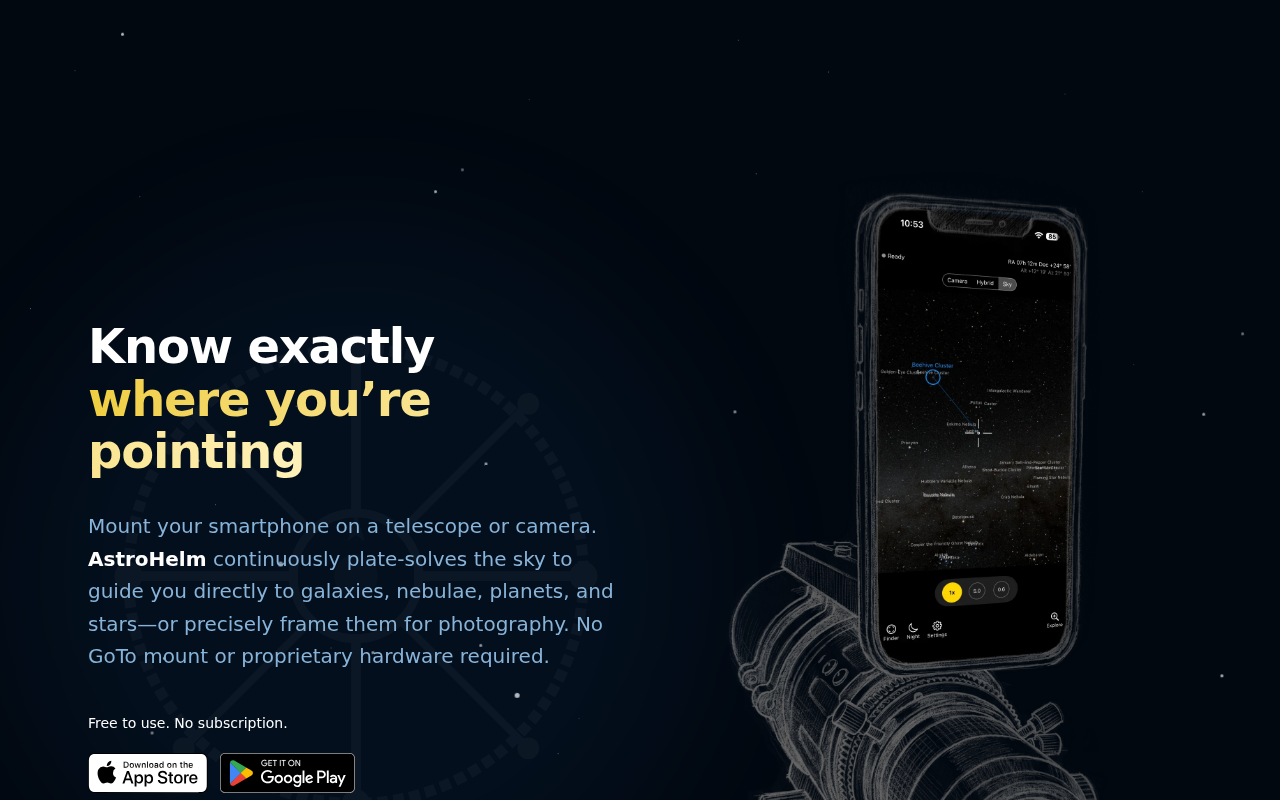
AstroHelm is an early-stage astronomy tool that debuted on Hacker News, using smartphone cameras and plate-solving (star-map matching) to determine where a telescope or telephoto lens is pointing and guide users to their target. Compared to GoTo motorized mounts costing hundreds of dollars, the approach is nearly free in hardware terms. Key technical challenges include limited low-light sensitivity, lens distortion, coordinate calibration errors magnified at high zoom, and cross-device compatibility. Though still unproven in the field, it exemplifies the "software-defined hardware" trend democratizing consumer astronomy.
A Small Tool Tackling a Real Astrophotography Pain Point
Anyone who has done amateur astronomy knows the shared frustration: how do you precisely point a telescope or telephoto lens at a specific celestial target? The night sky is packed with thousands of stars, and the naked eye can barely distinguish which faint dot is the nebula, planet, or deep-sky object you actually want to image. Traditional solutions rely on finder scopes, GoTo motorized mounts, or endless manual tweaking — options that are either expensive or unfriendly to beginners.
AstroHelm recently debuted on Hacker News as a Show HN project, proposing a clever approach: using a smartphone camera directly to assist in aligning a telescope or telephoto lens. While the project is still in early stages (11 upvotes and 7 comments at the time of writing), the problem it targets is genuine and widespread.
The Core Idea: Turn Your Phone Into a Pointing Assistant
Judging by the project's name and positioning, AstroHelm's core value is transforming the smartphone everyone already owns into a precision alignment aid. A phone camera can capture night-sky images, and combined with plate solving or star matching techniques, the software can determine where the lens is currently pointed and guide the user to swing it toward the target.
The big advantage here is accessibility. Compared to motorized GoTo systems that can cost hundreds or even thousands of dollars, a software-plus-smartphone setup is essentially free, giving entry-level astronomy enthusiasts the same "point-and-see" alignment experience. For photographers shooting the Moon or planets with telephoto lenses, this kind of tool is equally practical — telephoto fields of view are extremely narrow, and hunting for a target manually can eat up a lot of time.
Plate solving is a key technique in astronomy software: the program compares a captured star-field image against a pre-loaded star catalog database, identifies the relative positions and brightness patterns of star points, and back-calculates the RA/Dec coordinates at the image center — typically to arcsecond-level accuracy. The technique originated in automated guiding systems at professional observatories and has gradually migrated to consumer devices in recent years, thanks to open-source algorithms like astrometry.net and increasingly powerful smartphone processors. A simpler variant, star matching, only needs to recognize the relative arrangement of a few bright stars for a rough fix; it demands less from the hardware but delivers lower precision. The trade-off between these two approaches directly determines where AstroHelm lands on the spectrum between usability and performance.
Technical Challenges and Potential Hurdles
Doing this well is harder than it sounds. First, there is the accuracy of star-map matching itself: a phone camera's light sensitivity, lens distortion, and capture angle all affect recognition reliability. Second, calibrating the relationship between the phone's coordinate frame and the telescope's physical pointing direction is tricky — any tiny offset gets dramatically amplified at high magnification.
Beyond those fundamentals, cross-device compatibility, low-light image processing, and real-time performance requirements are all areas this type of application needs to keep refining. Early Hacker News discussions typically zero in on exactly these implementation details, and community feedback is especially valuable for an open or indie project still finding its footing.
Calibration in astrophotography means establishing a correspondence between the optical center of the phone or telescope and actual celestial coordinates. Even if star-map matching is spot-on, a slight tilt in how the phone is mounted on the telescope — or an incorrectly entered focal length — will introduce a systematic pointing error. Professional GoTo systems handle this through a "three-star alignment" routine: the user manually centers three known stars in sequence, letting the system build a coordinate model. For an approach like AstroHelm that relies on the phone's inertial sensors (accelerometer + gyroscope + magnetometer), geomagnetic interference, sensor drift, and hardware variation across phone models are additional variables that can destabilize calibration.
What This Means for Astronomy Enthusiasts
AstroHelm represents a broader trend of "software-defined hardware capability" — using algorithms and existing consumer devices (smartphones) to replace or augment tasks that previously required dedicated hardware. This idea has enormous room to grow in consumer astronomy; in recent years, multiple apps leveraging smartphone computing power for sky recognition and celestial tracking have already emerged.
For ordinary enthusiasts, tools like this matter not just because they save money, but because they lower the psychological barrier to getting started. When pointing at a target stops being a frustrating cycle of trial and error, more people can actually sink into the joy of stargazing and astrophotography.
One caveat: AstroHelm is still in early demo territory. Its real-world accuracy, performance characteristics, and applicable scenarios all await validation from more users. Interested enthusiasts are encouraged to keep an eye on the project and join the community conversation.
Summary
AstroHelm takes "smartphone camera-assisted telescope and telephoto lens alignment" as its entry point, attempting to solve a real astrophotography pain point with a low-cost software solution. Although the project is early-stage and community discussion is limited, its direction aligns well with the broader democratization of consumer astronomy tools — making it well worth watching.
Related articles

JobRunner MCP Server: AI Agents Can Now Fix Failed Java Jobs
JobRunner launches an open-source MCP server enabling AI agents to view cluster status, diagnose failures, and recover Java jobs—incident response from any cloud coding environment or existing agent.

MLAI Digital Launches 9 Security Agents: MCP Server Safeguards the Full Lifecycle of Agentic AI
MLAI Digital launches Security MCP Server with nine built-in specialized security agents covering vulnerability discovery, attack simulation, prompt injection detection, API and infrastructure assessment, and accelerated remediation—embedding security validation across the full Agentic AI lifecycle from development to production.

Running Isaac Lab on H100 GPUs: Exploring Better Approaches
Exploring optimization methods for running Isaac Lab on NVIDIA H100 GPUs, including MIG configuration, mixed precision, TensorRT acceleration, and community experience to improve robotics simulation and reinforcement learning efficiency.