ASUS Ascent GX10 Unboxing: A 1.5-Liter Desktop Supercomputer Takes On Large Model Compute

ASUS Ascent GX10 packs a GB10 superchip into a 1.5L desktop chassis, supporting development and inference of models up to 405B parameters.
Based on a Bilibili creator's unboxing video, this article introduces the ASUS Ascent GX10 mini supercomputer. At just 1.5 liters and 1.6 kg, it uses NVIDIA reference design language and a minimalist front. It is powered by the NVIDIA GB10 Grace Blackwell superchip, with Grace CPU and Blackwell GPU interconnected via NVLink-C2C, supporting dual-unit stacking for models up to 405B parameters. It ships with the NVIDIA AI software stack (PyTorch, TensorFlow) and sits between high-end workstations and cloud compute. Actual performance and stability still need independent testing.
Title
ASUS Ascent GX10 Unboxing: A 1.5-Liter Desktop Supercomputer Takes On Large Model Compute
Meta Description
ASUS Ascent GX10 mini supercomputer unboxing: a 1.5-liter chassis with the NVIDIA GB10 Grace Blackwell chip, supporting 405B model development and inference plus dual-unit stacking, with an out-of-the-box AI software stack that lowers the barrier to development.
Article Content
As large model parameter counts keep ballooning, compute supply seems naturally tied to "data centers" and "clusters." But ASUS offers another possibility with a desktop device just 1.5 liters in volume: cramming supercomputer-grade compute into a mini chassis so developers can run hundred-billion-parameter models right on their desk. Recently, a Bilibili creator "极能核计算机" (Jinenghe Computer) showed off this mini supercomputer called the Ascent GX10 (referred to verbally as CX-10 in the video), whose core selling point targets the most painful compute barrier in AI development.
Unboxing: NVIDIA reference design language, a compact 1.5-liter chassis
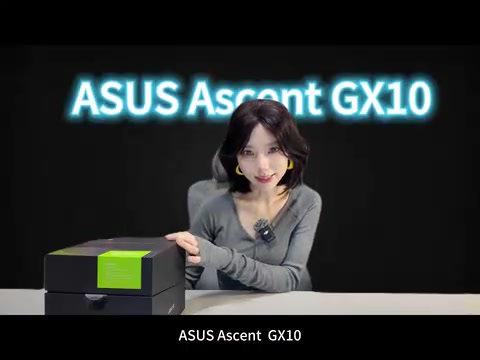
According to the Bilibili creator "极能核计算机," the Ascent GX10's packaging follows the NVIDIA reference style. The whole unit weighs just 1.6 kg and is more compact than a non-reference RTX 5090 graphics card. This "small box" form factor breaks the stereotype of traditional workstations or server chassis.
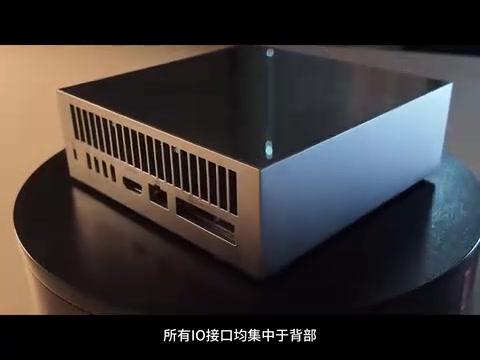
The front design is extremely clean, with only a power button, and all IO ports concentrated on the back. This ultra-minimal front allows the GX10 to blend perfectly into any office environment, rather than being confined to a data center or a dedicated lab corner like traditional compute equipment. For algorithm engineers or researchers who need a quiet, tidy workspace, this detail has considerable practical value.
Core configuration: GB10 superchip and dual-unit stacking expansion
The GX10's compute comes from the NVIDIA GB10 Grace Blackwell superchip. The video specifically notes that the device supports dual-unit stacking expansion and can support development and inference of models up to 405B parameters. This spec means it's not a "toy-grade" edge device, but a desktop-grade platform capable of hosting current mainstream open-source large models (such as the Llama 3.1 405B class).
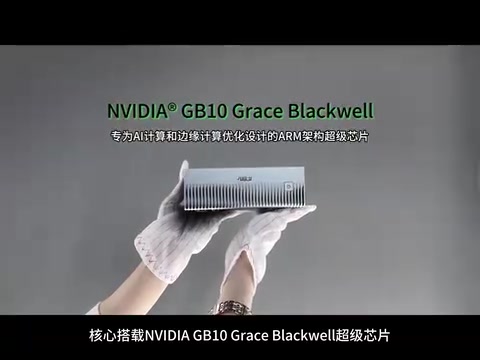
Architecturally, the Grace CPU and Blackwell GPU are interconnected via NVLink-C2C, a design specifically optimized for AI workloads in terms of energy efficiency and memory bandwidth. The key to a desktop-grade device handling 405B models lies in high-bandwidth memory and chip-to-chip interconnect efficiency, rather than simply stacking more GPUs.
The Grace Blackwell superchip is a heterogeneous SoC design NVIDIA introduced for AI and high-performance computing scenarios. "Grace" refers to the Arm-based CPU portion, and "Blackwell" refers to the new-generation GPU architecture. The two are connected via the NVLink-C2C chip-to-chip interconnect bus rather than traditional PCIe. NVLink-C2C's bandwidth is far higher than PCIe, allowing the CPU and GPU to share data in a manner close to unified memory, reducing the latency and energy overhead of frequent copying during large-scale model inference. This design makes deliberate trade-offs in energy efficiency for AI workloads, and is one of the key prerequisites enabling desktop-grade small devices to host hundred-billion to several-hundred-billion-parameter models.
The deployment threshold for 405B-parameter models deserves separate mention. For a model like Llama 3.1 405B, the weights alone require about 800GB of VRAM at FP16 precision; even with FP8 or INT4 quantization, hundreds of GB of memory are still needed. Therefore, a single GX10's native memory capacity is usually insufficient to host a complete 405B model independently. The so-called "supports up to 405B" typically relies on memory pooling after dual-unit stacking, along with techniques such as quantization and tensor parallelism. Understanding this helps objectively assess the device's practical applicability boundaries.
Software stack: an out-of-the-box AI development environment
Beyond hardware, the GX10 comes preinstalled with the NVIDIA AI software stack, covering the entire workflow from prototyping to deployment, and supports mainstream frameworks such as PyTorch and TensorFlow. The video emphasizes that it "saves the complex environment configuration process," which hits a daily pain point for many AI developers—reproducing a working CUDA environment locally often takes hours or even days.

The out-of-the-box software stack lowers the barrier to AI development, letting researchers spend time on model design and experiments rather than on version conflicts among drivers and dependencies. For university labs, startup teams, or individual developers, this "plug-in-and-go" experience may be more appealing than peak compute figures.
The NVIDIA AI software stack is a collection of software built around GPU-accelerated computing, typically including CUDA drivers and runtime, acceleration libraries such as cuDNN, the TensorRT inference optimization tool, and prebuilt framework images in the NGC container catalog. For heterogeneous platforms like Grace Blackwell (Arm CPU + GPU), the software stack also needs to provide a compilation toolchain and precompiled packages adapted to the Arm architecture; otherwise, developers compiling frameworks like PyTorch from source themselves would be very cumbersome. This is exactly where the value of a preinstalled software stack lies: it locks in the compatibility combinations among drivers, CUDA versions, and framework binaries, reducing "version hell"-style environment debugging costs.
Application scenarios and market positioning
The creator listed scenarios such as event broadcasting, modeling and rendering, biomedicine, and smart manufacturing. What these scenarios share is a need for real-time inference or medium-scale training, but without the conditions to build their own data centers. The GX10's positioning sits between high-end workstations and cloud compute: more private and lower-latency than the cloud, and more compact and easier to deploy than traditional workstations.
It's worth noting that the video content comes from a single creator's unboxing demonstration. The actual inference performance on 405B models, the specific efficiency of dual-unit stacking, and long-term operational stability still need more independent testing to verify. For teams considering a purchase, it's advisable to watch for subsequent benchmark data, especially memory bandwidth and actual token generation speed.
Summary
The ASUS Ascent GX10 compresses the Grace Blackwell platform into a 1.5-liter volume, using a desktop form factor to meet large model development needs—a direction worth watching. It may not replace data center clusters, but it offers a "near-field" solution to compute anxiety: bringing compute closer to developers. Whether this small box can truly drive day-to-day development of large-scale AI models will be revealed by more real-world test data.
One-line Summary
ASUS Ascent GX10 packs a GB10 superchip into a 1.5-liter desktop chassis, supporting development and inference of models up to 405B parameters.
Paragraph Summary
Based on a Bilibili creator's unboxing video, this article introduces the ASUS Ascent GX10 mini supercomputer. The device is only 1.5 liters in volume and 1.6 kg, featuring NVIDIA reference design language and a minimalist front for easy integration into office environments. It is powered by the NVIDIA GB10 Grace Blackwell superchip, with the Grace CPU and Blackwell GPU interconnected via NVLink-C2C, and supports dual-unit stacking expansion for development and inference of models up to 405B parameters. On the software side, it comes preinstalled with the NVIDIA AI software stack, supports PyTorch and TensorFlow, and eliminates complex environment configuration. Its positioning sits between high-end workstations and cloud compute, targeting scenarios such as event broadcasting, biomedicine, and smart manufacturing that need near-field compute. The article also notes that current information comes from a single creator's demonstration, and actual performance and stability still require independent testing.
Related articles

LangChain Retry Middleware Configuration: Practices and Selection Guide
Based on Reddit community discussion, this article analyzes LangChain ModelRetryMiddleware retry parameter configuration practices, covering the selection logic and alternatives for key options like max_retries, backoff_factor, and jitter.

Texas Senate Race in Trouble: Why Are Republicans Nervous?
Texas Senate race stirs Republican anxiety. Based on street interviews, this article analyzes the Democratic offensive in funding, organization, and running everywhere, and how Republicans are defending "Texas, Texas" amid the political pendulum effect.

Gemini Chat Now Generates and Edits Google Docs Directly, a New Breakthrough in Office Productivity
Google Gemini's chat interface now generates and edits PDF, Google Docs, Sheets, Slides, Markdown, TXT, and code files. Available to all users; web supports all formats, mobile only PDF for now.