Async Interviews + Editorial Polish: Journalistic Tech Makes It Easy for Tech People to Get Published on HackerNoon

Journalistic Tech turns tech people's answers into bylined HackerNoon articles through async interviews.
Journalistic Tech is a Product Hunt product that uses asynchronous interviews to solve the problem of tech people "having insights but not being able to write them out." Users pick from 273 tech topics, answer about 13 questions via voice or text on their own schedule, and their content becomes a bylined draft that editors review and polish before it's published and distributed on HackerNoon. Splitting creation into "interviewees provide opinions, editors handle structure" lowers the barrier to expression, suiting developers, founders, and technical managers with hands-on experience who aren't good at writing. Launched by HackerNoon co-founder David Smooke, it's essentially a productized content supply pipeline. Topic coverage and the number of intermediate steps still need verification through actual use.
Tech people often have insights worth sharing, but they frequently get stuck at the "write it down" step. Journalistic Tech, newly launched on Product Hunt, tries to solve this problem with asynchronous interviews: you just answer questions, and editors handle the rest.
From "Writing an Article" to "Answering Questions"
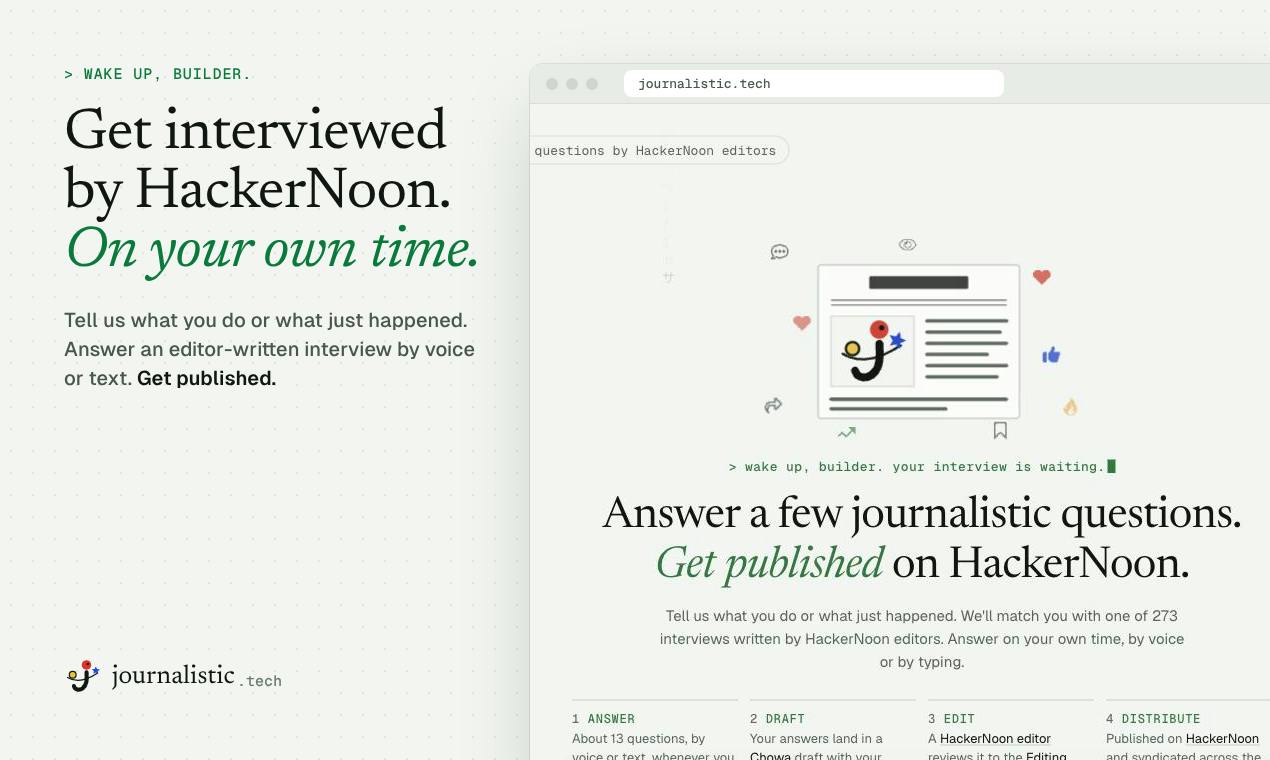
Journalistic Tech's positioning is clear — asynchronous interviews that help you get published on HackerNoon. The workflow is: you first tell it what you want to talk about, or what has happened recently, and the system matches you with one of 273 tech interview topics. Then, on your own schedule, you answer roughly 13 questions via voice or text.
There's no pressure of a real-time conversation, and no need to write a long article all at once. Once you've finished answering, your content is organized into a bylined draft, reviewed and polished by editors, and ultimately published on HackerNoon and distributed across the web.
HackerNoon is an independent tech media platform founded in 2016, known for its community-driven content production that allows any tech professional to sign up and publish articles. Unlike the traditional editorial commissioning model, HackerNoon uses an open submission plus editorial review approach, covering areas such as software development, blockchain, artificial intelligence, and startups. The platform has repeatedly tried to optimize its content supply chain through technical means, such as automated editing tools and contributor incentive systems. Journalistic Tech was launched by a HackerNoon co-founder, so its output can plug directly into HackerNoon's publishing and distribution system — a key channel advantage that distinguishes this product from general writing-assistance tools.
Why This Model Is Worth Noticing
The barrier to technical writing has never been "having nothing to write about" — it's "not knowing how to organize it." Journalistic Tech splits creation into two parts: the interviewee provides opinions and details, and the editor handles structure and expression. This division of labor is common in traditional media, but productizing it, making it asynchronous, and connecting it directly to a tech community platform like HackerNoon is what makes it relatively novel.
For developers, founders, and technical managers, this lowers part of the expression cost. You don't need to become a writer first to produce bylined content. On Product Hunt it received 82 votes and ranked 11th, suggesting this angle has some audience recognition.
Asynchronous interview refers to an interview format in which the interviewer and interviewee do not communicate at the same time. The interviewee can answer questions one by one at their convenience, and the interviewer then organizes the content. This approach is common in remote work scenarios and cross-time-zone collaboration, as it eliminates the scheduling pressure and on-the-spot expression anxiety of real-time conversations. In product design, asynchronous interviews are usually paired with structured question lists to compensate for the information loss caused by the lack of follow-up questions and interaction. For tech people who aren't good at improvisational expression, the asynchronous format allows them to deliberate on their answers repeatedly, thereby improving the accuracy and depth of the content — but it may also sacrifice the spontaneous insights that naturally emerge in conversation.
Who It's For, and Who Might Not Benefit
The target audience is fairly clear: tech people with hands-on experience who aren't good at writing, founders who want to share behind-the-scenes product stories, and those hoping to build a personal brand through HackerNoon exposure. The flexibility of asynchronous interviews is especially friendly to professionals with fragmented schedules.
But if you already have mature writing habits, or want complete control over every word and sentence of your article, this "interview-to-draft-then-editor" process may feel like too many intermediate steps. In addition, interview topics are currently fixed at 273 tech directions — whether the coverage is broad enough still needs more real-world use to verify.
A Brief Observation
Journalistic Tech was launched by David Smooke, and HackerNoon is the tech media platform he co-founded. This makes the whole product feel more like a content production pipeline: turning technical experience in the community into publishable articles through structured interviews. For content platforms, this is a noteworthy innovation in supply methods; for tech professionals, it offers a lighter path to sharing than starting from scratch on their own.
One-line Summary
Journalistic Tech turns tech people's answers into bylined HackerNoon articles through asynchronous interviews.
Paragraph Summary
Journalistic Tech is a product launched on Product Hunt that aims to solve the problem of tech people "having insights but not being able to write them out" through asynchronous interviews. Users are matched with one of 273 tech topics, answer about 13 questions via voice or text at their convenience, and their content is then organized into a bylined draft, reviewed and polished by editors, and published and distributed on HackerNoon. This division of labor — interviewees provide opinions, editors handle structure — lowers the barrier to expression and suits developers, founders, and technical managers with hands-on experience who aren't good at writing. The product was launched by HackerNoon co-founder David Smooke and is essentially a productized content supply pipeline. However, the breadth of topic coverage and the number of intermediate steps still need to be verified through actual use.
Related articles

Prompt Engineering for Beginners: From Writing Prompts to Engineering Thinking
Starting from the essence and four functions of prompts, this article systematically explains the six-step process, four success criteria, learning value, and practical limitations of prompt engineering to help you build a complete understanding.

Anthropic Launches Nasdaq IPO: AI Giant's Listing and Risk Disclosures
Anthropic officially launches its Nasdaq IPO under ticker ANT, with market valuation expected to potentially exceed SpaceX's record. The prospectus devotes nearly 100 pages to AI risks, while first-half revenue grew over 14x but net losses widened sharply, reigniting the AI bubble debate.

Rust cURL Clone Uses 4,832 unsafe Blocks—Is the Memory Safety Myth Broken?
A Rust cURL clone uses 4,832 unsafe keywords, challenging Rust's memory safety narrative. We analyze what unsafe really means, compare Fil-C, and examine rewrite motives.