Attention vs. Dynamic Wave vs. Hybrid Sequences: Which Is More Efficient?

Dynamic Wave recurrent layers mixed with attention achieve the best quality, but efficiency advantages depend on implementation details.
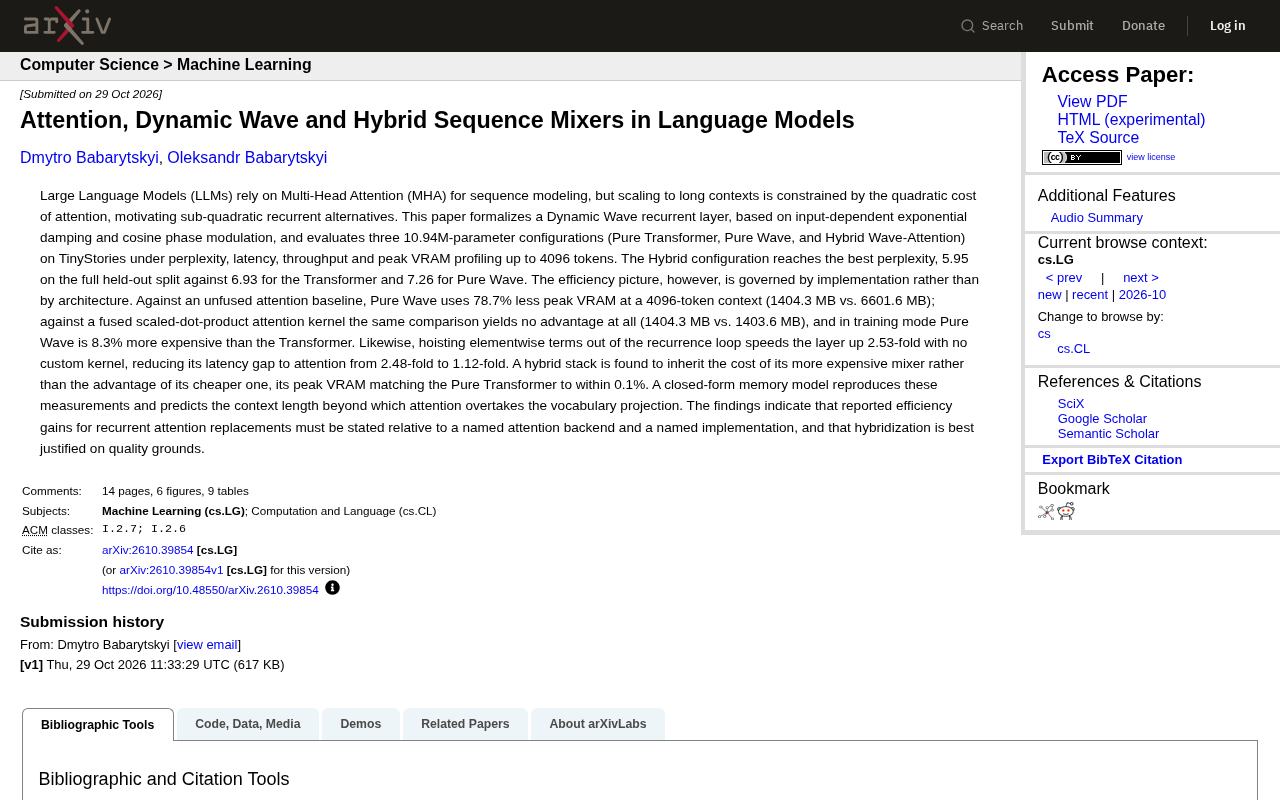
The paper systematically compares pure Transformer, pure Dynamic Wave recurrent layer, and hybrid Wave-Attention. On TinyStories, the hybrid configuration achieves the best perplexity of 5.95, outperforming pure Transformer's 6.93 and pure Wave's 7.26, indicating hybridization should be justified by quality, not efficiency. Efficiency conclusions are dominated by implementation: pure Wave reduces peak memory by 78.7% vs. an unfused attention baseline, but has no advantage against fused attention kernels and is 8.3% more expensive in training. Hoisting element-wise terms out of the recurrence accelerates by 2.53×, narrowing the latency gap from 2.48× to 1.12×; the hybrid stack inherits the cost of the more expensive mixer. The paper stresses that reporting efficiency gains must specify the attention backend and implementation details.
Large language models (LLMs) rely on multi-head attention (MHA) for sequence modeling, but the quadratic computational cost limits long-context scaling, spurring various sub-quadratic recurrent alternatives. A recent paper proposes a Dynamic Wave recurrent layer and systematically compares three configurations: pure Transformer, pure Wave, and hybrid Wave-Attention. The results show that the hybrid configuration wins on quality, but efficiency advantages depend heavily on implementation details—when compared against fused attention kernels, the pure Wave's memory advantage vanishes entirely, and it is even more expensive during training.
The Dynamic Wave Layer: Input-Dependent Damping and Phase Modulation
The paper formalizes a Dynamic Wave recurrent layer whose core is input-dependent exponential damping and cosine phase modulation. This design attempts to introduce more flexible dynamic behavior while maintaining the sub-quadratic cost of the recurrent structure. The authors evaluate three configurations on the TinyStories dataset, each with 10.94M parameters: pure Transformer, pure Wave, and hybrid Wave-Attention, covering perplexity, latency, throughput, and peak memory, with context lengths up to 4096 tokens.
The quadratic cost of multi-head attention (MHA) refers to the O(n²·d) computation of standard self-attention over sequence length n (d is the hidden dimension), because each token must compute attention weights with all other tokens. This quadratic growth means that scaling context from 4K to 128K increases compute and memory demands quadratically, making it the primary bottleneck for long-context modeling.
Sub-quadratic recurrent alternatives are typically based on recurrent neural networks (RNNs) or state space models (SSMs), whose computation scales linearly with sequence length (O(n·d)). Such models process the sequence step by step through a compressed hidden state, avoiding explicit storage of all pairwise attention weights. The cost is limited state capacity, which may sacrifice quality on tasks requiring precise long-range retrieval—precisely the gap that hybrid configurations attempt to bridge.
Quality Comparison: Hybrid Configuration Has the Best Perplexity
On the full held-out set, the hybrid configuration achieved the best perplexity of 5.95, versus 6.93 for pure Transformer and 7.26 for pure Wave. This shows that simply replacing attention with a recurrent layer loses quality, and mixing the two can close that gap. The paper notes that the rationale for hybridization is best based on quality, not efficiency.
Perplexity is the standard evaluation metric for language modeling, defined as the exponent of the average negative log-likelihood per token; lower values indicate more accurate predictions on held-out text. Under the same vocabulary and data split, perplexity is directly comparable across architectures, so the paper uses it to quantify quality differences among the three configurations. Note that small perplexity differences (e.g., 5.95 vs. 6.93) may seem minor in absolute terms, but in language modeling they typically correspond to perceptible gaps in generation quality.
The Efficiency Truth: Implementation Decides Everything
The efficiency picture is dominated entirely by implementation rather than architecture. Compared to an unfused attention baseline, pure Wave reduces peak memory by 78.7% at 4096-token context (1404.3 MB vs. 6601.6 MB); but compared to a fused scaled dot-product attention kernel, the same comparison shows no advantage (1404.3 MB vs. 1403.6 MB), and in training mode pure Wave is 8.3% more expensive than Transformer.
Furthermore, hoisting element-wise terms out of the recurrence accelerates the layer by 2.53× without requiring a custom kernel, narrowing the latency gap with attention from 2.48× to 1.12×. The hybrid stack inherits the cost of the more expensive mixer rather than the advantage of the cheaper one, with peak memory within 0.1% of the pure Transformer.
Fused attention kernels refer to implementations that combine multiple operations in scaled dot-product attention—matrix multiplication, softmax, masking, and scaling—into a single GPU kernel, such as the FlashAttention series. Fusion greatly reduces memory read/write traffic and intermediate tensor footprint, making attention's actual memory and latency far lower than naive implementations. Therefore, comparing recurrent layers against unfused attention baselines overestimates the efficiency advantage of recurrent layers; only comparison against fused kernels reflects real-world competitiveness in deployment.
Memory Model and Implications
A closed-form memory model reproduces these measurements and predicts the context length at which attention overtakes vocabulary projection. The paper's conclusion: when reporting efficiency gains of recurrent attention alternatives, one must specify the attention backend and implementation details being compared; the rationale for hybridization should be based primarily on quality improvements.
These findings remind researchers and engineers that when evaluating novel sequence mixers, one cannot look only at architecture-level theoretical complexity—implementation optimizations (such as kernel fusion and loop hoisting) can completely overturn efficiency conclusions. For long-context applications, choosing a solution requires considering both quality requirements and the maturity of implementations in actual deployment environments.
A closed-form memory model here refers to using analytical formulas (rather than training or simulation) to describe how the memory footprint of different sequence mixers during inference varies with context length. It expresses the memory curves of attention (KV cache growing linearly with length) and recurrent layers (fixed-size state) as functions of context length, thereby reproducing measured data and predicting the context length at which attention overtakes fixed overheads like vocabulary projection due to KV cache expansion. The value of such models lies in turning scattered benchmark measurements into extrapolatable deployment guidance.
One-line Summary
Dynamic Wave recurrent layers mixed with attention achieve the best quality, but efficiency advantages depend on implementation details.
Paragraph Summary
The paper systematically compares three configurations: pure Transformer, pure Dynamic Wave recurrent layer, and hybrid Wave-Attention. On TinyStories, the hybrid configuration achieves the best perplexity of 5.95, outperforming pure Transformer's 6.93 and pure Wave's 7.26, indicating that the rationale for hybridization should be based on quality rather than efficiency. Efficiency conclusions are entirely dominated by implementation: pure Wave reduces peak memory by 78.7% relative to an unfused attention baseline, but shows no advantage against fused attention kernels and is even 8.3% more expensive during training. Hoisting element-wise terms out of the recurrence accelerates by 2.53×, narrowing the latency gap from 2.48× to 1.12×; the hybrid stack inherits the cost of the more expensive mixer. The paper emphasizes that reporting efficiency gains must specify the attention backend and implementation details.
Related articles

Private Key Set to 4? CA's Elementary Mistake Leaves TLS Exposed
CA eMudra set private keys to tiny values like 4, making TLS certificates brute-forceable. A Computerphile video demonstrates the full process from extracting public keys to forging certificates, and explores the fragility of the PKI trust chain.

How Gen Turns Data into Decisions with ChatGPT Work
In an OpenAI user case, business leader Gen shares how ChatGPT Work turns data into decisions: within hours of launch, teams can judge whether integrations and onboarding flows work, shifting decision iteration from hundreds of trial-and-error attempts to a fast feedback loop.

ChatGPT vs. Claude In-Depth Comparison: Strong at Coding but Weak at Research — How to Bridge the Gap?
A user considers switching from ChatGPT to Claude, finding Claude stronger at coding but shallower at research. We analyze the differences and share tips to make Claude's research deeper.