Atticus: A Claude-Powered Push-to-Talk Voice Assistant for macOS

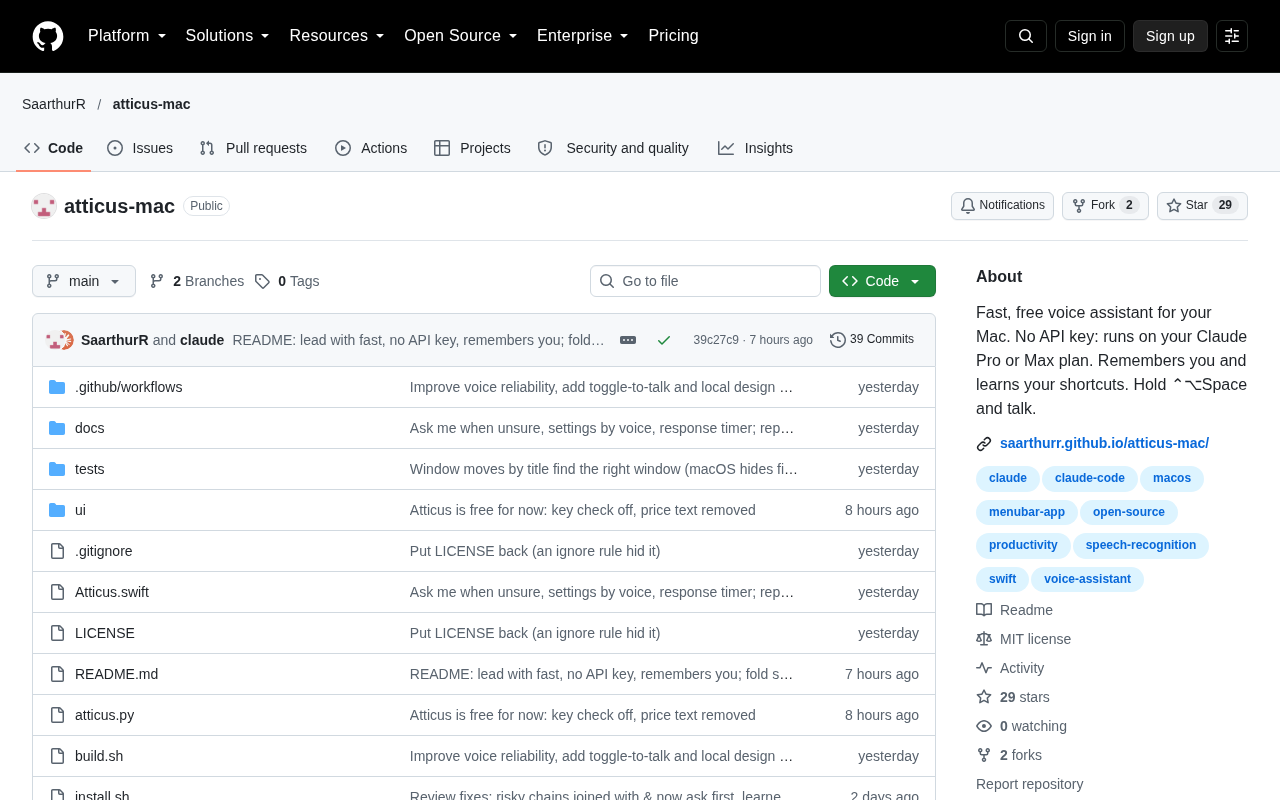
Atticus is a push-to-talk macOS voice assistant powered by the Claude CLI, built for developer workflows.
Atticus is a lightweight macOS voice assistant that uses a global push-to-talk hotkey instead of wake words, avoiding accidental triggers and limiting microphone access for privacy. Its core architecture decouples interaction from inference: the tool handles voice capture, hotkey listening, and result display, while all reasoning is delegated to the Claude CLI (`claude -p`). This keeps the project lean and lets it benefit from Claude's ongoing improvements, but limits its audience to technical users who already have the Claude CLI configured. Ultimately, the experience hinges on how well the interaction details — hotkey responsiveness, transcription accuracy, and result presentation — are executed.
What Is Atticus
Atticus is a voice assistant tool for macOS built around a "hold-to-talk" interaction model: press a shortcut key to start speaking, release to send the command. Rather than building its own model, it calls Claude directly via the command-line interface (claude -p), converts speech to text, passes it to Claude for processing, and returns the result to the user.
The elegance of this design lies in its decoupling — the voice input layer is separated from the reasoning layer (Claude). The developer doesn't need to build a new inference engine; they only need to handle voice capture, hotkey listening, and result display at the system level, leveraging Claude's existing capabilities to ship a functional desktop voice assistant.
Why Push-to-Talk
Most voice assistants rely on wake-word activation (like "Hey Siri"), but Atticus opts for a walkie-talkie-style push-to-talk model. In a desktop context, this approach offers several practical advantages:
- No accidental triggers: Wake-word systems are prone to false activations from ambient noise or conversation, whereas key-based triggering gives users full control — recording only happens when you actively press the key.
- Better privacy: The microphone is only active while the key is held down, eliminating the need for continuous ambient listening — a clear selling point for privacy-conscious desktop users.
- Intuitive for keyboard users: For developers and power Mac users who live on their keyboards, a global hotkey fits naturally into their workflow far better than calling out a wake word.
From a positioning standpoint, this feels more like a "voice-as-input" tool built for developers and productivity enthusiasts than a mass-market smart speaker-style assistant.
macOS provides a system-level Speech-to-Text framework, but tools like Atticus typically need to implement global hotkey listening at a lower level. Global shortcut detection on macOS relies on Core Graphics event tap APIs (CGEventTap) or higher-level NSEvent global monitors, which can capture keyboard events even when the app is not in the foreground. This capability requires users to grant the app permission under System Settings → Privacy & Security → Accessibility — one of the sensitive permissions governed by macOS's sandbox mechanism. Microphone access is similarly controlled by privacy permissions, triggering a system-level authorization prompt on first use. The existence of these two permissions also provides system-level backing for the privacy promise that "recording only happens when you press the key."
Technical Trade-offs
Atticus relies directly on claude -p as its command-line interface for inference, making it essentially a voice shell wrapped around the Claude CLI. This architecture comes with clear pros and cons.
Advantages
By delegating reasoning to Claude, the developer can benefit directly from Claude's conversation quality and continuous improvements without worrying about model hosting, compute costs, or model updates. The tool itself stays lightweight, focused purely on polishing macOS system capabilities — microphone access, global hotkeys, and speech-to-text.
Trade-offs
This tight coupling also means users need a working Claude environment with the appropriate configuration, naturally tilting the barrier to entry toward technical users. Additionally, overall latency, offline availability, and transcription accuracy all directly affect the experience — challenges common to any "voice front-end + cloud LLM" architecture.
claude -p is a non-interactive execution flag provided by Anthropic's official Claude CLI (command-line interface), where -p stands for "prompt" mode — it passes a piece of text as a one-shot prompt directly to Claude, receives the output, and exits immediately without entering an interactive multi-turn shell. This calling pattern is naturally suited for integration as a subprocess within other programs: the parent process (Atticus) simply passes the speech transcription as a string to claude -p and reads the standard output to get the model's response. Compared to calling an HTTP API, the CLI approach saves developers from managing authentication tokens, constructing request bodies, and handling HTTP errors — at the cost of depending on a locally installed and authenticated Claude CLI environment. This is the direct reason Atticus skews toward technical users: most non-technical users won't have a command-line AI tool pre-configured on their system.
Who Is It For
As a project that debuted on Hacker News under "Show HN," Atticus has a fairly clear target audience: macOS users who already use Claude, are comfortable with command-line workflows, and want to replace some keyboard input with voice. It's not trying to replace Siri — it's bringing Claude's capabilities to the desktop in a more natural, voice-driven way.
For tools like this, the real value isn't in technical complexity but in how well the interaction details are executed — how responsive the hotkey feels, how accurate the transcription is, how cleanly the results are presented. These are the factors that determine whether a "voice shell" can actually integrate into a daily workflow.
Summary
Atticus represents a typical pattern in today's AI application landscape: rather than reinventing the model wheel, it builds an interaction layer tailored to a specific use case on top of a mature LLM. The push-to-talk design has genuine merit in terms of privacy and control, and directly reusing claude -p keeps the project lean and focused. How far it goes depends on the quality of the interaction experience and the developer's ability to manage long-term dependency on Claude as an upstream provider.
Note: This article is based on the project summary from the Hacker News Show HN post. Refer to the project's official release information for further details.
Related articles

Chain of Thought Isn't Just for AI: How Humans Can Use CoT to Improve Thinking Quality
Chain of Thought isn't just a prompt trick for large models. Starting from a Hacker News discussion, this article analyzes why CoT works for human thinking too, breaks down actionable ways to transfer it, and highlights the key differences between human CoT and machine CoT.
Cloudflare Teams Up with OpenAI: Closi…
Cloudflare Teams Up with OpenAI: Closing the Loop from Vulnerability Discovery to Defense with AI
Cloudflare uses OpenAI Daybreak to investigate security vulnerabilities and generate reviewable remediation plans, while developers use Codex to boost coding efficiency and quality.

Orca Multi-Agent Orchestration in Practice: A Guide to Parallel Collaboration with Claude and Codex
Orca is Stable AI's free open-source agent workbench supporting 34 agents like Claude Code and Codex in parallel. Learn its Git worktree isolation, multi-model orchestration, and mobile management.