Audible Uses AI-Generated Audiobook Summaries to Help You Decide Before You Listen
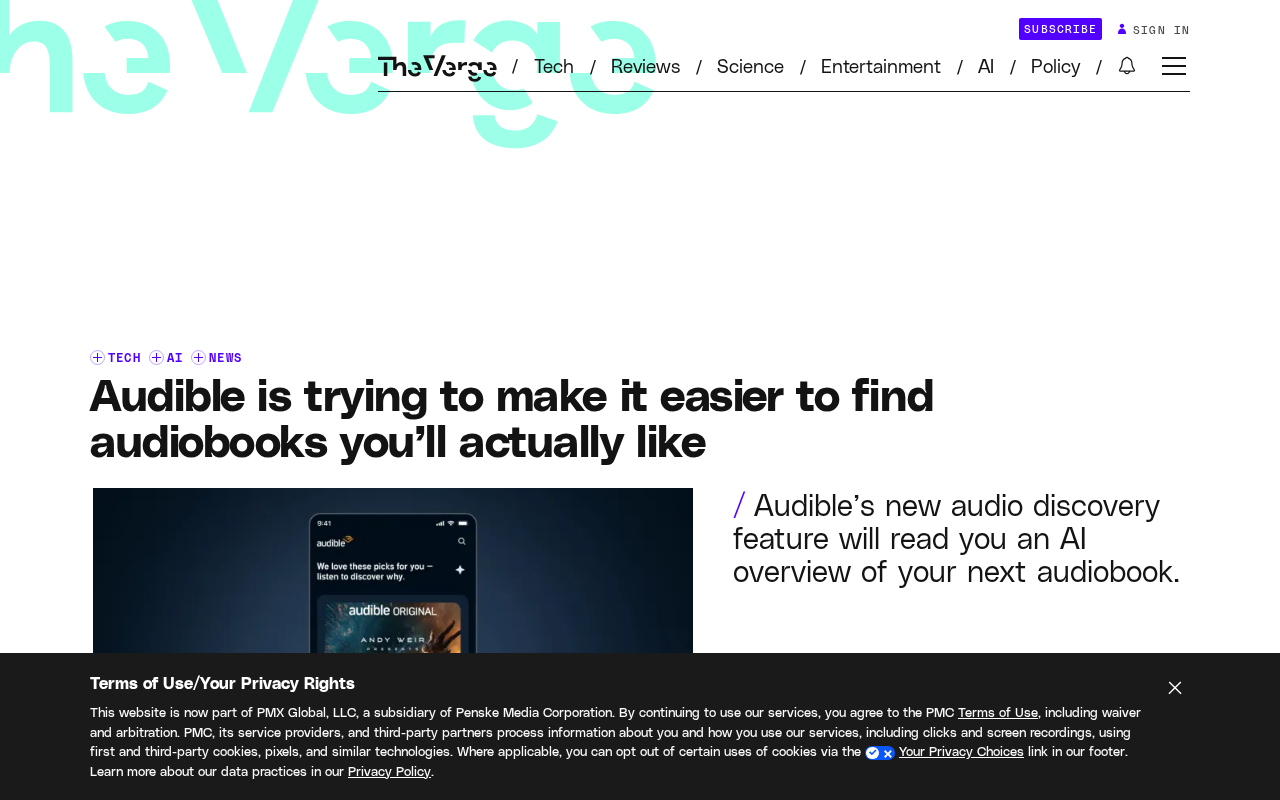
Audible launches AI summaries combining samples, overviews, and author commentary to aid book selection.
Audible addresses the audiobook pain point that samples aren't enough to judge a whole book by launching an AI-assisted summary feature that integrates samples, AI-generated overviews, and author commentary. The AI overview addresses what the book is about, the sample what it sounds like, and author commentary why it was written that way—turning single-dimension decisions into multi-dimensional judgment. The feature also offers recommendations, connecting discovery, evaluation, and recommendation. For the platform this points to retention and conversion; for users, lower decision costs. Yet accuracy, spoiler risk, and whether summaries convey narration's charm remain unverified.
Audiobook platform Audible is trying to use AI to solve an old problem: before you hit play, it's hard to tell whether an audiobook is right for you. According to RSS sources, Audible has launched an AI-assisted summary feature that combines audiobook samples, AI-generated overviews, and author commentary, giving users more reference information before they choose their next audiobook.
The Pain Point of Audiobook Discovery: Samples Aren't Enough
Audiobook purchasing decisions differ noticeably from those for print and ebooks. With text books, you can quickly flip through a few pages, scan the table of contents and opening paragraphs, and judge within minutes whether the style and pacing suit your taste. Audiobooks are constrained by linear playback—samples often cover only a short opening segment, revealing neither the arc of the whole book nor the narrative direction of the middle and later sections.
Audible's new feature targets exactly this gap. It combines three types of information: audiobook samples, AI-generated overviews, and the author's own commentary. Users no longer have to rely on a single opening audio clip to make a judgment; instead, they can read a structured content summary first, then combine it with the author's explanation of creative intent to form a more complete expectation.
Audiobook samples are typically the first 3–5 minutes of audio captured by the platform. Their design logic resembles the "sample chapter" of a print book, but constrained by audio's linear nature, users can't skip through a table of contents or randomly sample passages the way they can flip through a book. Early Audible sample features mainly served judgments about "audio quality and narration style" rather than content structure—exactly the gap AI overviews aim to fill. Similar industry attempts include Scribd's text summary previews and Spotify's audiobook preview cards, but placing AI structured overviews alongside author commentary is a differentiated design.
AI Overviews + Author Commentary: Bringing "Sample Reading" to Audio
From a feature design perspective, the AI overview plays the role of "quickly understanding what the whole book is about," akin to compressing a book's table of contents, themes, and key content into a readable summary. Author commentary supplements the creative background and expressive intent—information that algorithmic recommendations typically struggle to provide.
The value of this combination lies in its layering: the AI overview answers "what is this book about," the sample answers "what does it sound like," and author commentary answers "why did the author write it this way." Together, the user's basis for decision-making shifts from a single dimension to multiple dimensions.
The report also mentions that besides providing the above information, the feature will recommend audiobooks. This means Audible is trying to connect discovery, evaluation, and recommendation into a single chain, rather than making users jump back and forth between different pages.
AI-generated book overviews typically rely on large language models performing a hybrid of extractive and generative processing on the full text or chapter summaries, outputting dimensions such as themes, structure, and key arguments. The technical challenges lie in long-text context window limits and factual consistency—audiobooks often exceed 100,000 words, and models need hierarchical summarization (chapter-level → book-level) to avoid information loss. Author commentary is curated platform content, possibly drawn from author interviews, prefaces, or commissioned writing, and its coverage and update mechanism directly affect the information density of the feature.
What It Means for the Platform and Users
For users, the most direct change is lower decision-making cost. Audiobooks are not cheap, often run for hours, and the sunk cost of choosing the wrong one is higher than choosing the wrong ebook. Getting a structured overview in advance can reduce "abandoning a book halfway through."
For Audible, this feature points toward retention and conversion. If users find books that suit their taste more easily, their willingness to repurchase and renew subscriptions will also be stronger. AI overviews are also a way of reorganizing content—repackaging existing audio and text information on the platform to produce new discovery entry points.
User retention metrics in the audiobook market are usually measured by "monthly listening hours" and "completion rate," and abandoning books due to wrong choices directly drags down both. The commercial value of AI overview features lies in upfront filtering: users form reasonable expectations before sampling, reducing the probability of abandonment due to style mismatch. At the same time, structured overviews create new SEO/on-site search entry points for the platform—summary text can be indexed, improving exposure opportunities for long-tail books, which is especially meaningful for audiobooks by small and mid-sized authors.
Questions to Watch
Whether AI-generated overviews are accurate, whether they spoil key plot points, and how broad the coverage of author commentary is—these questions have no answers in the available information. Much of the appeal of audiobooks comes from the narrator's performance and sense of rhythm, and whether text summaries can convey that part of the experience is also something the feature needs to verify.
What is certain is that Audible is using AI to "help users make choices" rather than "replace users' content." Whether this direction can truly improve discovery efficiency still depends on user feedback after actual launch.
One-line Summary
Audible launches an AI summary feature combining samples, overviews, and author commentary to aid book selection.
Paragraph Summary
Addressing the audiobook pain point that "samples aren't enough to judge the whole book," Audible has launched an AI-assisted summary feature that integrates samples, AI-generated overviews, and author commentary to help users form a more complete expectation before listening. The AI overview addresses "what is this book about," the sample addresses "what does it sound like," and author commentary addresses "why was it written this way"—together turning a single-dimension decision basis into multi-dimensional judgment. The feature also provides audiobook recommendations, attempting to connect discovery, evaluation, and recommendation into one chain. For the platform, this points to retention and conversion; for users, decision-making costs drop. But the accuracy of AI overviews, spoiler risks, and whether they can convey the charm of narration remain to be verified.
Related articles

Jensen Huang Falls from Grace, Silicon Valley Accelerationism Faces Headwinds
An Economist article, 'Jensen Huang's Fall Is Bad News for Silicon Valley's Accelerationists,' sparked 174 points and 372 comments on Hacker News. This piece analyzes the narrative logic of accelerationism's bet on Nvidia, the divisions in the comment section, and the practical implications for AI practitioners.

NVIDIA Releases Alpamayo 2 Edge: A 2B Reasoning VLA Lands on DRIVE Thor
NVIDIA releases Alpamayo 2 Edge, a 2B-parameter reasoning vision-language-action model that plans driving trajectories on DRIVE AGX Thor with explanations, at 160-190ms pixel-to-trajectory latency. This article analyzes its parameter trade-offs, latency metrics, interpretability value, and production deployment challenges.

Win a Car for Getting Close to 50 Pounds? The Whatnot Marketing Behind a YouTube Challenge
An analysis of the YouTube challenge "Get Close to 50 Pounds and Win a Car," exploring how it drives traffic to livestream platform Whatnot and why weight-guessing content attracts viewers and converts commercially.