Auditing Test-Time Reasoning: The Truth About Apparent Search Gains and Selection Failures

The audit shows test-time search gains come mostly from prompting, not structure, with selection-stage failures as the key bottleneck.
A DisasterBench study decomposed test-time reasoning for structured workflow planning into discovery, validation, and selection stages. Nominal tree search turned out to be non-adaptive sampling, with gains from prompt design rather than structure. Majority voting failed to select the discovered correct workflow in 10-19% of tasks, and 57 of 60 audited cases had substantive errors. The study recommends auditing the actual pipeline and reporting stage-specific metrics.
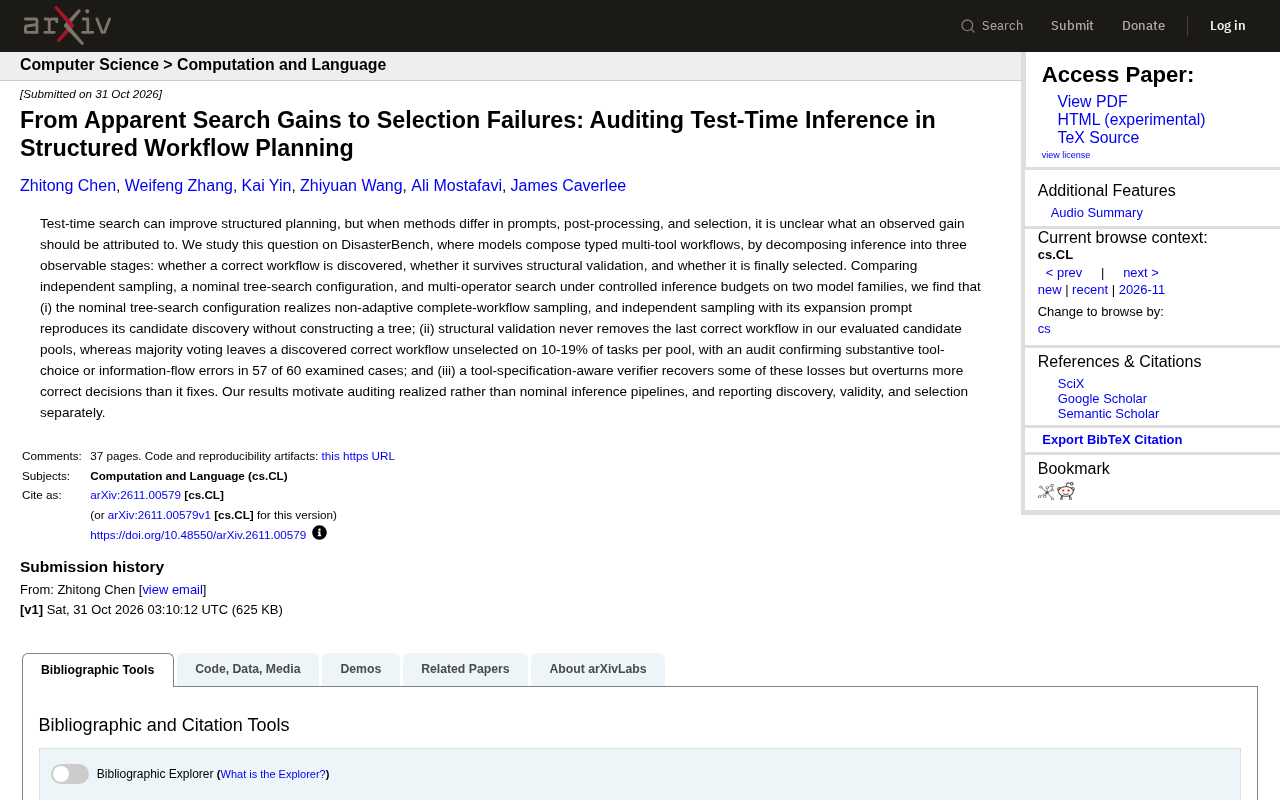
In structured workflow planning, test-time search methods are often claimed to improve model performance. However, when different methods differ in prompting, post-processing, and selection strategies, what should the observed gains actually be attributed to? A study on DisasterBench conducted an in-depth audit of this ambiguous question by decomposing reasoning into three observable stages: whether the correct workflow is discovered, whether it passes structural validation, and whether it is ultimately selected.
Deconstructing the Reasoning Pipeline: Three Stages
The study explicitly divides the reasoning process into three phases—discovery, validation, and selection—and compares three methods across two model families: independent sampling, a nominal tree search configuration, and multi-operator search, while controlling the inference budget. This decomposition allows researchers to pinpoint the source of performance changes rather than vaguely attributing them to "search."
Discovery Stage: Nominal Tree Search Is Actually Non-Adaptive Sampling
A key finding is that the so-called tree search configuration actually implements non-adaptive full workflow sampling. Independent sampling with its extended prompt reproduces the same candidate discovery results without constructing a tree. This means that the "structure" of tree search brings no actual advantage in the discovery stage—the gains may come from prompt design rather than the search algorithm itself.
Non-adaptive Sampling refers to a candidate generation process that does not rely on intermediate feedback or pruning; all candidate paths are generated independently and do not affect each other. In contrast, adaptive tree search dynamically decides whether to expand or backtrack based on evaluations of intermediate nodes. The so-called "tree search" configuration in the study does not actually implement adaptive branching, so its candidate discovery process is equivalent to independent multiple sampling with an extended prompt. This explains why independent sampling can reproduce identical discovery results—the structure itself contributes no additional information, and the gains come from prompt design.
Validation Stage: Structural Validation Never Removes the Last Correct Workflow
In the evaluated candidate pools, structural validation never removed the last correct workflow. This sounds like good news, but the study further reveals a serious problem in the selection stage.
Test-time Search refers to methods that, during model inference (rather than training), use additional computational resources to explore multiple candidate outputs and select the best solution among them. Common forms include independent sampling (multiple independent generations followed by aggregation), tree search (such as Tree of Thoughts, ToT, which builds reasoning paths through branching and backtracking), and multi-operator search (combining different reasoning operators). The core assumption of these methods is that more reasoning attempts can improve final answer quality. However, actual effectiveness depends heavily on candidate generation diversity, verifier reliability, and the accuracy of the selection strategy.
Selection Failure: The Blind Spot of Majority Voting
Majority voting is designed to aggregate multiple candidates, but the study finds that in each pool it causes the already-discovered correct workflow to be unselected in 10-19% of tasks. More seriously, an audit of 60 cases confirmed that 57 of them contained substantive tool selection or information flow errors. In other words, majority voting often ignores the truly correct option because of superficial consensus.
The Verifier's Dilemma: Repair and Misjudgment Coexist
The study also tested a tool-specification-aware verifier, which was able to recover some losses, but surprisingly, it overturned more correct decisions than it repaired. This finding suggests that current verifier designs may be too aggressive, introducing new errors while correcting others.
Majority Voting is a commonly used candidate aggregation strategy: multiple candidate answers are voted on, and the one with the most votes wins. Its implicit assumption is that correct candidates will form a consensus. But in structured workflow planning, incorrect candidates may cluster because they share similar error patterns, causing "superficial consensus" to override correct but minority candidates. In the study, 10-19% of tasks were therefore unselected, indicating that majority voting is sensitive to the diversity distribution of the candidate pool and cannot simply be regarded as a reliable selection mechanism.
Implications: Audit the Actual Reasoning Pipeline and Report Stage-Specific Metrics
This study strongly recommends that when evaluating test-time reasoning, one should audit the pipeline that actually runs rather than the nominal configuration, and report metrics separately for the three stages of discovery, validity, and selection. Reporting only final accuracy masks failures in the selection stage and leads to misjudgments about method effectiveness. For developers and researchers building reliable structured workflow planning systems, this audit framework provides a clearer diagnostic perspective.
The study also points out that prompt design plays an important role in the discovery stage, while improvements to selection strategies may be the key to enhancing overall performance. Future work can explore more robust selection mechanisms to reduce reliance on superficial consensus.
One-line Summary
The audit reveals that test-time search gains mostly come from prompting rather than structure, and selection-stage failures are the key bottleneck.
Paragraph Summary
A study on DisasterBench audited test-time reasoning for structured workflow planning by decomposing it into three stages: discovery, validation, and selection. The study found that nominal tree search is actually non-adaptive sampling, and independent sampling alone can reproduce the same candidate discoveries, with gains stemming from prompt design rather than search structure. Structural validation never removed the last correct workflow, but majority voting failed to select the already-discovered correct workflow in 10-19% of tasks, and 57 of 60 audited cases contained substantive errors. A tool-specification-aware verifier overturned more correct decisions than it repaired. The study recommends auditing the actual reasoning pipeline and reporting stage-specific metrics.
Related articles

AI Coding Enters the Team Collaboration Era: Interpreting Three Major Moves from Meta, GitHub, and Mistral
Meta acquires Conductor, GitHub Copilot Fusion becomes available, Mistral opens Large 4 weights—three moves show AI coding shifting from code generation to organizing development workflows. This article explains task orchestration, model collaboration, and cost control for developers.

Building a RAG Assistant with Dify: A Practical Guide to Knowledge Bases, Workflows, and Agent Nodes
How should knowledge bases, workflows, and Agent nodes connect in a Dify RAG assistant? We break down the division of labor and wiring logic for a shippable app.
 Tech Frontiers
The AI Industry Doesn't Lack Marketing—It Lacks Good Products
AI faces market selloffs and public skepticism—is marketing really the problem? This analysis of market signals and product experience argues the core困境 is incomplete products and a gap between promises and experience; the only way to change perceptions is to ship better products.