AurionMail: An End-to-End Encrypted Office Suite with a Single Password
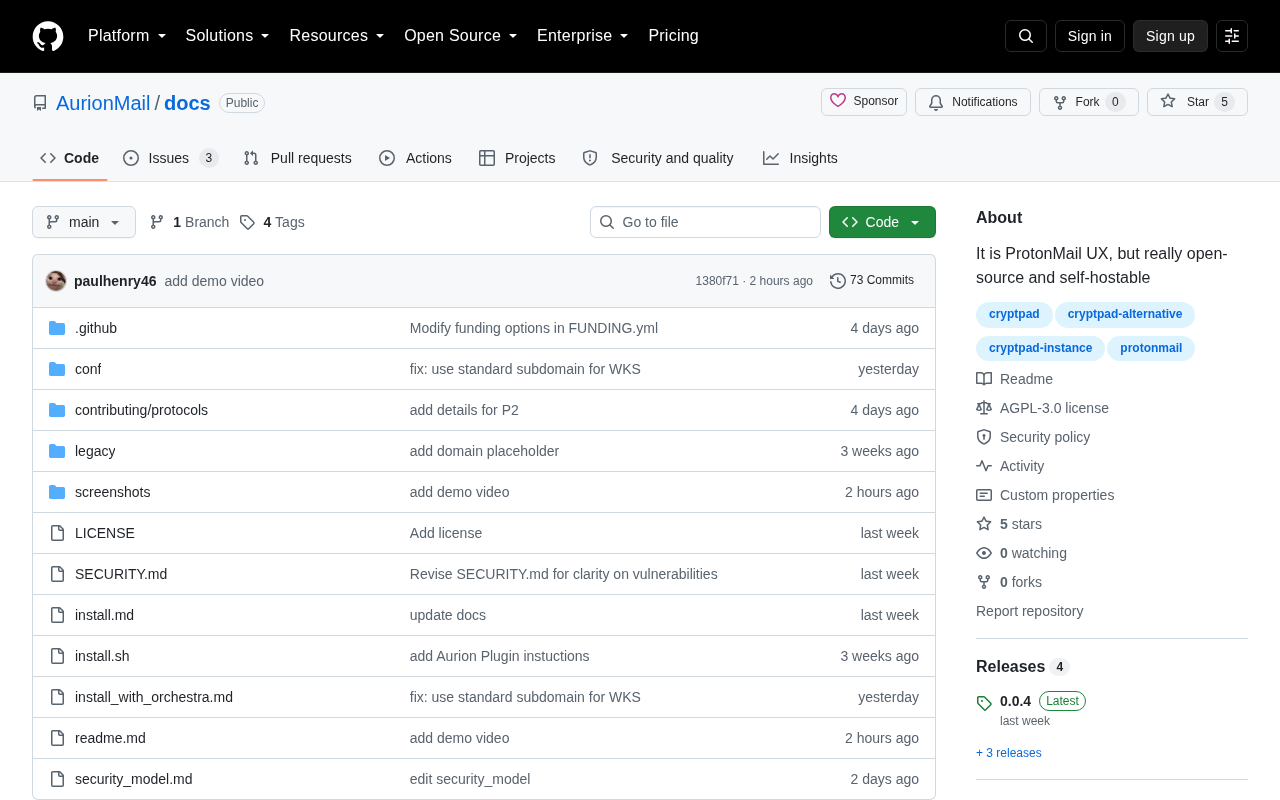
AurionMail combines CryptPad and Stalwart into a single-password end-to-end encrypted office suite.
AurionMail is an early-stage open-source project that integrates CryptPad's zero-knowledge collaboration platform with Stalwart's Rust-based mail server to deliver a complete end-to-end encrypted office suite. Its standout feature is a single-password UX that simplifies access to encrypted email, documents, and collaboration tools, though this convenience introduces trade-offs around single points of failure and password strength dependency.
A Privacy-First Encrypted Suite Redefining Secure Productivity
In an era of increasingly frequent data breaches and privacy violations, end-to-end encryption (E2EE) has evolved from a niche option for tech enthusiasts into a necessity for everyday users. Yet most encrypted tools on the market share a common pain point: usability and security are hard to achieve simultaneously. Either the encryption isn't strong enough, or the barrier to entry is too high—ordinary users are often deterred by complex key management and multiple account passwords.
AurionMail aims to strike a balance between these two extremes. It's an integrated end-to-end encrypted office suite built on CryptPad and Stalwart, with its standout feature being a single-password user experience: users only need to remember one password to access the entire suite of encrypted email, document collaboration, and more.
Technical Architecture: The CryptPad + Stalwart Combination
AurionMail isn't built from scratch—it stands on the shoulders of two mature open-source projects. This "compositional" engineering approach is worth noting.
CryptPad: A Zero-Knowledge Collaboration Platform
CryptPad is a well-known end-to-end encrypted collaboration suite offering online tools for documents, spreadsheets, whiteboards, presentations, and more. Its core feature is a "zero-knowledge" architecture—the server itself cannot read user content, as all encryption and decryption happens on the client side. This means that even if the server is compromised, attackers cannot access plaintext data.
Stalwart: A Modern Mail Server Written in Rust
Stalwart is a modern mail server written in Rust that supports JMAP, IMAP4, SMTP, and other protocols, renowned for its high performance and security. Integrating Stalwart means AurionMail has full email sending and receiving capabilities, rather than being limited to document collaboration alone.
By combining these two projects, AurionMail aims to build a complete encrypted office ecosystem covering "email + documents + collaboration," positioning itself against mainstream suites like Google Workspace or Microsoft 365—but with privacy as a first-class design principle.
The Single-Password Experience: Balancing Convenience and Risk
The single-password UX is AurionMail's core selling point and its most thought-provoking design decision.
From the user's perspective, remembering just one password clearly lowers the barrier to entry. In traditional encryption schemes, users often need to manage master passwords, private key files, recovery phrases, and other credentials—losing any one of them could mean permanently losing access to their data. A single password simplifies all of this into one entry point.
However, this design also introduces security considerations worth noting:
- Single point of failure: If this password is compromised, an attacker could potentially gain access to both email and documents simultaneously.
- Password strength dependency: The security of the entire system is highly dependent on the strength of this one password—a weak password becomes a fatal weakness for the whole system.
- Recovery mechanisms: Under a zero-knowledge architecture, if a user forgets their password, the service provider cannot help recover data. This is a double-edged sword for ordinary users.
Whether AurionMail's trade-off between convenience and security can withstand real-world scrutiny still requires more public audits and community verification.
Trends and Challenges in Open-Source Encryption Tools
The emergence of projects like AurionMail reflects a clear trend in the privacy technology space: integrating mature open-source encryption components to lower the barrier to using privacy tools.
This approach has unique advantages. Compared to building from scratch, integrating community-vetted projects like CryptPad and Stalwart allows developers to stand on the shoulders of giants, avoid reinventing the wheel, and achieve higher code auditability. For encryption software, being open-source and auditable is almost a prerequisite for building trust—no one wants to entrust sensitive data to a black box.
That said, such projects also face real-world challenges. AurionMail is still in its early stages, and integrating multiple complex systems is inherently a formidable engineering task. Ensuring seamless encryption chains between components and maintaining long-term updates and security patches are areas that require ongoing investment.
Conclusion: A Worthwhile Experiment in Private Productivity
AurionMail represents one direction for privacy-first office suites: using compositional engineering to reduce development costs, and single-password design to lower user barriers. For individuals and small teams who value data sovereignty and want to break free from surveillance by big tech companies, this is an option worth watching.
Of course, as an early-stage project, its maturity, stability, and long-term maintainability remain to be seen. But regardless, in an era where end-to-end encryption is increasingly becoming a mainstream requirement, more and more experiments like AurionMail are pushing privacy tools from "geek-exclusive" toward "accessible to everyone." This trend itself is worth affirming.
Related articles

JobRunner MCP Server: AI Agents Can Now Fix Failed Java Jobs
JobRunner launches an open-source MCP server enabling AI agents to view cluster status, diagnose failures, and recover Java jobs—incident response from any cloud coding environment or existing agent.

MLAI Digital Launches 9 Security Agents: MCP Server Safeguards the Full Lifecycle of Agentic AI
MLAI Digital launches Security MCP Server with nine built-in specialized security agents covering vulnerability discovery, attack simulation, prompt injection detection, API and infrastructure assessment, and accelerated remediation—embedding security validation across the full Agentic AI lifecycle from development to production.

Running Isaac Lab on H100 GPUs: Exploring Better Approaches
Exploring optimization methods for running Isaac Lab on NVIDIA H100 GPUs, including MIG configuration, mixed precision, TensorRT acceleration, and community experience to improve robotics simulation and reinforcement learning efficiency.