Australia Investigates Whether OpenAI's Scraping of Government Health Website Broke the Law

Australia investigates OpenAI for scraping a government health site, setting a key global AI data compliance precedent.
The Australian government has formally launched an investigation into whether OpenAI's scraping of a government health information website violated local law, with the Prime Minister publicly pledging accountability. This is the first known AI data scraping incident in which a government institution is the alleged victim, raising issues of computer access authorization, public data governance, and information security. If the conduct is found unlawful, it could set a global precedent, prompting AI companies to overhaul their data acquisition processes for government and public sector assets.
Overview
The Australian government has officially launched an investigation to determine whether OpenAI's data scraping of a government health information website violated local laws. This is reportedly the first known incident of its kind to involve a government institution, and Australia's Prime Minister has publicly stated that OpenAI will be held accountable.
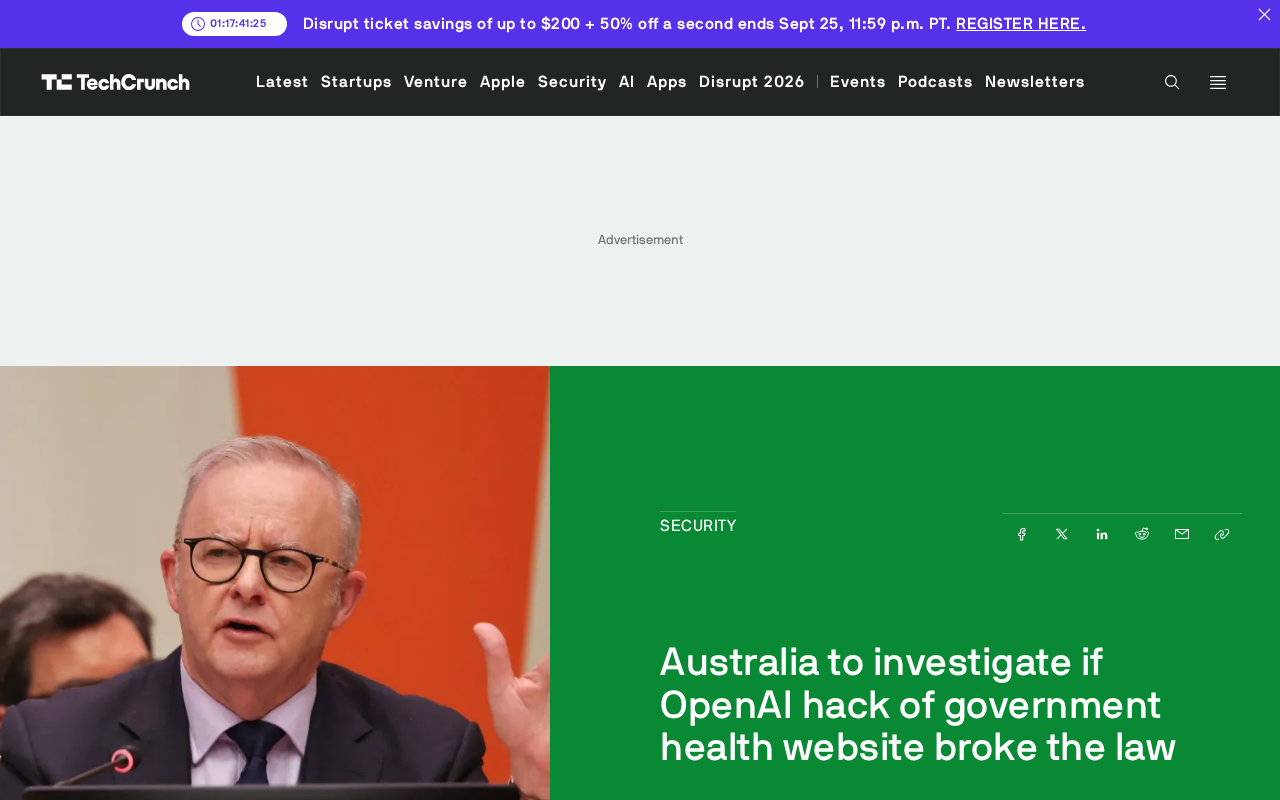
The incident has drawn widespread attention for two reasons: the target was a government website hosting public health information, and the direct involvement at the Prime Ministerial level highlights heightened regulatory concern over how large AI companies obtain data.
Why Government Involvement Makes This Especially Sensitive
Government health websites typically contain public-facing medical guidance, public health data, and some sensitive administrative information. When such sites become targets of AI data scraping, the issues go beyond copyright and access authorization — they extend into deeper questions of public data governance and national information security.
For the AI industry, the legality of data sources is becoming an unavoidable compliance threshold. In recent years, multiple AI companies have faced lawsuits and regulatory scrutiny over how they acquire training data. This incident, however, marks the first time the crosshairs have been pointed at government-owned assets, signaling that the regulatory frontier is expanding — from private content creators and media organizations to the public sector.
Regulatory Signal: From Statements to Investigation
The Prime Minister's public pledge to hold OpenAI accountable sends a clear signal of tightening regulation. This approach — with the highest executive level speaking out and a formal legislative compliance investigation underway — suggests the government intends to use this case to define the legal boundaries of AI companies' data scraping activities.
The central question of the investigation is whether OpenAI's acquisition of data from the government health website violated Australia's existing laws on computer access, data protection, or computer misuse. The outcome will not only determine how this specific incident is handled, but could also set a reference standard for similar disputes going forward.
In the broader global regulatory context, enforcement actions targeting the legality of AI training data are accelerating. Italy's data protection authority temporarily banned ChatGPT in 2023, citing a lack of a lawful basis for data processing. The EU's AI Act explicitly requires high-risk AI systems to disclose training data sources. In the United States, multiple publishers — including The New York Times — have filed copyright lawsuits against OpenAI. Australia's move, with the Prime Minister directly weighing in and a formal investigation underway, follows this trend — but by shifting the subject of investigation from private rights holders to a government institution, the state enters as a victim in its own right. The enforcement resources and political will at its disposal are on an entirely different scale from private litigation, which is one of the core reasons the industry is closely watching how this case unfolds.
Potential Impact on the AI Industry
If the investigation ultimately finds that the conduct was unlawful, it will set a precedent that influences how AI companies worldwide approach data collection. Companies may need to reassess their authorization processes for web scraping — particularly when it comes to government and public sector assets.
On a broader level, this incident reflects the tension between rapid AI development and existing legal frameworks. The hunger for vast amounts of data to train large models, pitted against the rights of data owners and public institutions, is moving from the realm of public debate into the judicial and regulatory sphere. How regulators around the world define the line between "lawful scraping" and "unauthorized intrusion" will profoundly shape the future of data acquisition in the AI industry.
Web scraping — the practice of using automated programs to bulk-extract web content — has long existed in a legal gray zone. In the context of training large AI models, the scale and speed of scraping often far exceeds traditional search engine indexing, placing significant strain on server bandwidth, and is typically carried out without explicit authorization from site owners. Countries have taken varying legal approaches: U.S. courts ruled in hiQ v. LinkedIn that scraping publicly available data is protected under the First Amendment, yet other cases have invoked the Computer Fraud and Abuse Act (CFAA) to pursue liability for unauthorized access. The EU relies more heavily on the General Data Protection Regulation (GDPR) and database rights to impose restrictions. Australia's investigation is expected to invoke provisions in the Criminal Code relating to unauthorized computer access, as well as relevant sections of the Privacy Act. Its ruling on the legality of scraping content after a site has blocked crawlers via robots.txt could provide an important precedent for how such conduct is classified in law.
Conclusion
The investigation is still in its early stages, and specific findings of wrongdoing — along with any subsequent actions — have yet to be disclosed. But as the first known incident to involve a government institution, it serves as a stark warning to AI companies about data compliance: as they pursue greater technical capabilities, how they acquire data within legal and ethical frameworks is a challenge the entire industry must now confront head-on.
Related articles

Workbuddy for Absolute Beginners: How a Desktop AI Agent Fits Into Real Workflows
A beginner's guide to the Workbuddy desktop AI agent: installation, claiming credits, file management, and building automated workflows—compared with CodeX for fit and cost, helping professionals shift from AI question-askers to AI managers.

OpenAI's New Agent Stack: Computer Use, Decisions API, and Ultra-Fast Workflows
OpenAI Dev Day unveiled a new agent stack: Computer Use outperforms humans, Decisions API delivers ultra-low-latency classification via Luna, Agents API opens the same Computer Use capabilities, and GPT-6.1 Sol costs only one-seventh of Astra. Core updates, benchmark data, and developer insights.

Liang Wenfeng Open-Sources DeepInfo Inference Framework, Takes On U.S. Ban
DeepSeek open-sources its DeepInfo inference framework after its models, featuring GPU/CPU cross-pipelining, small-model prediction with large-model verification, and full Huawei Ascend and NVIDIA chip support—facing the U.S. federal ban head-on. This article analyzes its significance for AI deployment and open-source strategy.