Australia's Proposed Mandatory AI Incident Reporting Exposes the Real Governance Gap

Australia's mandatory AI incident reporting push exposes a deeper gap: organizations can't trace what their agents actually did.
Australia's push for mandatory AI incident reporting is less about compliance paperwork and more about forcing organizations to confront a missing observability capability. The core problem is the "time window" between autonomous agent actions — agents execute a second action before the first is evaluated, and traditional logs are too slow to catch the damage. Production approaches like post-hoc log review, hard rate limits, and human-in-the-loop checkpoints each have significant limitations. The article concludes that AI governance is shifting from model evaluation toward operational traceability of agent behavior, and organizations should design audit trails and authorization models into their systems now rather than waiting for regulators to force the issue.
One Regulatory Proposal, One Core Governance Gap Exposed
Australia is moving toward mandatory AI incident reporting (Dark Reading, 2026). On the surface, this looks like a compliance disclosure requirement — but treating it as just another paperwork exercise misses the deeper logic worth examining.
The real issue isn't whether to report. It's that most organizations fundamentally cannot explain after the fact: which agent took which action, at what time, under what authorization. When regulators find that the primary record of an AI failure is a customer service ticket or a complaint email — rather than an internally traceable audit log — mandatory reporting frameworks become inevitable.
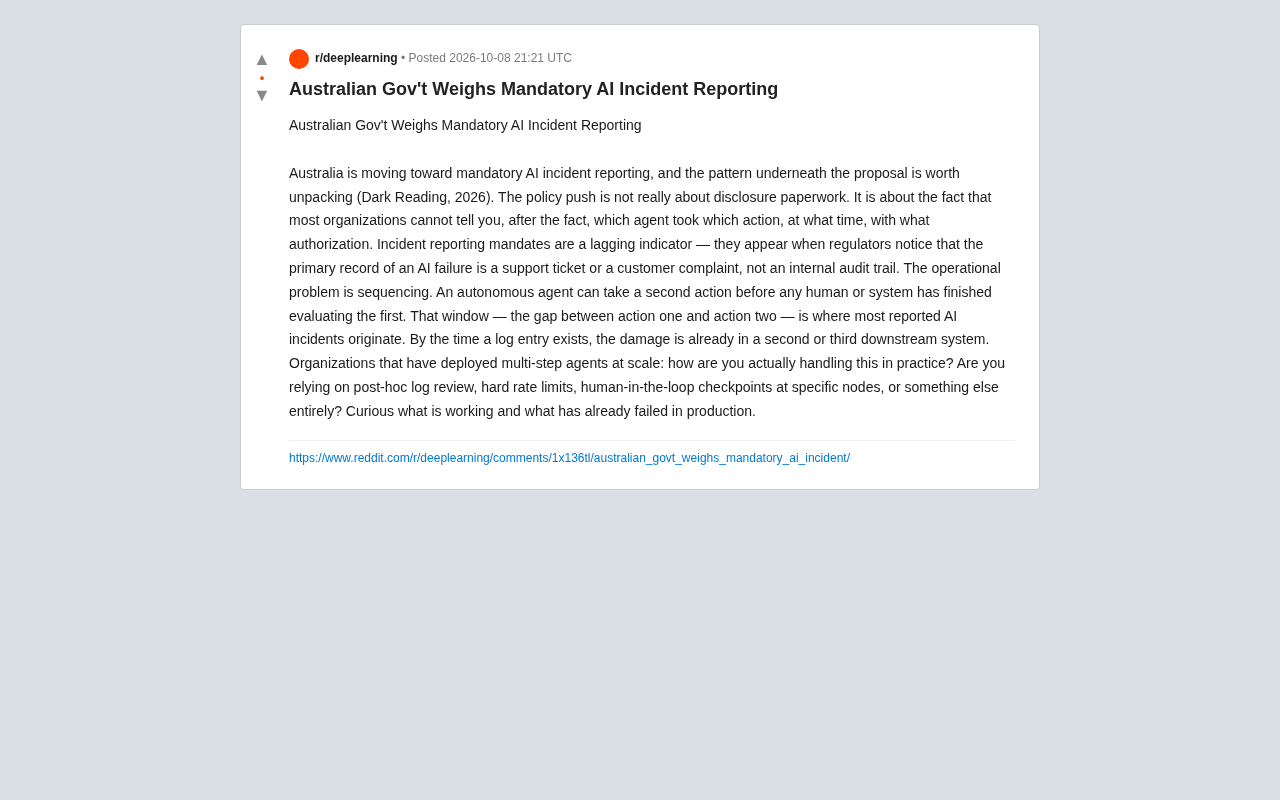
In other words, incident reporting requirements are a lagging indicator — their very existence proves that frontline observability has already broken down. Regulators aren't creating problems; they're filling a governance vacuum that has existed for some time.
The Real Pain Point: The "Time Window" Between Agent Actions
The core operational challenge this proposal surfaces is a sequencing problem.
An autonomous agent can execute a second action before any human or system has finished evaluating the first. The gap between action one and action two is where the vast majority of reported AI incidents actually originate.
Why Logs Always Lag Behind
Traditional monitoring relies on log records — but for multi-step autonomous agents, logs are inherently delayed. By the time a log entry is written, damage has often already propagated to a second or even third downstream system. This means:
- Post-hoc log review captures outcomes, not decision moments;
- Cross-system chain reactions make single-point attribution difficult;
- Accountability (which agent, under what authorization) gets diluted across the chain.
This explains why regulators are focused on incident reporting — it's currently the only mechanism that forces organizations to make invisible failures visible.
How Teams Are Actually Handling This in Production
The original thread posed a very practical question to practitioners who have deployed multi-step agents at scale: how are you actually managing the inter-action window? Several dominant approaches emerged from the discussion, but none has proven to be a silver bullet.
Post-hoc Log Review
The most common and most reactive approach. Low implementation cost, but — as noted above — by the time you read the logs, downstream systems are already affected. Better suited for retrospective analysis than real-time protection.
Hard Rate Limits
Artificially widening the interval between agent actions by capping how many actions an agent can execute per unit of time, buying room for evaluation. The tradeoff is throughput and responsiveness — in high-frequency scenarios, this can significantly degrade the user experience.
Human-in-the-Loop Checkpoints
Inserting manual confirmation steps at specific critical junctures. This can effectively intercept high-risk actions, but as agent volume scales, humans become a bottleneck — and these checkpoints tend to devolve into rubber-stamp exercises.
Human-in-the-loop (HITL) design faces a fundamental tension in practice: the core value of agent automation lies in reducing human intervention, while HITL checkpoints reintroduce human involvement at critical nodes. As agent throughput grows, the latency from manual confirmation accumulates into a system bottleneck. Operations teams tend to lower the trigger threshold to maintain throughput, ultimately rendering HITL ineffective. The current mainstream direction in both academia and industry is "adaptive HITL" — dynamically deciding whether to trigger human review based on a risk score for each agent action (factoring in irreversibility, blast radius, confidence level, etc.), rather than intercepting uniformly at fixed checkpoints. This preserves automation efficiency while concentrating human attention on genuinely high-risk decision nodes.
Other Mechanisms
Some teams are working at the architecture level — for example, establishing authorization chains for agent behavior (which actions require which level of authorization), introducing pre-action reversibility assessments, or setting circuit breakers in downstream systems. These approaches address the root cause more directly, but come with significantly higher engineering complexity.
Where Regulation and Engineering Intersect
The value of Australia's proposal lies in elevating a challenge that engineering teams have long absorbed internally into a compliance-level concern. When "being able to explain which agent did what" becomes a legal obligation, organizations are compelled to design for traceability from the start of deployment — not as an afterthought.
This is a signal: AI governance is shifting from model capability evaluation toward operational-level observability requirements for agent behavior. For organizations preparing to deploy autonomous agents at scale, the better move is to proactively build audit trails, authorization models, and checkpoint mechanisms into system design — rather than waiting for regulation to force the issue.
The real test isn't whether you can report an incident. It's whether, when an incident occurs, you can still fully reconstruct that decision chain.
Observability in the context of AI agents differs significantly from traditional software systems. The classic three pillars — metrics, logs, and traces — are designed for deterministic systems that assume the same input produces the same output. But autonomous agent behavior is shaped by context, historical state, and model reasoning combined; the same trigger can produce different action chains at different times. Agent observability therefore also requires capturing the reasoning trace at the moment of decision, a snapshot of the contextual state at that moment, and the authorization source for the action taken. This is precisely why "audit trails" are harder to implement in agent systems than in traditional logging — they require capturing not just what happened, but why that decision was made at that moment.
Background
The sequencing problem is especially complex in multi-agent systems. When multiple agents run in parallel and share resources or state, race conditions between actions can drive the system into states the designer never anticipated. Consider a financial transaction scenario: in the same millisecond that agent A is evaluating whether certain funds are available, agent B may have already transferred those funds. This class of problem doesn't exist in single-threaded systems, but is nearly unavoidable in distributed autonomous agent architectures. For this reason, the "time window" is not merely a monitoring blind spot — it is a systemic consistency problem. It demands that organizations introduce transactional guarantees at the architecture design stage, rather than relying on piecing together logs after the fact.
Related articles

Workbuddy for Absolute Beginners: How a Desktop AI Agent Fits Into Real Workflows
A beginner's guide to the Workbuddy desktop AI agent: installation, claiming credits, file management, and building automated workflows—compared with CodeX for fit and cost, helping professionals shift from AI question-askers to AI managers.

OpenAI's New Agent Stack: Computer Use, Decisions API, and Ultra-Fast Workflows
OpenAI Dev Day unveiled a new agent stack: Computer Use outperforms humans, Decisions API delivers ultra-low-latency classification via Luna, Agents API opens the same Computer Use capabilities, and GPT-6.1 Sol costs only one-seventh of Astra. Core updates, benchmark data, and developer insights.

Liang Wenfeng Open-Sources DeepInfo Inference Framework, Takes On U.S. Ban
DeepSeek open-sources its DeepInfo inference framework after its models, featuring GPU/CPU cross-pipelining, small-model prediction with large-model verification, and full Huawei Ascend and NVIDIA chip support—facing the U.S. federal ban head-on. This article analyzes its significance for AI deployment and open-source strategy.