Auto-Use Open Source Project Explained: One AI Agent to Handle Your OS, Browser, and Code

Auto-Use is an end-to-end AI agent that controls your computer like a human to complete any task.
Auto-Use is an open-source end-to-end AI Computer Use Agent that employs an "observe-think-act" loop mechanism, leveraging the visual understanding capabilities of multimodal LLMs to let AI directly operate the OS, browser, and write code just like a human. Unlike competitors focused on single scenarios, it pursues full-stack coverage. Still in its early stages, it faces reliability, security, and performance challenges, but its design philosophy aligns with the industry trend of AI Agents evolving from specialized tools to general-purpose agents.
Auto-Use Project Overview: An End-to-End AI Computer Use Agent
Auto-Use is an open-source project that has recently emerged on GitHub, positioning itself as an end-to-end AI Computer Use Agent. Its core philosophy is remarkably straightforward—one agent to do it all. Whether it's driving the operating system, controlling the browser, searching for web information, or writing code, Auto-Use aims to accomplish everything through a single intelligent agent.
The project is built with Python and has already garnered 57 stars on GitHub. While still in its early stages, its design philosophy aligns closely with current trends in the AI Agent space.
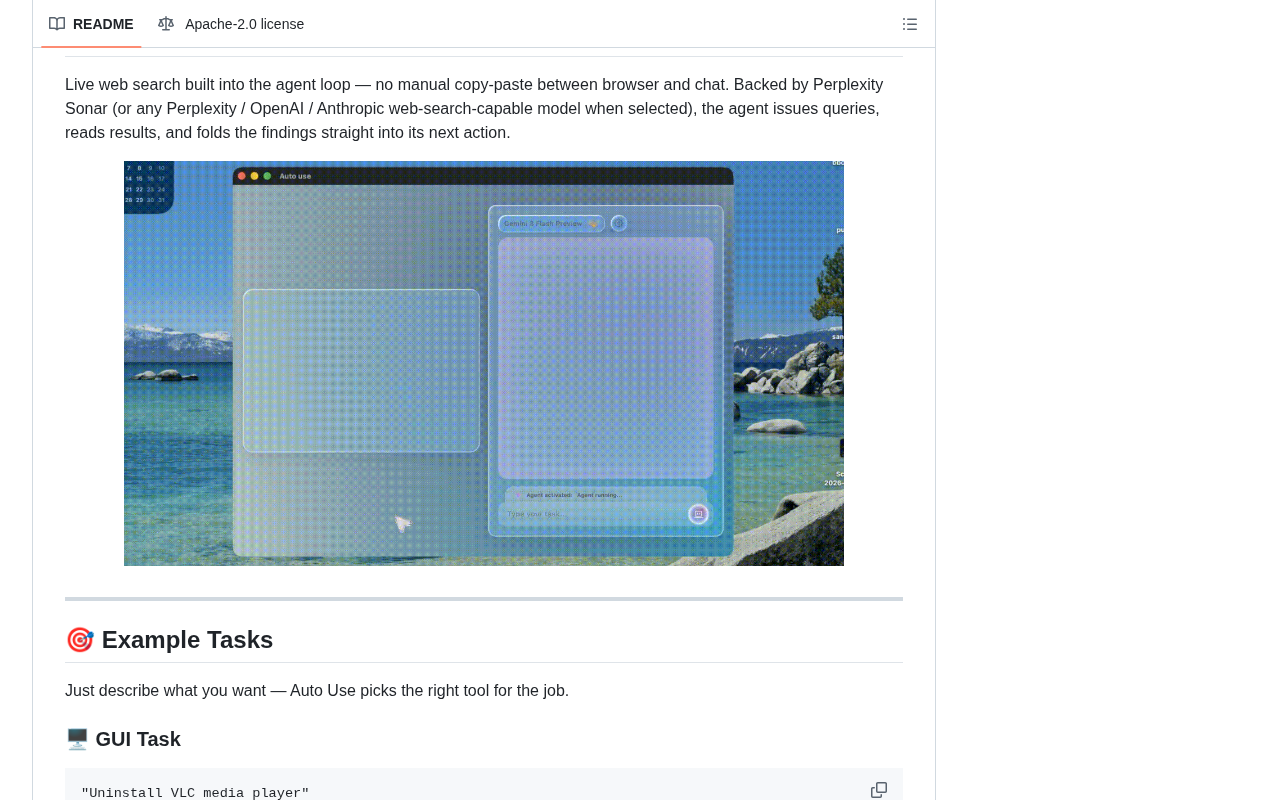
What Is a Computer Use Agent?
From Tool Calling to Direct Computer Control
Traditional AI assistants typically complete tasks through API calls—invoking a search engine API to retrieve information, or calling a file system API to read and write files. Computer Use represents an entirely new paradigm: AI directly operates the computer interface just like a human would.
Specifically, a Computer Use Agent can:
- Move the mouse, click buttons, and type text
- Open applications and switch windows
- Browse web pages and fill out forms
- Write and debug code in an IDE
This direction first gained widespread attention when Anthropic launched Claude Computer Use in 2024, followed by products like OpenAI's Operator. Auto-Use is the open-source community's implementation of this technical approach.
The Technical Principles Behind Computer Use
The core technology of a Computer Use Agent relies on the visual understanding capabilities of Multimodal Large Language Models (Multimodal LLMs). The workflow is typically a continuous loop: first, a screenshot of the current screen is captured; the screenshot is sent as image input to the multimodal model; the model understands the screen content and outputs the next action instruction (such as clicking a specific coordinate or typing certain text); the system executes the instruction and takes another screenshot, entering the next cycle. This "observe-think-act" loop draws from the classic paradigm in reinforcement learning, but delegates all decision-making to a pre-trained large language model rather than training a policy network through environmental reward signals. This means the model must simultaneously possess strong visual grounding capabilities (accurately identifying the positions of UI elements like buttons and input fields), contextual reasoning capabilities (understanding where the current action fits within the overall task), and error recovery capabilities (recognizing operation failures and adjusting strategies).
The Milestone Significance of Claude Computer Use
In October 2024, Anthropic released the Computer Use capability for Claude 3.5 Sonnet—the first computer control feature officially launched by a major AI company. Anthropic's implementation added a set of tool definitions (computer, text_editor, bash) to the API, enabling Claude to output screen operation instructions in a structured manner. On the internal benchmark OSWorld, Claude achieved a task completion rate of 14.9%—a number that may seem low, but considering the benchmark covers complex cross-application operating system tasks, this represented the state of the art at the time. This release directly spawned numerous follow-up projects in the open-source community, and Auto-Use is one of them.
Auto-Use's End-to-End Design Philosophy
The "end to end" in the project name reveals its core design philosophy. Unlike many Agent frameworks that require configuring different tool chains for different tasks, Auto-Use pursues a single agent covering all scenarios. Users simply describe their goal, and the agent independently plans the path, selects the operation method, executes, and verifies results.
In AI Agent architecture design, "end-to-end" and "tool orchestration" represent two fundamentally different philosophies. Tool orchestration frameworks (like LangChain, CrewAI) decompose complex tasks into multiple subtasks, with each subtask handled by a specialized tool or sub-agent, while the framework coordinates data flow and execution order between them. The advantage of this approach is that each step is controllable and debuggable, but the cost is high configuration complexity and potential "gaps" in the handoffs between tools. End-to-end design lets a single agent directly face the raw task description and raw operating interface, with the model autonomously completing the entire process from understanding to execution. This is similar to the trend in autonomous driving from modular approaches (separate perception-planning-control) toward end-to-end neural network approaches—end-to-end solutions have a higher ceiling, but place significantly greater demands on model capabilities.
This design dramatically lowers the barrier to entry—users don't need to understand the underlying tool orchestration logic, nor do they need to configure an Agent separately for each task.
Auto-Use Technical Positioning and Competitive Analysis
Position in the Open-Source AI Agent Ecosystem
In the open-source Computer Use Agent space, several well-known projects already exist. Here's how Auto-Use compares with mainstream competitors:
| Project | Characteristics | Focus Area |
|---|---|---|
| Open Interpreter | Primarily code execution | Terminal/code operations |
| Browser Use | Browser automation | Web interaction |
| Auto-Use | Full-scenario coverage | OS + Browser + Code |
Auto-Use's differentiation lies in its full-stack coverage. It isn't limited to browser automation or code execution alone—it aims to become a truly general-purpose computer operation agent.
Current Challenges Facing Auto-Use
Despite its advanced vision, Auto-Use as an early-stage project still faces numerous real-world challenges:
-
Reliability Issues: Vision-based interface operations are inherently unstable, and UI element recognition and interaction are prone to errors. Specifically, this instability stems from multiple layers: coordinate precision issues—the model needs to infer pixel-level click coordinates from screenshots, and differences in screen resolution, scaling ratio, and DPI settings all affect positioning accuracy; dynamic content issues—animations, lazy loading, and pop-ups on web pages may cause poorly-timed screenshots, resulting in the model seeing an interface state inconsistent with the actual state; cross-platform consistency issues—the same application can look vastly different across operating systems and theme settings, challenging the model's generalization capability. Current industry countermeasures include incorporating Accessibility Trees as supplementary information sources, using visual annotation techniques like Set-of-Mark to enhance element recognition, and combining DOM structure information (for web scenarios) to improve operation precision.
-
Security Considerations: Letting AI directly control the operating system introduces significant security risks, where misoperations could cause data loss. In practice, mainstream solutions typically employ multi-layered security mechanisms: the first layer is sandbox isolation, running the Agent in Docker containers or virtual machines to confine its operations to an isolated environment so that even misoperations won't affect the host system; the second layer is permission control, restricting the file directories the Agent can access, system commands it can execute, and network scope it can reach; the third layer is Human-in-the-Loop, requiring user confirmation before executing high-risk operations (such as deleting files, sending emails, or making payments). Anthropic explicitly recommends in its Computer Use documentation to run in a virtual machine and warns against granting internet access or sensitive data access. These security practices are equally critical for open-source projects like Auto-Use.
-
Performance Bottlenecks: Each operation requires screenshotting, analysis, and decision-making, resulting in execution efficiency far below direct API calls.
-
Community Maturity: 57 stars and 7 forks indicate the project is still in a very early stage, with its ecosystem yet to be established.
AI Agent Industry Trends and the Future of Computer Use
The emergence of Auto-Use reflects an important trend in the AI Agent space: the evolution from specialized tools to general-purpose agents.
2025 is widely considered the "Year of AI Agents," a judgment backed by deep technical and commercial factors. From a technical perspective, multimodal models like GPT-4o, Claude 3.5/4, and Gemini 2.0 achieved qualitative leaps in visual understanding and reasoning capabilities in 2024, providing sufficiently powerful infrastructure for Agent "eyes" and "brains"; the proliferation of long context windows (100K-1M tokens) enables Agents to maintain long-term memory for complex tasks; and the standardization of Function Calling and structured output capabilities makes model integration with external tools more reliable. From a commercial perspective, enterprise demand for AI automation has upgraded from "decision support" to "autonomous execution," and the traditional RPA (Robotic Process Automation) market is being redefined by AI Agents. Gartner predicts that by 2028, at least 15% of daily work decisions will be made autonomously by AI Agents—a prediction driving massive capital and talent into the field.
Major players are actively investing in computer use capabilities:
- Anthropic's Claude already has mature Computer Use functionality
- Google's Project Mariner focuses on browser agents
- Microsoft is deeply integrating Copilot's operational capabilities into Windows
Open-source community follow-through is crucial. Projects like Auto-Use, even if their current functionality is incomplete, provide developers with a foundation for exploration and customization. In the future, as multimodal model capabilities continue to improve and operating systems provide native support for AI agents, end-to-end computer use agents like these are poised to become one of the mainstream modes of human-computer interaction.
Conclusion: Auto-Use Is Worth Continued Attention
Auto-Use is an early-stage open-source project worth watching, representing the critical shift of AI Agents from "can chat" to "can work." While it's still far from production-ready, its end-to-end, full-scenario design philosophy points toward an exciting future—where AI is no longer just answering questions, but truly becoming your digital collaborator.
For developers following AI automation and the Computer Use direction, starting to track Auto-Use's development now may offer an early advantage in this emerging space.
Key Takeaways
- Auto-Use is an end-to-end AI Computer Use Agent capable of unified control over operating systems, browsers, and code writing
- The project adopts the Computer Use paradigm, enabling AI to directly manipulate the computer interface like a human rather than relying on API calls
- The technical core of Computer Use is a multimodal LLM-driven "observe-think-act" loop, demanding extremely high visual understanding and reasoning capabilities from the model
- Compared to competitors like Open Interpreter and Browser Use, Auto-Use pursues full-stack scenario coverage
- The project is still in its early stages (57 stars), facing challenges in reliability, security, and performance, which the industry addresses through techniques like sandbox isolation and accessibility trees
- The project reflects the industry trend of AI Agents evolving from specialized tools to general-purpose agents, with the maturation of multimodal model capabilities in 2025 providing the technical foundation for this direction
Related articles
Deep Dive into AI Agent Skill Design: …
Deep Dive into AI Agent Skill Design: Engineering Practices from Anthropic and Perplexity
A deep dive into Skill design philosophy from Anthropic's Claude Code team and Perplexity's Agent team, covering the Tax Test, Gotchas Flywheel, progressive disclosure, and Eval-First practices for building high-quality AI Agent skill systems.
Deep Dive into OpenAI's Official GPT-5…
Deep Dive into OpenAI's Official GPT-5.6 Prompting Guide: The Shift from Manual to Automatic
A deep dive into OpenAI's official GPT-5.6 Sol prompting guide: conciseness-first, outcome-oriented design, autonomy boundaries, tool routing, and reasoning intensity tuning.
 Deep Dives
Deep Dive into How OpenClaw (Open-Source Crayfish) AI Agent Works
Deep analysis of OpenClaw AI Agent internals: System Prompt, tool calling, SubAgents, Skill system, memory, and Context Engineering explained.