Automattic Board Reshuffle: The Power Shift After a Failed CEO Ouster

Automattic reshuffles its board after a failed CEO ouster, with founder Mullenweg consolidating control.
Automattic, the parent company of WordPress, has experienced a governance crisis: an internal push to temporarily suspend founder and CEO Matt Mullenweg failed, prompting an immediate board restructuring. Mullenweg leveraged the structural advantages of his founder status to defeat the challenge, and the new board is widely seen as further consolidating his personal control. The episode highlights classic governance tensions in founder-led tech firms and has drawn broad attention given WordPress's dominant position in the global CMS market. Analysts warn that the power struggle may ripple outward, eroding confidence in the platform's long-term stability among its vast developer and commercial customer base.
Overview
Automattic, the parent company behind WordPress, has just weathered a dramatic bout of internal turmoil. Following a failed attempt to suspend CEO Matt Mullenweg, the company moved swiftly to reconstitute its board of directors under entirely new leadership.
The episode has implications not only for Automattic's own governance structure, but — given the company's central role in the open-source ecosystem, with WordPress powering a significant share of the world's websites — for a much broader community.
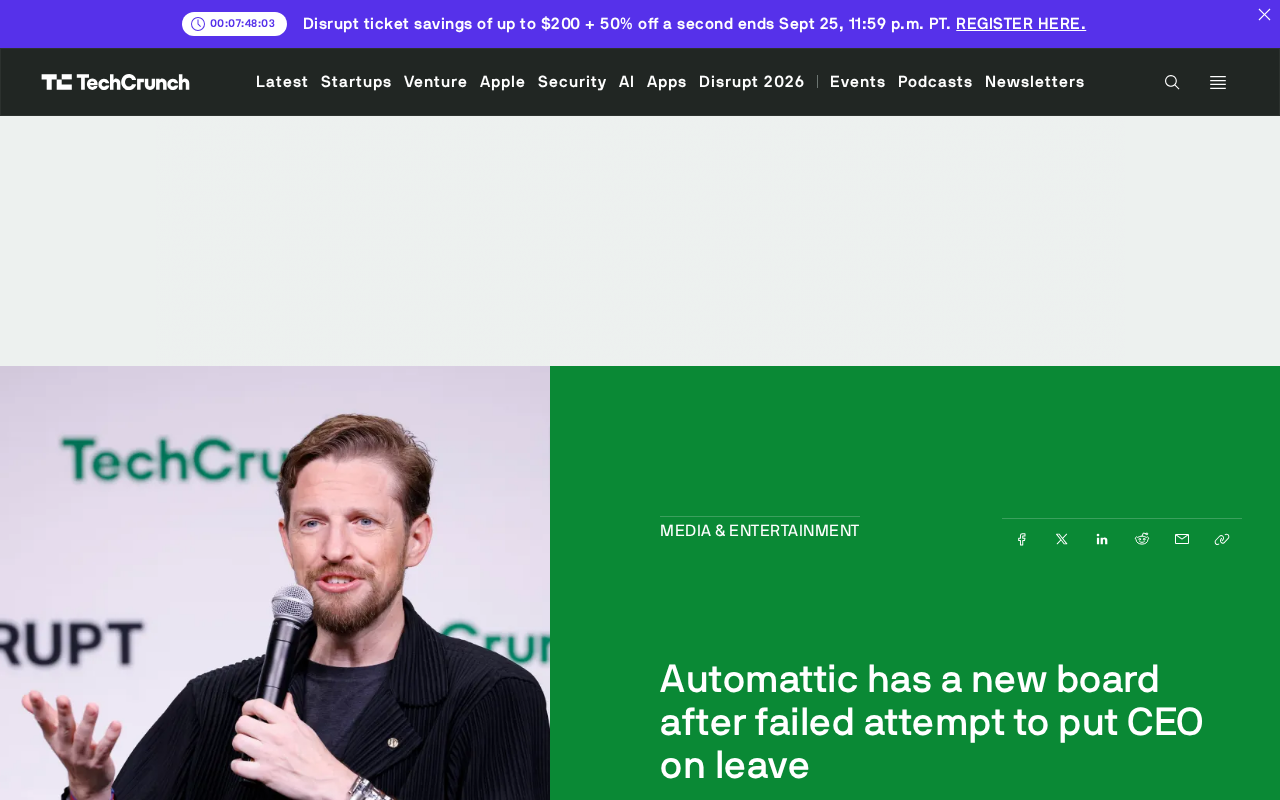
Why the CEO Ouster Failed
Based on available information, the crisis began with an internal push to temporarily remove Mullenweg from the CEO role. Moves like this typically reflect deep disagreements between board members or key stakeholders and a founder over strategic direction, corporate governance, or recent controversies.
The attempt, however, did not succeed. As co-founder of the WordPress project, Mullenweg commands considerable influence and authority within Automattic. Founder status tends to provide significant structural resilience at critical governance moments — and it is precisely this dynamic that has allowed many tech founders to hold their ground in boardroom battles.
The failure of the suspension motion signals, in a meaningful sense, that the existing power structure remains tilted in the founder's favor.
In the field of corporate governance, founders typically maintain control through several mechanisms. The most common is a Dual-Class Share Structure: shares held by the founder carry voting rights that are multiples of those held by ordinary shareholders, giving them a natural advantage in any shareholder vote. As WordPress co-founder and Automattic's founding CEO, Mullenweg very likely holds such super-voting shares. Beyond that, in a private company (unlike a public one), the board composition itself tends to be shaped by the founder and their allies, leaving outside shareholders with relatively limited leverage. Historically, figures like Mark Zuckerberg (Meta) and Larry Ellison (Oracle) have used similar mechanisms to fend off challenges from boards or investors. For Automattic, which has yet to go public, the absence of public shareholders and securities regulators as external checks makes the founder's structural advantage even more pronounced.
What the New Board Signals
With the suspension attempt defeated, the company chose to respond to the upheaval through a board restructuring. For a private tech company, changes in board composition are often the most direct expression of a power rebalancing.
The formation of the new board could carry several implications:
A Signal of Consolidating Power
If the new board is more aligned with Mullenweg, then this restructuring effectively strengthens the founder's grip on the company, marginalizing voices that had sought to challenge him.
A Test of Governance Transparency
Having weathered such a public bout of turbulence, Automattic must now demonstrate to employees, the developer community, and its commercial customers that its decision-making processes are stable. How the new board is composed will be a key lens through which observers assess the company's future direction.
Ripple Effects Across the WordPress Ecosystem
Automattic's relationship with the WordPress open-source community has already been in a sensitive state in recent years. Governance instability at the corporate level can easily spill over into the broader community of developers, agencies, and site owners who depend on WordPress — shaping their assessment of the platform's long-term stability.
Potential Impact on the Open-Source Community
WordPress is one of the most widely used content management systems in the world, and the stability of the company behind it has direct consequences for its vast ecosystem. When a parent company experiences events like a failed CEO ouster and an emergency board reshuffle, the community naturally wonders: will the leadership disruption affect product roadmaps, open-source commitments, and community governance?
For organizations and individuals who have built their businesses on WordPress, keeping a close eye on Automattic's governance is not an overreaction — it is a reasonable way to assess platform risk.
Understanding the impact of this turbulence on the community requires grasping the nuanced, dual nature of the relationship between Automattic and the WordPress open-source project. WordPress itself is an open-source project hosted by the WordPress Foundation, theoretically independent of any commercial entity. However, Automattic employs a large number of core WordPress contributors and operates WordPress.com, the largest commercial hosting platform for WordPress. This structure — in which a commercial company effectively steers an open-source project — means that internal instability at Automattic directly affects the allocation of core development resources and the direction of project decisions. In 2024, the public conflict between Mullenweg and hosting provider WP Engine had already prompted the community to question the neutrality of WordPress's governance. This latest internal power struggle only deepens that unease. The core worry is this: when commercial interests and the open-source ethos come into conflict, who will safeguard the continuity of open-source commitments?
Conclusion
From a failed ouster to a board reshuffle, Automattic completed a fierce round of power realignment in the span of just a few days. The episode highlights a classic tension in founder-led tech companies — the ongoing contest between founder influence and institutionalized governance.
Whether the new board will deliver a more stable and transparent governance structure remains to be seen. For the entire WordPress ecosystem, every tremor at the parent company level is worth watching closely.
Note: Due to limited information in the source material, portions of this article are based on contextual analysis of the events. For specific details, please refer to official disclosures as they become available.
Related articles

Chain of Thought Isn't Just for AI: How Humans Can Use CoT to Improve Thinking Quality
Chain of Thought isn't just a prompt trick for large models. Starting from a Hacker News discussion, this article analyzes why CoT works for human thinking too, breaks down actionable ways to transfer it, and highlights the key differences between human CoT and machine CoT.
Cloudflare Teams Up with OpenAI: Closi…
Cloudflare Teams Up with OpenAI: Closing the Loop from Vulnerability Discovery to Defense with AI
Cloudflare uses OpenAI Daybreak to investigate security vulnerabilities and generate reviewable remediation plans, while developers use Codex to boost coding efficiency and quality.

Orca Multi-Agent Orchestration in Practice: A Guide to Parallel Collaboration with Claude and Codex
Orca is Stable AI's free open-source agent workbench supporting 34 agents like Claude Code and Codex in parallel. Learn its Git worktree isolation, multi-model orchestration, and mobile management.