automodel: A Universal Skill That Lets AI Agents Discover Scientific Models Automatically
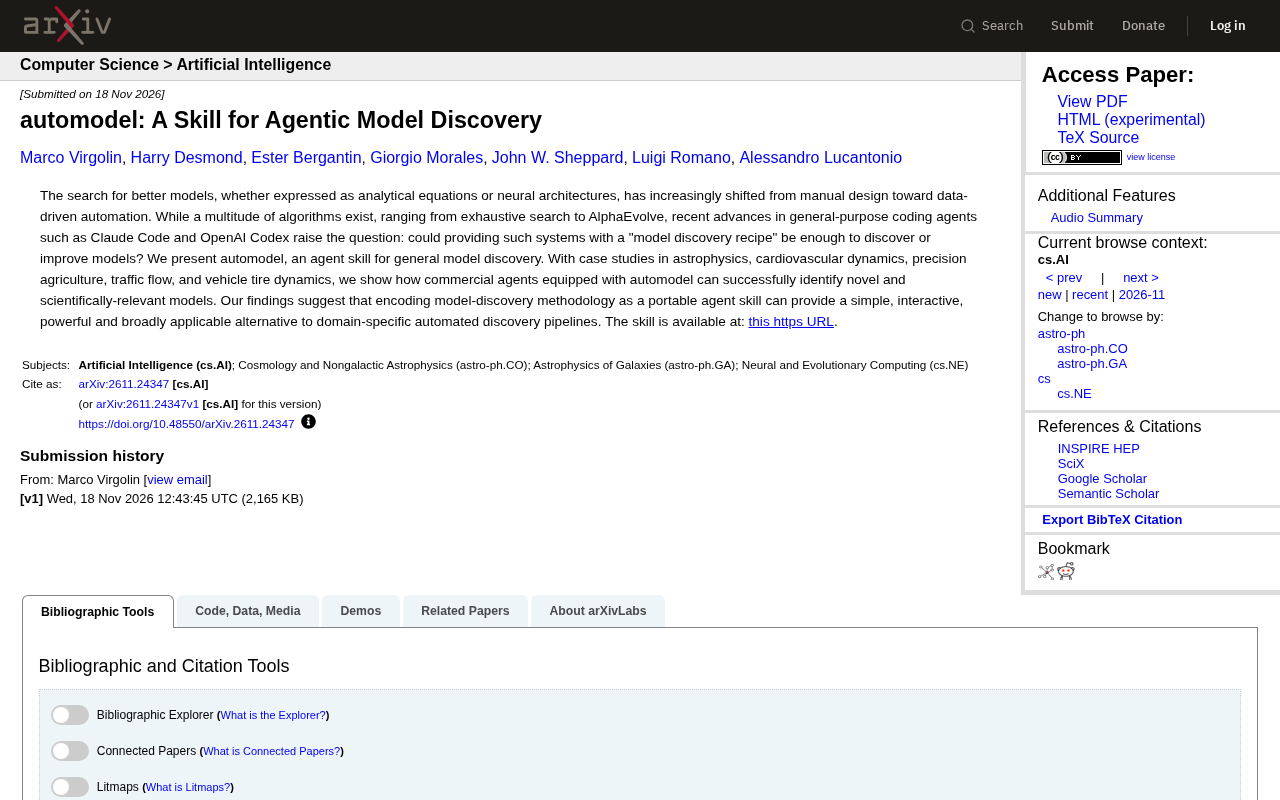
automodel packages model discovery methodology into a portable agent skill, enabling general coding agents to autonomously discover scientific models across domains.
automodel is an open-source GitHub project that breaks scientific model discovery into reusable steps packaged as an agent skill for general coding agents like Claude Code and OpenAI Codex. It aims to replace domain-specific automated pipelines with "general agents plus methodology skills." Case studies across five domains show agents identifying new, scientifically relevant models, though quantitative metrics and reproducibility still need community validation.
From Hand-Crafted Design to Agentic Discovery
Scientific modeling has long relied on domain experts' intuition and repeated trial and error. Whether it's finding analytical equations that describe celestial motion or designing neural network architectures for processing cardiovascular signals, the traditional path requires substantial human intervention. In recent years, automated model search algorithms have gradually matured—from exhaustive search to evolutionary methods like AlphaEvolve—all attempting to hand the task of "finding models" over to machines.
But a more radical question is emerging: since general-purpose coding agents like Claude Code and OpenAI Codex already possess powerful code generation and reasoning capabilities, could we simply give them a "model discovery recipe" and let them autonomously complete model discovery and even improvement?
The recently released automodel project on GitHub is a direct response to this question. It packages the methodology of model discovery into a portable agent skill, enabling commercial agents to find new scientific models across domains without the need for specialized pipelines.
Agent Skill is a capability extension mechanism in the current general-purpose coding agent ecosystem. Taking Claude Code's Skills as an example, it is essentially a set of structured prompts, tool-calling specifications, and process constraints that, once packaged and mounted onto an agent, enable it to follow a preset methodology in specific task scenarios. Unlike fine-tuning models or building independent pipelines, a skill does not change the underlying model weights but instead guides the reasoning path through context injection, making it portable across different agents. automodel leverages this characteristic to solidify the model discovery process into a reusable skill package.
AlphaEvolve is an evolutionary algorithm discovery system proposed by DeepMind. Its core idea is to use large language models to generate candidate programs, score them through automated evaluators, and iteratively optimize via evolutionary strategies (mutation, crossover, selection). It has been used to improve matrix multiplication algorithms and data center scheduling strategies. Compared to automodel, AlphaEvolve relies on purpose-built evaluation pipelines and search infrastructure; automodel, on the other hand, attempts to abstract similar methodologies into a lightweight skill executed by general-purpose agents—the two form a contrast in terms of delivery form.
What Is automodel
automodel positions itself as a "universal model discovery skill." It is not bound to any specific domain and does not require users to build complex automated discovery systems. According to the project description, it breaks down the model discovery process into reusable methodological steps and injects them as a skill into general-purpose coding agents.
This means users don't need to build a domain-specific search pipeline from scratch; instead, they can directly invoke Claude Code or OpenAI Codex and let them, guided by automodel, propose hypotheses, construct candidate models, evaluate fit quality, and iteratively improve. The project authors summarize this approach as: encoding model discovery methodology as a portable agent skill, thereby providing a simple, interactive, powerful, and broadly applicable alternative to domain-specific automated discovery pipelines.
The skill itself is open-sourced at https://github.com/unlayer-ai/automodel.
Empirical Case Studies Across Five Domains
The paper abstract lists five case studies covering astrophysics, cardiovascular dynamics, precision agriculture, traffic flow, and vehicle tire dynamics. These domains span a wide range—from macroscopic physics to biomedicine to engineering systems—demonstrating that automodel is designed to be domain-agnostic.
According to the original text, commercial agents equipped with automodel "successfully identified new, scientifically relevant models" in these cases. The keywords here are "new" and "scientifically relevant"—the former means the agent did not merely reproduce known formulas but proposed model forms not previously recorded; the latter emphasizes that these models have practical explanatory or predictive value within their domains.
That said, the original text does not disclose specific performance metrics, comparison baselines, or quantitative improvements for each case. Therefore, the results can currently only be understood qualitatively: automodel demonstrates a feasible path, but the extent of its advantages over traditional methods in each domain still requires more detailed experimental data.
Why "Skillification" Deserves Attention
automodel's core proposition is not about any particular new algorithm but about the delivery form. In the past, automated model discovery typically existed as specialized pipelines: designing search spaces for specific domains, defining evaluation functions, and tuning hyperparameters. Such systems work well but have high migration costs.
automodel chooses to abstract the methodology as an agent skill, and the direct benefit is reusability. The same skill can be mounted onto different general-purpose agents, and when faced with data and problem descriptions from different domains, the agent decides how to apply the methodology. This "methodology-as-skill" approach lowers the barrier to cross-domain model discovery and gives non-ML experts an opportunity to participate in the modeling process through natural language interaction.
Of course, the boundaries of this approach are also worth discussing. The reasoning capabilities of general-purpose agents determine the ceiling of the skill, and whether the skill itself can cover all the steps required for model discovery—hypothesis generation, structure search, parameter estimation, model selection—is not elaborated upon in the original text. The case studies provide an existence proof, but robustness and reproducibility still require community validation.
Domain-specific automated model discovery pipelines typically include several fixed stages: defining the search space (e.g., equation structures, network layer types), setting evaluation functions (fitting error, complexity penalty), selecting search algorithms (genetic programming, Bayesian optimization, reinforcement learning), and tuning hyperparameters for the specific domain. The advantage of such systems is high search efficiency and reproducible results, but each new domain requires redesigning the search space and evaluation criteria, resulting in significant migration costs. automodel's "skillification" approach directly targets this pain point by replacing hand-designed search spaces with the reasoning capabilities of general-purpose agents.
Potential Impact on Scientific Research Workflows
If automodel's approach holds, it could change the relationship between researchers and modeling tools. Traditionally, building a domain model requires writing code, designing experiments, and repeated debugging; in the agent skill paradigm, researchers can describe problems and data in natural language, and the agent completes candidate model generation and screening under methodological guidance.
This does not mean domain knowledge becomes unimportant. On the contrary, how to define problems, how to judge whether a model is "scientifically relevant," and how to design evaluation criteria still rely heavily on expert judgment. automodel is more about automating the repetitive search and trial-and-error stages, freeing human energy for problem definition and result interpretation.
The project is currently released as an open-source skill. Whether it can form a community ecosystem and accumulate cross-domain success and failure cases will determine whether it remains an interesting proof of concept or becomes a generalizable research paradigm.
One-line Summary
automodel packages model discovery methodology into a portable agent skill, enabling general-purpose coding agents to autonomously discover scientific models across domains.
Paragraph Summary
automodel is an open-source project on GitHub that breaks down the methodology of scientific model discovery into reusable steps, packages them as an agent skill, and mounts it onto general-purpose coding agents like Claude Code and OpenAI Codex. Its core proposition is to replace domain-specific automated discovery pipelines with "general-purpose agents plus methodology skills," lowering the barrier to cross-domain modeling. The project conducted case studies in five domains—astrophysics, cardiovascular dynamics, precision agriculture, traffic flow, and vehicle tire dynamics—where agents successfully identified new, scientifically relevant models. However, the original text does not disclose specific performance metrics or quantitative comparisons, so the results remain qualitative; robustness and reproducibility still require community validation.
Related articles

Michael Nielsen Takes Down His Classic Neural Network Textbook, Sparking Community Discussion
Michael Nielsen's classic free textbook Neural Networks and Deep Learning has been taken offline, sparking discussion on Hacker News about the reasons and impact.

Inside the AI Training Data Market: The Trade-off Between Exclusivity and Discounts
G2i founder Gabe Greenberg reveals the dual-track pricing of the AI training data market: labs pay a premium for exclusive data or accept discounts that allow others to buy it.

SessionGraph: Unifying All Coding Agent Sessions in One Interactive Graph
SessionGraph aggregates coding agent sessions into an interactive graph, helping developers review, debug, and manage AI coding workflows across sessions. This article examines its positioning, value, and open questions.