autonomous-agents: A Collection of Autonomous AI Agents for Codebase Optimization
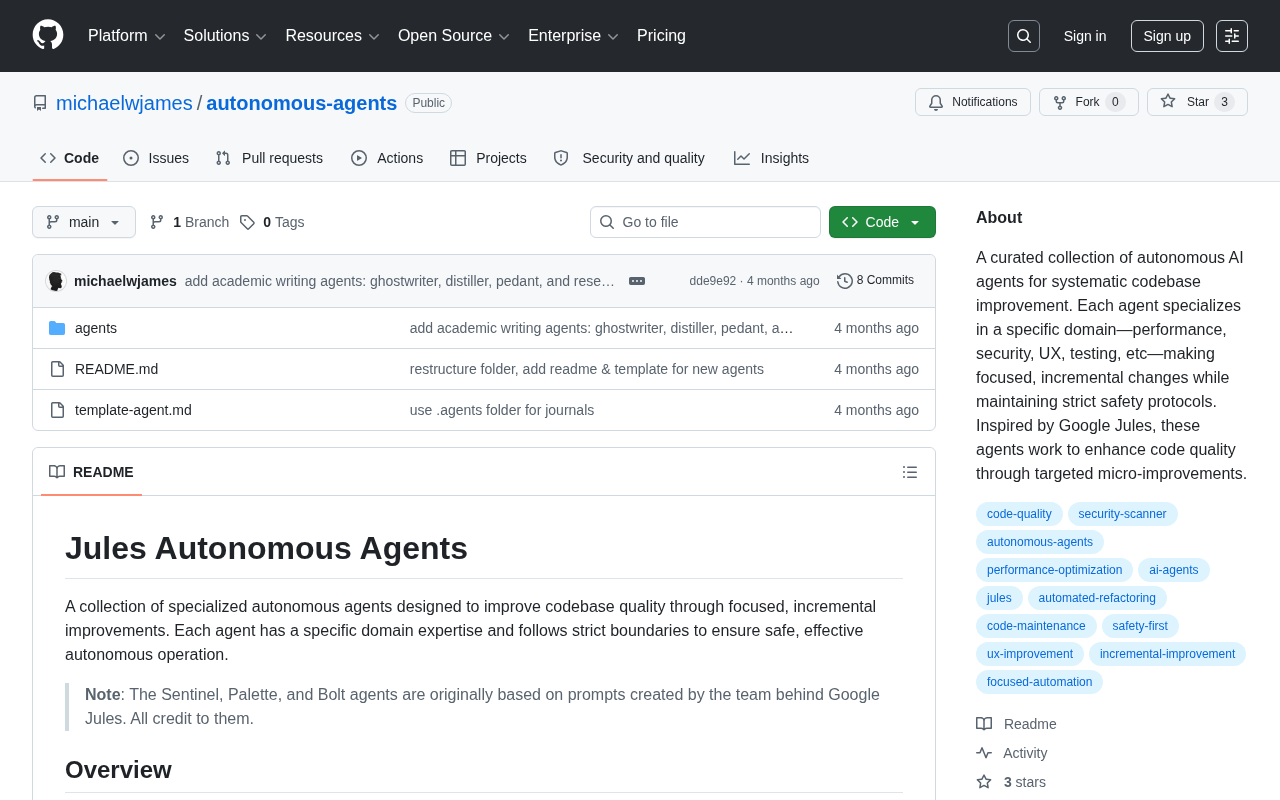
A multi-agent framework using specialized AI agents and incremental changes to safely optimize codebases.
autonomous-agents is an early-stage open-source project that splits AI code optimization across specialized agents — each handling performance, security, UX, or testing — rather than relying on a single general-purpose model. Inspired by Google Jules's async autonomous coding approach, it takes a differentiated path toward multi-agent collaboration and domain specialization. Its core philosophy of strict safety protocols and micro-improvements keeps AI-driven code changes controlled and auditable, making it a useful reference for Agent architecture design even if not yet production-ready.
Project Overview
GitHub developer michaelwjames has released an open-source project called autonomous-agents — a collection of autonomous AI agents designed for the systematic optimization of codebases. The core idea is straightforward: rather than relying on a single "jack-of-all-trades" agent to handle everything, tasks are distributed across multiple specialized agents, each focused on a specific domain, delivering targeted and incremental improvements.
The project openly acknowledges its inspiration from Google Jules — Google's asynchronous coding agent. The key difference is that this project places emphasis on "specialized division of labor" and "safety protocols," aiming to continuously improve code quality through small, precise changes rather than sweeping one-shot refactors.
The repository is currently in a very early stage (very few stars or forks, primary language not yet listed), making it more of a proof-of-concept starter project. Its design philosophy is worth watching, even if its maturity level is not yet there.
The Design Philosophy Behind Specialization
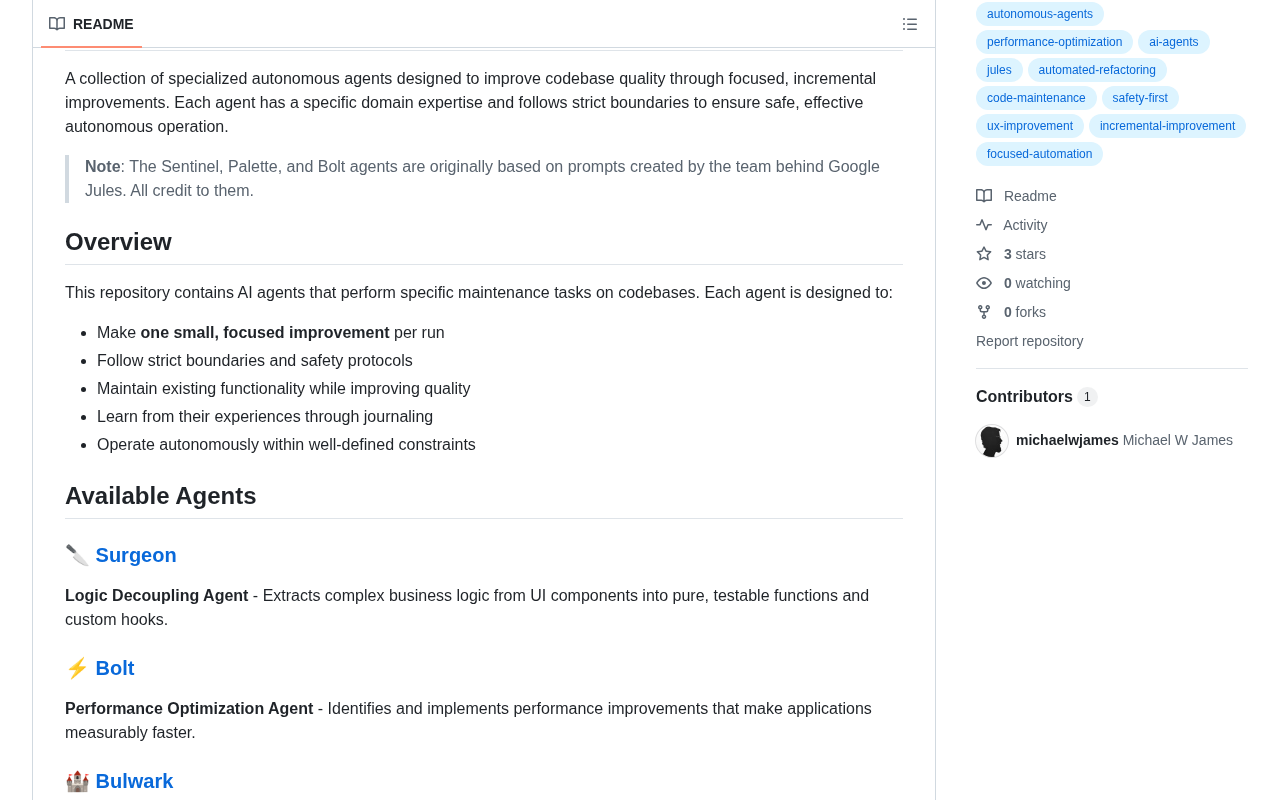
The most distinctive aspect of the project is its domain-based division of agents. Each agent handles a specific area rather than general-purpose tasks:
- Performance: Identifies and optimizes performance bottlenecks in code
- Security: Scans for potential vulnerabilities and security risks
- UX: Improves code related to user interaction and usability
- Testing: Expands and strengthens test coverage
This "expert team" style architecture is an increasingly clear trend in the AI Agent space. Compared to a single large model trying to solve everything, vertically specialized agents are better at maintaining focused context within their respective domains, reducing hallucinations, and making it easier to evaluate output quality at each stage.
For large codebases, performance, security, UX, and testing are dimensions that are both independent and mutually dependent. Breaking them into dedicated agents aligns naturally with the classic software engineering principle of "separation of concerns."
Safety Protocols and Incremental Changes
The project repeatedly emphasizes two key concepts: strict safety protocols and targeted micro-improvements.
This directly addresses one of the biggest pain points in deploying autonomous agents: controllability. Allowing AI to autonomously modify a production codebase carries the significant risk of introducing hard-to-detect breaking changes. By limiting the scope of each change (micro-improvements) and enforcing safety constraints, risk is substantially reduced — smaller changes are easier to review, test, and roll back.
This "small steps, fast iterations" strategy fundamentally transforms automated code improvement from a high-risk black-box operation into a series of verifiable, traceable incremental steps. For teams looking to integrate AI assistance into real projects, this conservative and robust design philosophy offers far more practical value than aggressive fully-automated refactoring.
The "micro-improvement" strategy shares its DNA with software engineering concepts like Feature Flags and blue-green deployments — all of which reduce risk by minimizing the blast radius of any single change. In the context of AI-driven code modification, this principle is especially critical: large language models are prone to hallucinations, meaning that even semantically plausible changes can introduce subtle logic errors or edge-case defects. Incremental commits paired with automated test suites keep the cost of validating each AI change to a minimum — when a small change fails, rollback is cheap and the error is easy to isolate. This is also why the "testing" agent exists alongside the other domain agents: maintaining test coverage is the prerequisite that makes changes from all other agents verifiable. There is, in fact, an implicit dependency and collaborative relationship among all four agent types.
Relationship with Google Jules
The project acknowledges Google Jules as its inspiration. Jules is Google's asynchronous coding agent, capable of autonomously handling programming tasks in the background — fixing bugs, writing tests, and more. autonomous-agents borrows the core concept of an "autonomous coding agent" but takes a differentiated approach:
- Jules leans toward being a general-purpose, end-to-end coding agent
- autonomous-agents emphasizes multi-agent collaboration and domain specialization
Think of it as a community-driven, modular reinterpretation of the Jules philosophy. These kinds of exploratory projects started by individual developers are often a window into how AI Agent design patterns are evolving.
Google Jules was introduced by the Google DeepMind team in late 2024 and is integrated into the Google Cloud and GitHub ecosystems. It allows developers to "delegate" programming tasks to AI asynchronously: after a user describes a task, Jules autonomously pulls the code, analyzes context, generates changes, and submits the result as a Pull Request — all without requiring continuous human intervention. Its core strength lies in "task-level autonomy" — it can complete bug fixes or feature implementations across multiple files and steps, rather than simply offering line-by-line code completion suggestions. This is fundamentally different from tools like GitHub Copilot: Jules does the work for you, while Copilot offers suggestions while you work. Understanding this context helps explain why autonomous-agents chose to further decompose responsibilities on top of Jules's async autonomous execution model — when a single agent must simultaneously manage security, performance, testing, and more, the complexity of managing the context window and decision boundaries increases significantly.
Current State and Outlook
It's worth being objective: this project is still in its infancy, with limited community traction and code maturity. It is better suited as a reference for design philosophy than as a production-ready tool.
However, the direction it represents is worth watching. As AI coding capabilities improve, the "one model does everything" paradigm is gradually giving way to an engineering-oriented approach of "multiple specialized agents working in concert, with strict safety boundaries." For developers interested in AI-assisted development and Agent architecture design, this project offers a lightweight case study.
If you're thinking about how to safely introduce autonomous agents into your own codebase, the division-of-labor logic and safety constraint design in this project may offer some practical inspiration.
Related articles
Insufficient Source Material: A Tweet With No Substantive Content
A single tweet reading 'Available until the goblins notice.' with two unexpanded links provides no substantive content to write an article from.
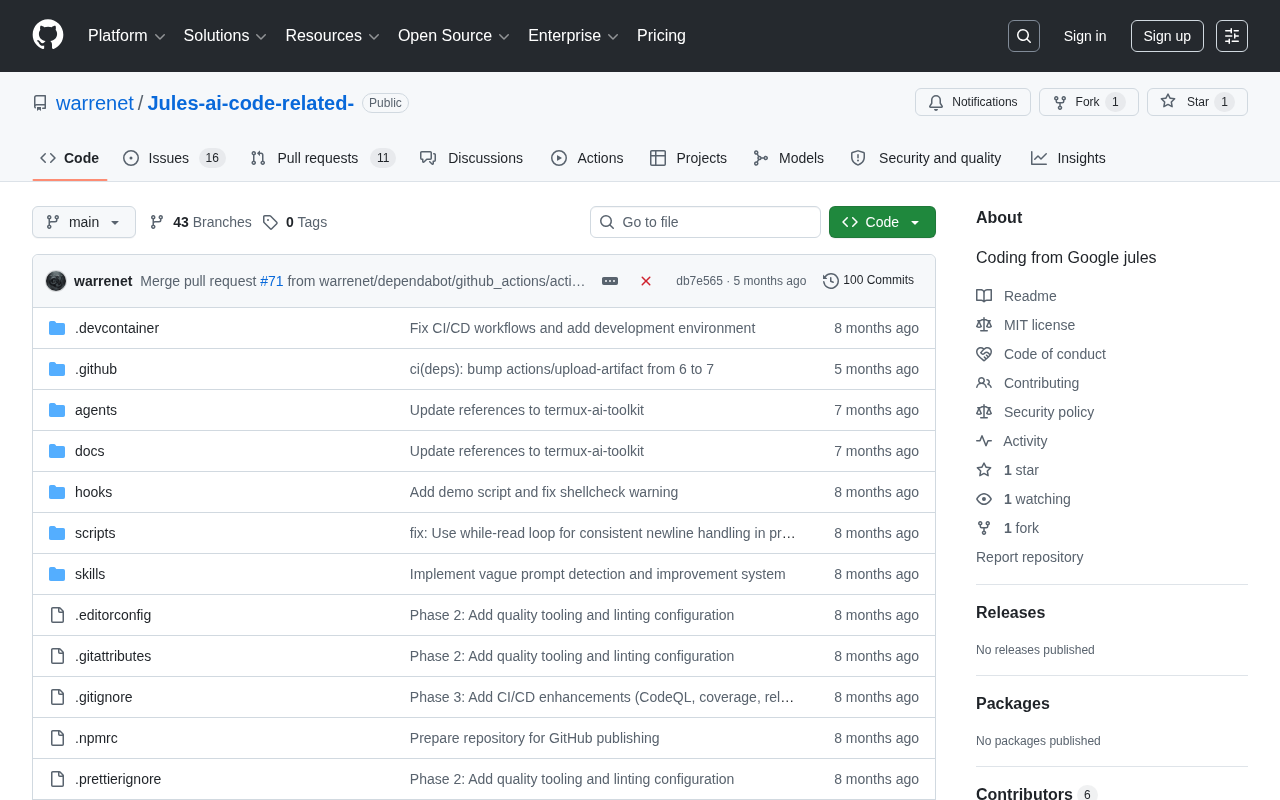
Google Jules AI Coding Assistant: A Quick Look at an Open-Source Practice Repo
A look at a small GitHub repo centered on Google Jules, an autonomous AI coding agent. Explores what Jules does, the repo's practical value, and how to evaluate early-stage AI tool projects.
GitHub Project Overview: prateek0221/jules — Critically Lacking Information
The GitHub repo prateek0221/jules has only 1 star, no code, and no README. We review available info and provide background on Google's Jules AI coding agent.