Autonomous Trucking Gets a Regulatory Break: A Pivotal Turning Point for the Industry

Regulatory barriers ease for autonomous trucking, potentially accelerating commercial freight deployment.
Autonomous trucking has long been seen as more commercially viable than consumer self-driving vehicles, thanks to structured highway conditions and a growing driver shortage. However, a fragmented federal-state regulatory framework has kept full commercialization out of reach. Recent signs of policy easing could reduce legal risk and time-to-market for companies deep in road testing. AI plays a central role across perception, route planning, fleet dispatch, and predictive maintenance, with highway environments offering favorable conditions for algorithm training. Challenges around long-tail edge cases, extreme weather reliability, and public trust remain — but this regulatory signal may mark the start of a broader shift in logistics cost structures.
A Key Regulatory Barrier for Autonomous Trucks Begins to Lift
TechCrunch Mobility, the publication's dedicated vertical covering the future of transportation, has recently turned its attention to a challenge that has long plagued the autonomous freight industry — regulatory hurdles. With signs of a shifting policy environment, self-driving trucks may finally be approaching a new window of opportunity.
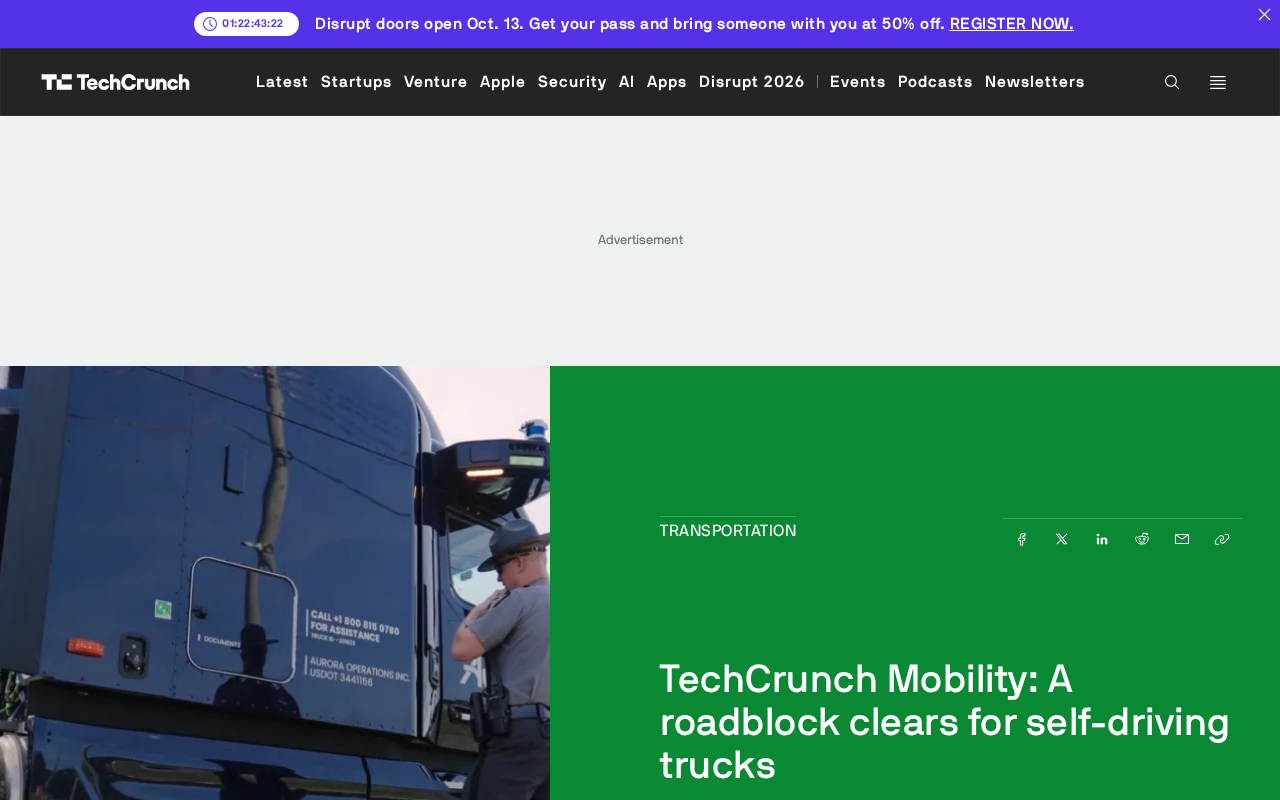
The deployment of autonomous technology in freight has long been viewed as more commercially promising than consumer vehicles. Long-haul highway routes are relatively fixed, freeway driving conditions are more structured, and the growing shortage of truck drivers has made autonomous trucking a high-priority bet for both capital and engineering talent. Yet regulatory and policy uncertainty has remained a sword of Damocles hanging over the entire industry.
Why Regulation Is the Industry's Critical Variable
Unlike consumer autonomous vehicles, heavy-duty trucks operate across multiple states or regions, requiring coordination between federal and local regulations at two distinct levels. A fully loaded self-driving truck traveling at highway speed carries consequences far more severe than a passenger car in the event of an accident. As a result, regulators have been especially cautious about approving testing and commercial deployment.
When a signal like "a roadblock clears" emerges, it means the industry has gained clearer guidance on a path to compliance. For companies that have already invested heavily in road testing, a more transparent policy environment can significantly reduce both the time cost of commercialization and legal risk — and gives investors a more optimistic outlook on returns from this sector.
The U.S. autonomous trucking regulatory framework operates on a classic federal-state dual-track structure. At the federal level, the National Highway Traffic Safety Administration (NHTSA) sets safety standards, while the Federal Motor Carrier Safety Administration (FMCSA) governs commercial trucking operating permits. At the state level, each state may independently legislate testing conditions, insurance requirements, and accident liability. This fragmented landscape means a self-driving truck crossing state lines could face more than a dozen different compliance regimes. "Friendly" states like Texas and Arizona were early movers in opening up driverless commercial testing, creating de facto regulatory havens that attracted major players such as Waymo Via, Aurora, and Kodiak to concentrate their core testing corridors in those regions. The specifics of the latest policy shift are still being disclosed, but by industry convention, this typically signals the federal government issuing clearer operational frameworks for driverless operations, or key states expanding the geographic scope of commercial permits.
The Role of AI in Freight Autonomy
TechCrunch Mobility specifically highlights that AI plays a role in the future of transportation that is "more important than ever." In the context of autonomous trucking, AI is responsible not only for perception and decision-making, but is deeply embedded in route planning, fleet dispatch, energy optimization, and predictive maintenance.
The relative predictability of long-haul highway operations is precisely the kind of environment where current AI autonomous driving systems perform best. Compared to urban roads filled with pedestrians, cyclists, and unpredictable events, closed or semi-closed highway freight corridors offer a far more algorithm-friendly environment for training and validation. This is why many in the industry believe freight may achieve true large-scale driverless operation before consumer vehicles do.
The AI architecture of autonomous trucking systems differs in important ways from passenger vehicle solutions. With payloads often exceeding tens of tons, braking distances are several times longer than a typical car, requiring the system to anticipate obstacles over a much larger time horizon. The extended vehicle body and trailer combination (articulated structure) also introduces unique challenges in turning and reversing control. The dominant technical approach uses LiDAR as the primary sensor, fused with cameras and millimeter-wave radar to build a redundant perception stack, with deep learning models handling real-time environmental understanding and path planning. Predictive maintenance is a standout AI application unique to freight — by continuously collecting sensor data from the engine, tires, and braking systems, models can issue warnings hundreds of kilometers before a failure occurs. This has direct commercial value in reducing operating costs and avoiding cargo delays, and represents a differentiating capability that pure passenger vehicle applications rarely emphasize.
Industry Outlook and Remaining Challenges
While a regulatory easing is certainly a positive signal, full commercial deployment of autonomous trucks still faces multiple significant tests. Handling long-tail edge cases, maintaining reliability in extreme weather, integrating with existing logistics infrastructure, and building public trust in driverless heavy vehicles are all unavoidable challenges.
From an ecosystem perspective, gradual regulatory opening will incentivize more companies to increase investment, driving coordinated maturity across the supply chain — sensors, compute chips, high-definition mapping, and fleet operations platforms. As regulatory frameworks become clearer, it is increasingly evident that autonomous freight is transitioning from a "technology validation" phase to a "commercial deployment" phase.
For practitioners and investors focused on the future of transportation, this policy signal is worth continued attention. It is not just about the success or failure of a single technology approach — it could reshape the entire cost structure and operating model of the logistics industry.
The term "long-tail scenarios" refers to statistically rare edge cases that a system must nonetheless handle correctly — such as non-standard hand signals from construction workers, faded road markings in backlighting conditions, or improvised detour signs after a truck-height barrier is damaged. These scenarios are naturally underrepresented in training data, yet are often high-frequency triggers for real-world accidents. Compared to passenger cars, heavy-duty trucks add physical complexity on top of these long-tail challenges: stability control after a blowout, managing brake fade on a long downhill, and traction management under full load on icy roads. The industry generally addresses this through a "simulation augmentation + real-world closed-loop" strategy — generating large volumes of edge-case scenarios in virtual environments for model training, then using on-road data to continuously calibrate the distribution gap between simulation and reality. This process demands enormous computational investment and time, and is one of the core sources of competitive moat for leading companies.
Related articles

Understanding DeepSeek in 3 Minutes: The Rise from a Quant Hedge Fund to an Open-Source AI Leader
DeepSeek's history in 3 minutes: from High-Flyer Quant's compute build-up to V2's MLA inference cost cuts, V3's $5.576M training bill, R1's open-source global shock, and V4 with a $7B Series A.

Local Creative Writing Model Showdown: Fine-tuned Qwen3.8 27B Wins, DeepSeek v4.1 Underwhelms
Bilibili creator tests seven local creative writing models: Hemingway and HumanLike Chat based on Qwen3.8 27B perform best, DeepSeek v4.1 is plain, Dongfang Shuo ranks last with confused characters. Includes three test prompts, scores, and usage advice.

Liang Wenfeng's Three Big Bets: Why Did DeepSeek Open-Source Its 82% Gross Margin?
Why did DeepSeek open-source DeepInfer, its 82% gross margin inference framework, and then launch a hundred-billion funding round? An analysis of Liang Wenfeng's three big bets and the open-source strategy.