AUV Reinforcement Learning Project Hiring: Unity + PPO Implementation Needs

A Reddit job posting seeks a developer to complete an AUV reinforcement learning project using Unity + Python + PPO, reflecting the industry's shortage of hybrid simulation RL talent.
A Reddit job posting shows that a team needs a developer to complete an AUV reinforcement learning system based on a Unity simulation environment and Python PPO algorithm, representing a "half-finished relay" type of outsourcing. The article breaks down the three major module connections required by the project: Unity environment wrapping, Python-side PPO integration, and the communication bridge, and points out that the uniqueness of the AUV scenario lies in the need for custom underwater dynamics and sensor simulation. The article further analyzes the technical rationality of the AUV + PPO combination, emphasizing that PPO trains stably but the difficulty lies in reward shaping, observation normalization, and curriculum design. For both sides of the outsourcing arrangement, the article recommends clarifying delivery standards and accounting for code audit costs. Finally, it points out that hybrid talent capable of handling both Unity engineering and RL tuning remains scarce, and such skills are more competitive than simply grinding algorithm problems.
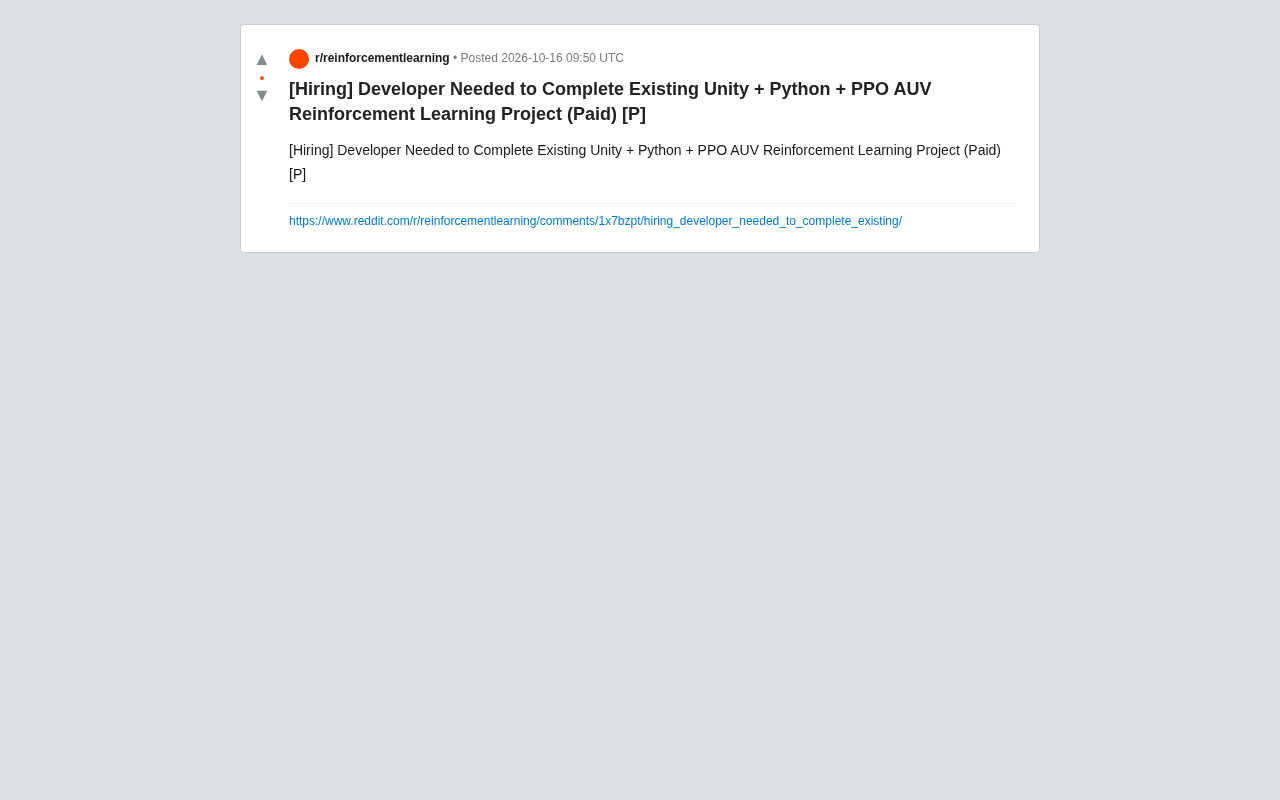
According to a job posting on Reddit, a team is looking for a developer to complete an existing project: an AUV (Autonomous Underwater Vehicle) reinforcement learning system based on a Unity simulation environment with Python-based training, using PPO (Proximal Policy Optimization) as the algorithm. The project is paid and represents a typical "half-finished relay" need—some code and scenes already exist, and an external developer is needed to fill in the training pipeline and deployment chain.
Project Requirements Breakdown: From Unity Scene to PPO Training Loop
According to the job description, the developer's work will most likely involve connecting three modules: environment wrapping on the Unity side, PPO algorithm integration on the Python side, and the communication bridge between them. Unity typically interfaces with Python through the ML-Agents toolkit, but the uniqueness of the AUV scenario lies in the need for custom physics interactions such as underwater dynamics, buoyancy, and current disturbances. If the original project has already built the Unity scene and sensor simulation, the incoming developer's focus should be on correcting the definitions of the observation space and action space so they match PPO's input/output requirements.
Another point worth noting is the phrasing "complete an existing project." This means the codebase may suffer from missing documentation, version conflicts, or training non-convergence. The successor needs to first conduct a code audit to confirm the Unity version, ML-Agents version, Python dependencies, and whether the PPO implementation uses Stable-Baselines3, Ray RLlib, or a custom build. Migration costs vary greatly across different tech stacks.
ML-Agents (Unity Machine Learning Agents) is an open-source toolkit released by Unity for training agents in Unity simulation environments. Its working principle is: the Unity side defines observations, actions, and rewards through Agent scripts, and communicates with an external Python training process via gRPC. The Python side provides reference implementations of algorithms such as PPO and SAC (based on PyTorch), and can also interface with third-party libraries such as Stable-Baselines3 or Ray RLlib through the mlagents-envs interface.
For non-standard scenarios like AUV, ML-Agents' advantage lies in fast environment setup and good visualization, but the default DecisionRequester and VectorObservation mechanisms need to be adapted for continuous action spaces (such as thruster force and rudder angle). A common mistake developers make is directly applying the Behavior Parameters configuration from ML-Agents examples while ignoring the coupling between the underwater physics timestep (Fixed Timestep) and the training step size, which can lead to unstable training or policies that cannot be transferred.
Why the AUV + PPO Combination Deserves Attention
Autonomous control of AUVs is a classic scenario for reinforcement learning deployment. Underwater environments have limited communication and no GPS availability, and traditional control methods perform poorly when dealing with complex ocean currents and dynamic obstacles. PPO, as an on-policy algorithm, trains stably and is relatively insensitive to hyperparameters, making it suitable for first getting a policy working in simulation and then transferring it. There has already been considerable academic work using Unity or Gazebo to build AUV simulations, combined with PPO to train obstacle avoidance, path tracking, and attitude control policies.
This type of outsourcing demand also reflects the state of the industry: there is a huge gap between reinforcement learning projects that "can run a demo" and those that "can stably train a usable policy." Many teams have scenarios and algorithm frameworks, but lack hybrid developers who can handle both Unity engineering and RL tuning. PPO itself is not complicated; what is difficult is reward shaping, observation normalization, and training curriculum design.
PPO (Proximal Policy Optimization) is an on-policy reinforcement learning algorithm proposed by OpenAI in 2017. Its core idea is to limit the difference between the old and new policies during each policy update to avoid training collapse caused by excessively large update steps. Its objective function introduces a clipping operation, restricting the importance sampling ratio to the [1-ε, 1+ε] interval (usually ε=0.2), thereby balancing sample efficiency and training stability.
In AUV scenarios, PPO's advantages are reflected in:
- Insensitivity to reward scale: Compared with off-policy algorithms such as DDPG, PPO has higher tolerance for reward shaping, making it suitable for designing sparse or segmented rewards in underwater environments.
- Support for parallel sampling: Trajectories can be collected simultaneously through multiple Unity environment instances to accelerate training.
- Easy debugging: Metrics such as policy entropy, value loss, and clip ratio can be monitored intuitively, making it easier to judge whether training has converged.
However, note that the on-policy nature of PPO means old samples become invalid after each update, so it places high demands on simulation environment throughput. In underwater dynamics simulation, if Unity's physics stepping is too slow, training efficiency will become a bottleneck.
Risks and Advice for Outsourcing This Type of RL Project
For employers, the pitfalls the successor may face include: whether the physical parameters of the original Unity scene are reasonable, whether the reward function has already been defined, and whether training already has baseline metrics. If this information is not transparent, developers can easily fall into a situation of repeated debugging without being able to deliver. It is recommended to clarify delivery standards before cooperation, such as "after 5 million training steps, the average reward reaches X" or "the success rate exceeds Y% in N test scenarios."
For developers, quoting should include code audit and debugging time. A project that appears to be "only missing the training part" may actually require reconstructing the observation space or replacing the communication layer. The PPO algorithm implementation itself can reuse open-source libraries, but AUV dynamics modeling and curriculum learning design are where the real workload lies. In addition, Reddit job postings usually do not provide detailed technical documentation, so the upfront communication cost cannot be ignored.
Reward shaping is the most time-consuming and experience-dependent part of reinforcement learning projects. In AUV scenarios, a typical reward function may include: positive reward for reaching the target point, negative penalty for colliding with obstacles, penalty for energy consumption, and penalty for attitude stability. The problem is that the weights of these components need repeated adjustment—too large a weight may lead to overly conservative or aggressive policies, while too small a weight may cause the learning signal to be drowned out by noise.
Observation normalization is equally critical. AUV sensor data (such as IMU, depth gauge, and sonar) vary greatly in scale. If fed directly into a neural network, gradient updates will be biased toward dimensions with large numerical values. A common practice is to use running mean/std for online normalization of observations, but care must be taken to freeze the statistics into the inference side after training, otherwise distribution shift will occur during deployment.
Curriculum learning is an effective means of improving training success rates: start with simple scenarios (no currents, single obstacle), then gradually increase difficulty (multiple obstacles, dynamic flow fields), avoiding the agent being unable to obtain effective reward signals in the early stage because the task is too difficult. These engineering details often determine project success more than the PPO algorithm itself.
Talent Demand Trends in AI Engineering as Seen from a Job Posting
Although this post is small, it reflects one facet of current AI deployment: there are more and more simulation + reinforcement learning projects, but talent capable of connecting game engines with Python training pipelines remains scarce. Unity ML-Agents lowers the entry barrier, but industrial-grade projects have requirements for physical accuracy, training efficiency, and policy robustness that far exceed tutorial level. For developers who want to enter this field, mastering PPO tuning, reward design, and Unity physical interaction will be more competitive than simply grinding algorithm problems.
The job posting does not disclose the budget range, project duration, or specific tech stack details. Interested parties need to proactively contact the poster for more information.
One-line Summary
A Reddit job posting seeks a developer to complete an AUV reinforcement learning project using Unity + Python + PPO, reflecting the industry's shortage of hybrid simulation RL talent.
Paragraph Summary
A Reddit job posting shows that a team needs a developer to complete an AUV reinforcement learning system based on a Unity simulation environment and Python PPO algorithm, representing a "half-finished relay" type of outsourcing. The article breaks down the three major module connections required by the project: Unity environment wrapping, Python-side PPO integration, and the communication bridge, and points out that the uniqueness of the AUV scenario lies in the need for custom underwater dynamics and sensor simulation. The article further analyzes the technical rationality of the AUV + PPO combination, emphasizing that PPO trains stably but the difficulty lies in reward shaping, observation normalization, and curriculum design. For both sides of the outsourcing arrangement, the article recommends clarifying delivery standards and accounting for code audit costs. Finally, it points out that hybrid talent capable of handling both Unity engineering and RL tuning remains scarce, and such skills are more competitive than simply grinding algorithm problems.
Related articles

Chain of Thought Isn't Just for AI: How Humans Can Use CoT to Improve Thinking Quality
Chain of Thought isn't just a prompt trick for large models. Starting from a Hacker News discussion, this article analyzes why CoT works for human thinking too, breaks down actionable ways to transfer it, and highlights the key differences between human CoT and machine CoT.
Cloudflare Teams Up with OpenAI: Closi…
Cloudflare Teams Up with OpenAI: Closing the Loop from Vulnerability Discovery to Defense with AI
Cloudflare uses OpenAI Daybreak to investigate security vulnerabilities and generate reviewable remediation plans, while developers use Codex to boost coding efficiency and quality.

Orca Multi-Agent Orchestration in Practice: A Guide to Parallel Collaboration with Claude and Codex
Orca is Stable AI's free open-source agent workbench supporting 34 agents like Claude Code and Codex in parallel. Learn its Git worktree isolation, multi-model orchestration, and mobile management.