Averaged Annealed Markov Chains Achieve the Algorithmic Threshold for Tensor PCA

Spherical Langevin dynamics with annealing and ergodic averaging reaches the Tensor PCA algorithmic threshold from a cold start, overturning the view that local algorithms are inferior.
This article interprets the paper "Averaged Annealed Markov Chains Achieve the Algorithmic Threshold for Tensor PCA, Part II: Langevin Dynamics." Tensor PCA has an information-computation gap: global algorithms like spectral methods and sum-of-squares succeed above the algorithmic threshold, while local algorithms like Markov chains were thought to need higher SNR. The paper proves that spherical Langevin dynamics, via annealing and ergodic averaging, achieves strong recovery from uniform random initialization in polynomial time, with SNR reaching the algorithmic threshold. Combined with Part I's discrete-time results, this shows local Markov chains can succeed from an uninformative cold start up to the threshold, breaking the traditional view and offering new ideas for other information-computation gap problems.
Tensor Principal Component Analysis (Tensor PCA) is a classic problem in statistics and computation, whose core challenge lies in recovering an unknown vector from noisy tensor power observations. For a long time, the academic community widely believed that local algorithms (such as Markov chains) perform far worse than global algorithms (such as spectral methods or sum-of-squares) in Tensor PCA. However, a recent paper, "Averaged Annealed Markov Chains Achieve the Algorithmic Threshold for Tensor PCA, Part II: Langevin Dynamics," overturns this perception, proving that through a clever combination of annealing and ergodic averaging, spherical Langevin dynamics can reach the algorithmic threshold from uniform random initialization in polynomial time. Based on the paper's abstract, this article provides an in-depth interpretation of its background, methods, results, and significance.
The Information-Computation Gap in Tensor PCA
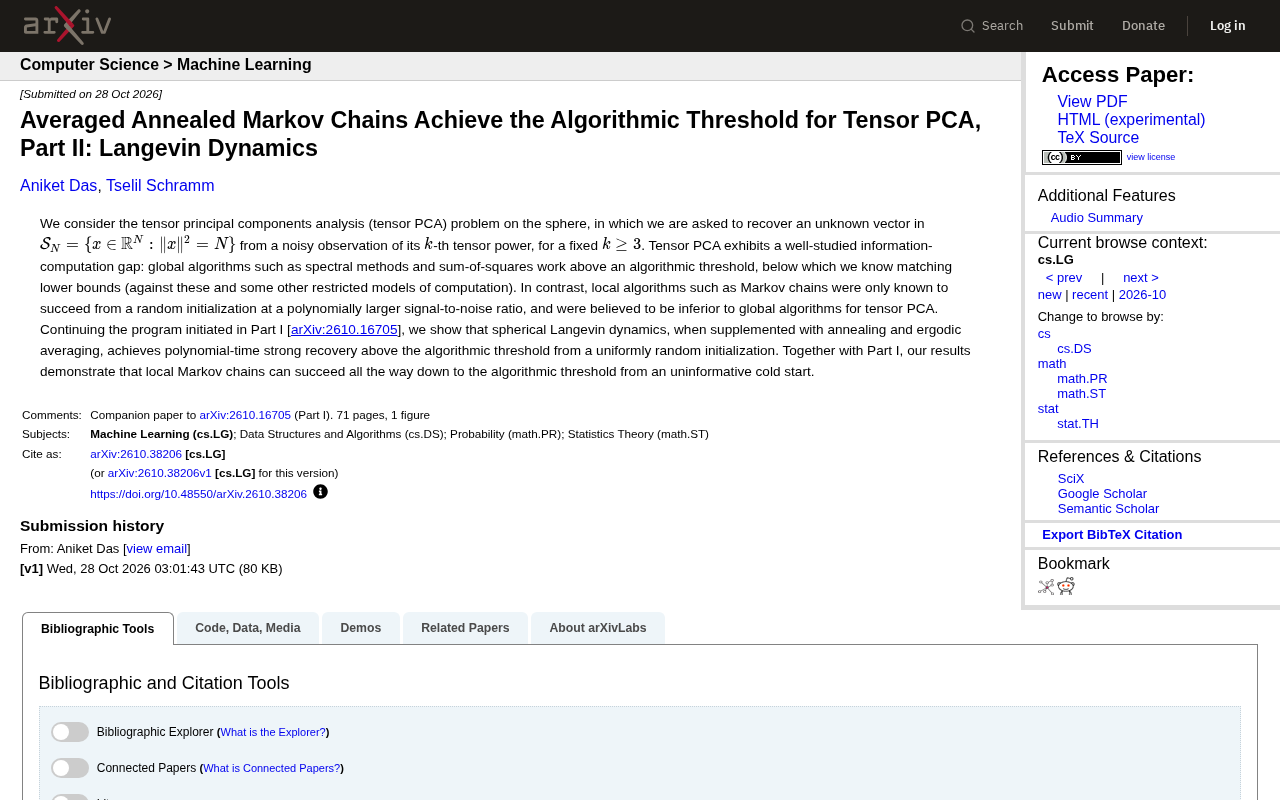
The Tensor PCA problem is defined on the sphere $\mathcal{S}_N={x\in\mathbb{R}^N:\lVert x\rVert^2=N}$: given noisy observations of the $k$-th order tensor power of an unknown vector $x$ (with $k\ge3$ fixed), the goal is to recover $x$. This problem exhibits a well-known "information-computation gap": when the signal-to-noise ratio is above a certain algorithmic threshold, global algorithms such as spectral methods and sum-of-squares can successfully recover in polynomial time; when the signal-to-noise ratio is below this threshold, lower bounds for these algorithms and certain restricted computational models indicate that they must fail. However, for local algorithms such as Markov chains, it was previously known only that a polynomially higher signal-to-noise ratio is required for success under random initialization, and thus they were considered disadvantaged in Tensor PCA.
Information-computation gap refers to the phenomenon in statistical estimation problems where a gap exists between the information-theoretically optimal threshold and the threshold achievable by polynomial-time algorithms. In Tensor PCA, the information-theoretic threshold is lower than the algorithmic threshold: when the signal-to-noise ratio lies between the two, an optimal estimator exists (but may be computationally infeasible), while all known polynomial-time algorithms fail. Such gaps are widespread in high-dimensional statistical problems, such as sparse principal component analysis, the planted clique problem, and community detection, and constitute one of the most central open problems in the field of statistical computation. Understanding the nature of the gap helps characterize the role of computational complexity in statistical estimation.
Spectral methods estimate the unknown vector by constructing some matrix unfolding or moment matrix of the observed tensor and computing its principal eigenvector. Sum-of-squares (SoS) is a hierarchical relaxation method based on semidefinite programming that provides a unified framework for polynomial-time algorithms and can generate corresponding lower bounds. In Tensor PCA, spectral methods succeed when the signal-to-noise ratio is above the algorithmic threshold, and SoS also succeeds at the same threshold, with SoS lower bounds showing that any SoS algorithm fails below this threshold. Local algorithms such as Markov chains were previously believed to require a higher signal-to-noise ratio, so this paper's proof that they reach the threshold is of breakthrough significance.
From Local to Global: The Power of Annealing and Averaging
This paper is a continuation of work following Part I (arXiv:2610.16705). Part I may have already demonstrated the annealing-averaging strategy for discrete-time Markov chains, while this paper focuses on continuous-time spherical Langevin dynamics. The key innovation is the introduction of annealing and ergodic averaging into Langevin dynamics. Annealing gradually lowers the temperature parameter, guiding the dynamics from a "cold start" state of uniform random initialization to gradually focus on high-probability regions; ergodic averaging reduces variance by time-averaging the trajectory, enhancing the stability of the estimate. The combination of the two enables the local algorithm to overcome the adverse effects of initialization and achieve strong recovery above the algorithmic threshold.
Spherical Langevin dynamics is a stochastic differential equation defined on the sphere: $dX_t = \nabla f(X_t)dt + \sqrt{2\beta^{-1}}dW_t$, where $f$ is the objective function (such as the likelihood of Tensor PCA), $\beta$ is the inverse temperature, and $W_t$ is Brownian motion. Its stationary distribution is proportional to the restriction of $\exp(\beta f(x))$ on the sphere. At low temperatures, the stationary distribution concentrates near the maximum of $f$. This dynamics is a continuous-time MCMC sampling method, commonly used in high-dimensional optimization and sampling. Annealing refers to gradually lowering the temperature (increasing $\beta$), causing the distribution to gradually concentrate from uniform to high-probability regions; ergodic averaging refers to the time average of the trajectory $\frac{1}{T}\int_0^T X_t dt$, whose variance is much smaller than that of a single-point estimate, thereby improving recovery stability.
Theoretical Results and Significance
The core conclusion of the paper is that spherical Langevin dynamics with annealing and ergodic averaging, starting from uniform random initialization, can achieve strong recovery in polynomial time, and the required signal-to-noise ratio reaches the algorithmic threshold. Together with the results of Part I, this proves that local Markov chains can start from an uninformative cold start and succeed all the way up to the algorithmic threshold. This finding breaks the traditional view that local algorithms are inferior to global algorithms in Tensor PCA and opens new avenues for the theoretical analysis of local algorithms.
Strong recovery means that the normalized inner product between the estimated vector and the true vector $x$ approaches 1 (or the angle approaches 0), i.e., not only is the signal direction detected, but the entire vector is recovered with high precision. In Tensor PCA, strong recovery typically requires the signal-to-noise ratio to be above some constant, whereas weak recovery only requires a nonzero inner product. The strong recovery result in this paper means that Langevin dynamics above the algorithmic threshold can output an estimate almost parallel to $x$ with high probability, which is a stronger guarantee than signal detection and shows that the annealing and averaging strategy not only identifies the signal direction but also accurately approximates the true vector.
Implications for Algorithm Design and Practice
Although the theoretical analysis targets the specific problem of Tensor PCA, its methodology has broader implications. Annealing and averaging are classic techniques in Markov chain Monte Carlo (MCMC), and this paper shows that they can significantly improve the performance of local algorithms in complex high-dimensional problems. For practitioners, this means that when designing sampling algorithms based on Langevin dynamics, appropriately incorporating an annealing schedule and ergodic averaging may bring substantial improvements. Moreover, this result motivates us to re-examine other problems with information-computation gaps and explore whether local algorithms can likewise reach the threshold.
Future Research Directions
The paper leaves several open questions: for example, can similar analysis be generalized to more general tensor models or different noise structures? How does the optimal design of the annealing schedule affect the convergence rate? Furthermore, the combination of Part I and Part II presents a unified picture of discrete and continuous-time versions, but the discretization error and computational cost in practical implementations still require further study. Exploring these questions will help bridge the theoretical gap between local and global algorithms.
In summary, through rigorous theoretical analysis, this work proves that local Markov chains can reach the algorithmic threshold in Tensor PCA, challenging the entrenched perceptions in the field and providing new ideas for algorithm design in high-dimensional statistical computation.
One-line Summary
Spherical Langevin dynamics combined with annealing and ergodic averaging reaches the Tensor PCA algorithmic threshold from a cold start, overturning the view that local algorithms are inferior.
Paragraph Summary
This article interprets the paper "Averaged Annealed Markov Chains Achieve the Algorithmic Threshold for Tensor PCA, Part II: Langevin Dynamics." Tensor PCA exhibits an information-computation gap: global algorithms such as spectral methods and sum-of-squares succeed above the algorithmic threshold, while local algorithms such as Markov chains were previously believed to require a higher signal-to-noise ratio. The paper proves that spherical Langevin dynamics, by introducing annealing (gradual cooling) and ergodic averaging (time averaging to reduce variance), can achieve strong recovery from uniform random initialization in polynomial time, with the required signal-to-noise ratio reaching the algorithmic threshold. Combined with the discrete-time results of Part I, this proves that local Markov chains can succeed from an uninformative cold start all the way up to the threshold, breaking the traditional view that local algorithms are inferior to global algorithms and providing new ideas for other information-computation gap problems.
Related articles

AI Comic Drama with WorkBuddy from Scratch: A Step-by-Step Skill Pack Installation Guide
Learn how to create AI comic dramas with WorkBuddy from scratch. This guide covers installation, Skill pack import and invocation, plus a script generation demo with manual revision tips to get you through the first step from script to storyboard.

WorkBuddy Agent Runs the Entire GEO Database Mining Pipeline with a Single Prompt
WorkBuddy agent automates GEO database mining: from data search and curation to batch correction, differential analysis, co-expression networks, feature gene screening, and immune infiltration—a single prompt generates a complete bioinformatics report, greatly lowering the barrier to bioinformatics analysis.

PC Memory Wasted? Hacker News Debates Centralized Data Centers
Hacker News users argue that personal computer memory is wasted and should be centralized in data centers, sparking debate on centralized vs. distributed computing resource allocation. This article analyzes the logic behind the claim, the costs of centralization, and new tensions in memory resource allocation in the AI era.