Awesome Agent Skills: Open-Source Library of 1000+ AI Agent Skills Supporting Claude Code, Cursor, and Other Major Tools
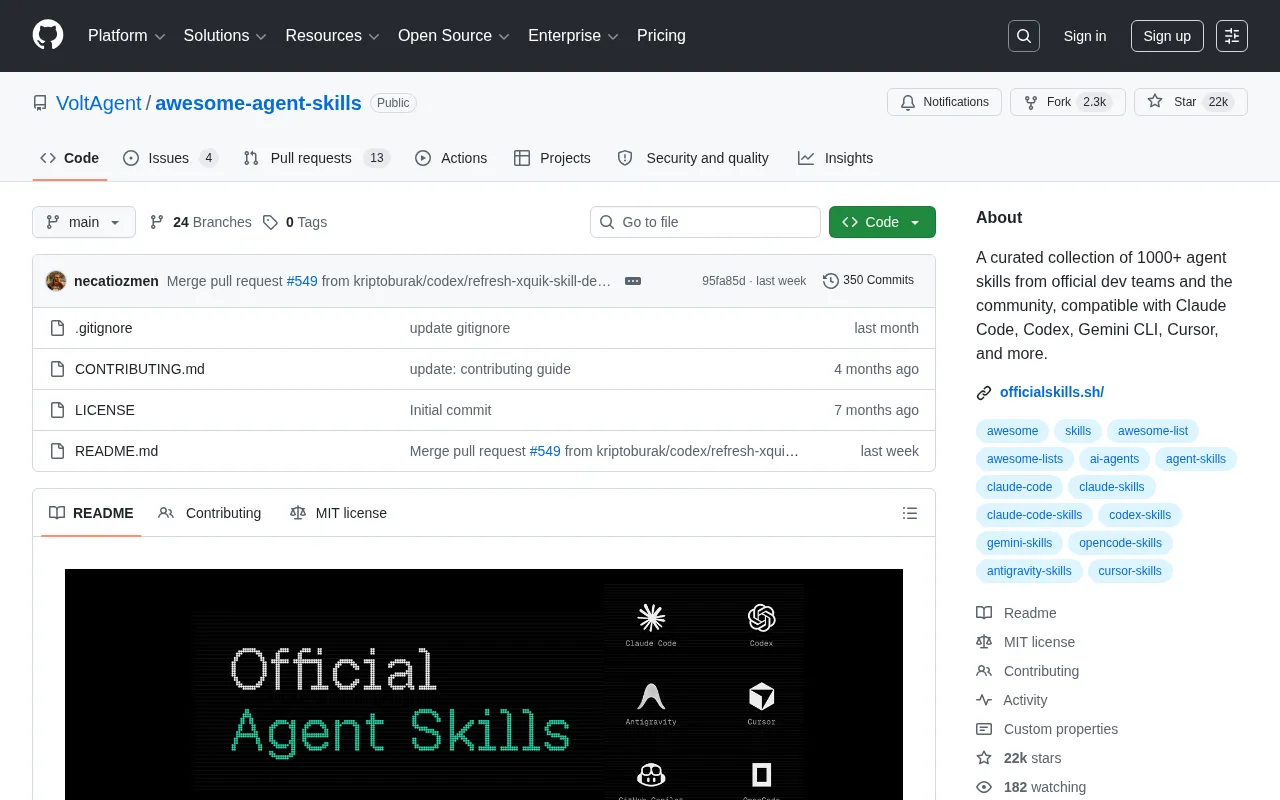
VoltAgent open-sources 1000+ AI agent skills supporting major AI coding tools cross-platform
The VoltAgent team has open-sourced the awesome-agent-skills project on GitHub, collecting over 1,000 AI agent skills with cross-platform compatibility for Claude Code, Codex, Gemini CLI, Cursor, and other major tools. The project has earned 20,000+ Stars and uses a community-driven model for continuous expansion. Agent Skills are more structured and reusable than traditional prompts, providing developers and teams with standardized AI programming best practices.
Project Overview
In an era where AI programming assistants are flourishing, how can we unlock the full potential of tools like Claude Code, Codex, Gemini CLI, and Cursor? The VoltAgent team has open-sourced a project on GitHub called awesome-agent-skills, which aggregates over 1,000 AI Agent Skills contributed by both the official development team and the community, providing developers with a one-stop skill resource library.
Since its launch, the project has quickly garnered enthusiastic response from the developer community, accumulating over 20,000 Stars and 2,100+ Forks, making it one of the fastest-growing AI tool projects on GitHub.
The Evolution of AI Programming Assistants
Between 2024 and 2025, AI programming assistants underwent a transformative leap from simple code completion to autonomous programming agents. Early GitHub Copilot primarily offered line-level code suggestions, whereas today's Claude Code can autonomously execute terminal commands, read and write files, run tests, and iteratively fix issues; Cursor deeply embeds AI into the editor workflow, supporting multi-file context understanding and codebase-level refactoring. This paradigm shift from "completion tool" to "programming agent" has created an urgent need for standardized skill configurations—developers need a systematic way to define and manage AI agent behavior patterns rather than writing prompts from scratch every time.
It's worth noting that VoltAgent itself is an open-source TypeScript AI agent framework, positioned similarly to Next.js in web development—providing structured development paradigms for building AI agent applications. It supports multi-model integration, tool calling, memory management, and other core capabilities. The awesome-agent-skills project is a key practical component of its ecosystem, transforming the framework's abstract capabilities into concrete skill resources that developers can use directly.

What Are Agent Skills? A Detailed Explanation
Core Concept
Agent Skills can be understood as "capability plugins" for AI programming assistants. Each Skill defines a set of specific behavior patterns, prompt templates, or workflows that enable AI agents to accomplish specific types of tasks more precisely.
For example: a "Code Review" skill contains specific instructions for security vulnerability patterns to watch for, performance optimization suggestions, and code style checks during reviews; while an "API Design" skill covers professional knowledge including RESTful best practices, error handling conventions, and documentation generation.
Technical Implementation Mechanism
The underlying implementation of Agent Skills relies on configuration protocols provided by each AI tool. For instance, Claude Code loads project-level instructions through CLAUDE.md files, Cursor defines behavior specifications through .cursorrules files, and Codex supports injecting skill context through system prompts. These configuration files are essentially structured meta-prompts that are loaded into the model's context window during session initialization, persistently influencing the AI agent's behavior patterns throughout the entire working session. Unlike temporary prompts, these meta-prompts exist as "system-level instructions" throughout the conversation context, ensuring the AI agent maintains consistent behavioral standards across multiple interaction turns.
Key Differences Between Agent Skills and Traditional Prompts
Compared to simple prompts, Agent Skills are more structured and reusable. They typically include:
- Context Definition: Clearly specifying the scenarios and prerequisites where the skill applies
- Behavior Specifications: Detailed execution steps and decision logic
- Output Format: Standardized result presentation
- Error Handling: Strategies for handling exceptional situations
This structured design allows skills to be shared across different projects and teams, unlike scattered prompts that are difficult to manage and reuse. From a software engineering perspective, Agent Skills are to AI agents what design patterns are to object-oriented programming—they encapsulate proven best practices into standardized, repeatable solutions.
Which AI Programming Tools Are Supported? Cross-Platform Compatibility Overview
One of the project's biggest highlights is its cross-platform compatibility. Currently supported AI programming tools include:
| Tool | Developer | Type |
|---|---|---|
| Claude Code | Anthropic | Command-line programming assistant |
| Codex | OpenAI | Code generation tool |
| Gemini CLI | Command-line AI assistant | |
| Cursor | Cursor Inc. | AI code editor |
Technical Challenges of Cross-Platform Compatibility
Achieving cross-platform compatibility is not simply a matter of format conversion. The underlying models and configuration formats of different AI programming tools have significant differences: Claude Code is based on Anthropic's Claude model family and uses XML-tag-style prompt structures; Codex is based on OpenAI's models and prefers natural language instructions; Gemini CLI uses Google's Gemini model with unique advantages for multimodal input. Achieving cross-platform compatibility requires abstract skill design, separating core logic from platform-specific format adaptation layers. This means that the core intent and behavior specifications of each skill are unified, but when actually deployed to different tools, they are converted through an adaptation layer into configuration formats that the specific tool can understand.
This broad compatibility means developers don't need to repeatedly write skill configurations for different tools—one set of Skills can be seamlessly used across multiple platforms, significantly reducing migration costs.
A Community-Driven Open-Source Ecosystem
Diverse Skill Sources
The 1,000+ skills in the project come from two main categories:
- Official Development Team Contributions: High-quality skills that have undergone rigorous testing and validation, covering common development scenarios
- Community Contributions: Practical experience summaries from developers worldwide, covering various niche domains and specialized needs
Rapid Growth Metrics
Judging from the project's Fork count (2,161), a large number of developers are not only using these skills but actively participating in contribution and customization. This community-driven model ensures the skill library continues to expand, covering an ever-growing range of development scenarios.
The community-driven model adopted by awesome-agent-skills continues the successful approach of the "awesome-list" series of projects on GitHub. These projects accept community contributions through Pull Request mechanisms, with maintainer teams conducting quality reviews. The 20,000+ Star growth rate is a phenomenal performance in GitHub history—for reference, many well-known awesome-series projects typically take years to accumulate similar Star counts. The high Fork rate (approximately 10:1 Star-to-Fork ratio) indicates that developers are not just bookmarking but actively engaging in secondary development and customized deployment based on the project—this deep participation is an important indicator of an open-source project's actual impact.
Practical Value: Who Should Use This?
Individual Developers
- Quickly access verified best practices, saving time on trial and error
- Reduce repetitive work in configuring AI assistants
- Learn how other developers efficiently use Claude Code, Cursor, and other tools
Teams and Enterprises
- Standardize AI tool usage norms and specifications across the team
- Consolidate team knowledge into reusable skill assets
- Lower the AI tool onboarding barrier for new members and accelerate team collaboration
Future Outlook: Development Trends for Agent Skills
As AI programming assistants evolve from "auxiliary tools" to "collaborative partners," the importance of Agent Skills will continue to grow. Foreseeable trends include:
- Enhanced Skill Orchestration: Supporting combinations of multiple skills to complete complex workflows. Skill Orchestration is a cutting-edge direction in the AI agent domain, closely related to the currently hot Agentic Workflow concept. In Agentic Workflows, AI agents no longer execute single tasks but autonomously plan, decompose, and coordinate the execution of multiple subtasks. Skill orchestration is the key infrastructure for realizing this vision—by combining atomic skills according to dependency relationships and execution logic, AI agents can complete end-to-end complex workflows such as "analyze requirements → design architecture → generate code → write tests → execute deployment."
- Vertical Domain Deepening: More specialized skills emerging for specific industries and technology stacks, such as compliance code review in fintech, data privacy handling in healthcare, resource optimization for embedded systems, and other niche directions
- Ecosystem Marketization: Formation of skill trading and sharing platforms similar to plugin stores, where developers can publish, rate, and subscribe to high-quality skills, and excellent skill creators may receive economic returns
For developers looking to improve AI programming efficiency, awesome-agent-skills is a resource library worth bookmarking. Whether you use Claude Code, Cursor, or other AI programming tools, you can find practical solutions to boost your productivity.
Key Takeaways
- VoltAgent's open-source project aggregates 1,000+ AI agent skills, earning 20,000+ Stars on GitHub
- Supports cross-platform compatibility with major AI programming tools including Claude Code, Codex, Gemini CLI, and Cursor
- Skills come from both the official development team and community contributions, forming a community-driven continuously growing ecosystem
- Agent Skills are more structured and reusable than simple prompts, including context definitions, behavior specifications, and error handling
- Provides standardized AI tool usage best practices for both individual developers and teams
Related articles
 Product Reviews
The Programmer's Desk Setup Guide: Building a Workspace That Feels Like Home
Discover how programmers build productive, comfortable workspaces. From multi-monitor setups to ergonomic design, explore the desk philosophy that drives focus and flow.
 Product Reviews
Qoder vs Cursor Real-World Comparison: Which $20/Month AI IDE Is Better?
Hands-on comparison of Qoder vs Cursor AI IDEs: Agent autonomy, human interaction count, and architecture decisions. Qoder needed only 2 interactions vs Cursor's 8.
 Product Reviews
Cursor Cloud Agent Demo: Eliminating Bottlenecks Across the Entire Software Development Lifecycle
Deep analysis of Cursor's Cloud Agent demo showing how cloud VMs, automated test artifacts, and a full-chain control plane systematically eliminate human bottlenecks across the software development lifecycle.