awesome-LLM-resources: A Comprehensive LLM Collection with 8000+ Stars, Covering Multimodal, Agent, MCP, and 11 Major Domains
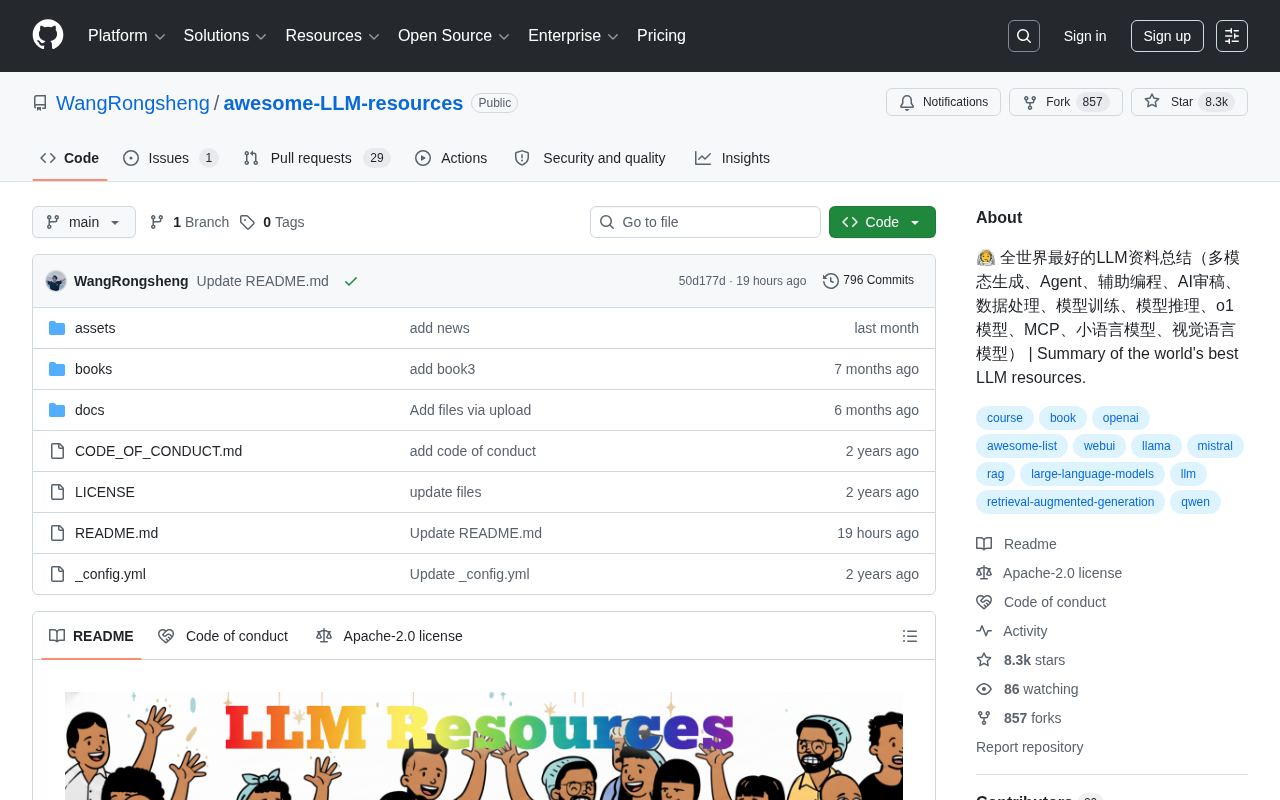
A curated GitHub repo with 8000+ Stars covering 11 major LLM domains from Agents to MCP.
awesome-LLM-resources is a GitHub repository with 8,215 Stars that curates the best LLM resources across 11 core domains: multimodal generation, AI Agents, AI-assisted coding, AI paper review, data processing, model training, model inference, o1 reasoning models, MCP protocol, small language models, and vision-language models. With zero lines of code, it maps the entire LLM technical evolution from 2023-2025.
awesome-LLM-resources: A Comprehensive LLM Collection with 8000+ Stars, Covering Multimodal, Agent, MCP, and 11 Major Domains
When a developer claims to have curated "the world's best LLM resources," you'd assume they're exaggerating—until 8,000+ Stars prove them right. The GitHub project we're looking at today, awesome-LLM-resources, is exactly that kind of repo: not a single line of code, yet wildly popular across the developer community as a comprehensive LLM resource collection.
How Popular Is This LLM Resource Repository?
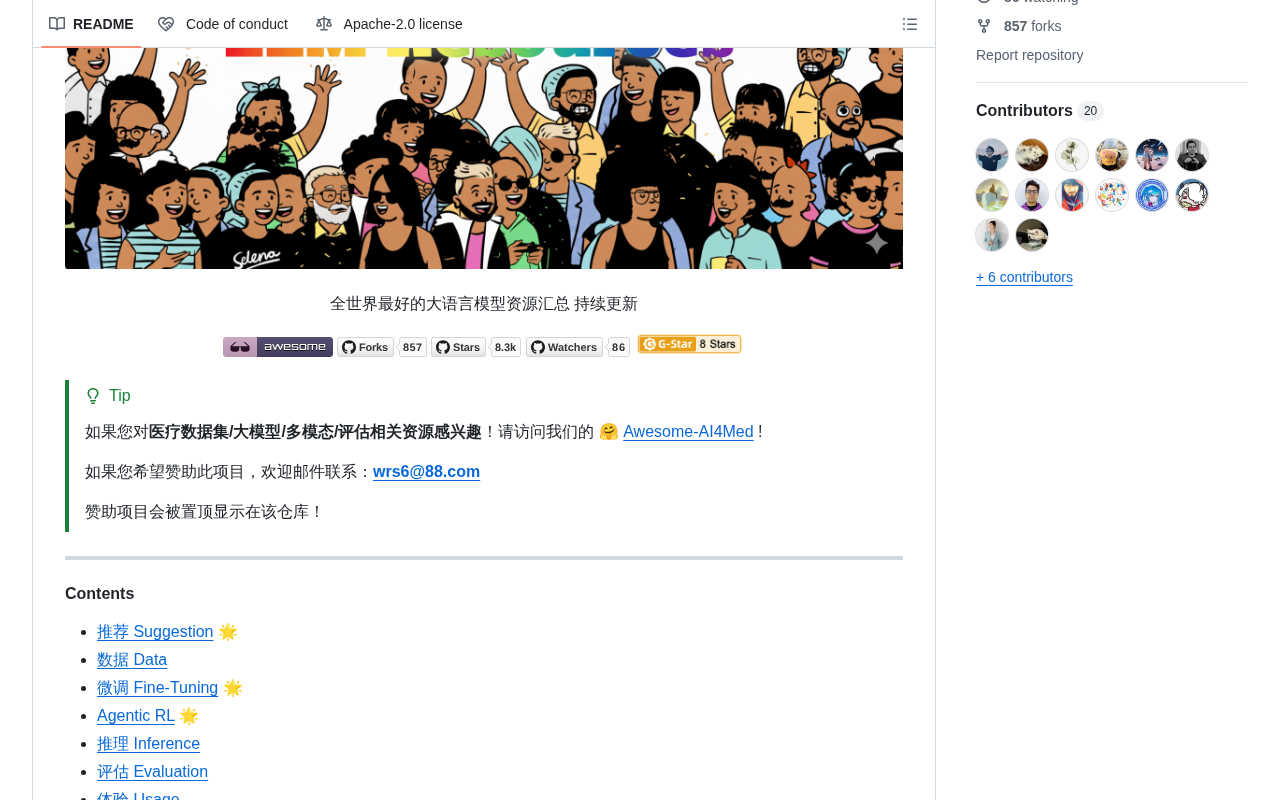
awesome-LLM-resources, maintained by developer WangRongsheng, has a straightforward positioning—"the world's best LLM resource collection." As of now, the repository has earned 8,215 Stars and 840 Forks, firmly placing it among the top LLM resource curation projects.
What's most interesting is that this repository has no specific programming language—it's a purely curated resource project. 8,215 Stars, 840 Forks, zero lines of code—this is probably one of the most successful "no-code" projects on GitHub. WangRongsheng has proven a simple truth through action: In the AI era, people who can organize information well are more popular than people who can write code.
It's like how you don't need to open your own restaurant—just publish a Michelin Guide and foodies worldwide will follow you. While "the world's best LLM resource collection" sounds like an e-commerce seller's self-description, the repo genuinely covers every nook and cranny of the LLM field.
In an age of information overload, what's truly scarce isn't knowledge itself, but someone who helps you make sense of it all.
Covering 11 Core Domains: A Full-Course Feast of the LLM Landscape
This repository's coverage is like a full-course banquet of the LLM field—eleven main dishes, none missing. Let's go through them one by one:
Multimodal Generation
This covers content generation across multiple modalities including text, images, and video. Simply put, it's about making AI not just write articles, but also create artwork and produce videos. The technologies behind products like DALL·E, Midjourney, and Sora all fall into this category. The core challenge of multimodal AI is understanding semantic relationships across different modalities—for example, when you say "a cat wearing a suit in a meeting," the model needs to simultaneously understand the textual meaning and the corresponding visual expression.
Agent (AI Agents)
AI Agent is one of the hottest directions right now. Unlike traditional question-and-answer interactions, Agents can autonomously perceive their environment, make plans, invoke tools, and execute complex tasks. Tell it "analyze this sales data and generate a report," and it will independently decide to read the file, run analysis, create charts, and write the report—all without your intervention. AutoGPT and LangChain Agents are representative projects in this space.
AI-assisted Coding
One of the most successful commercial applications of LLMs. Tools like GitHub Copilot, Cursor, and Windsurf have profoundly changed how programmers work. Writing code has shifted from "typing line by line" to "describing requirements for AI to generate, while you review and adjust."
AI Paper Review
An emerging and controversial direction. Some academic conferences are already exploring AI-assisted peer review, though it has sparked considerable discussion about review quality and academic integrity. It's particularly interesting to see AI-assisted coding and AI paper review side by side—one helps you write code, the other helps you review papers, neatly addressing the two major pain points of programmers and researchers.
Data Processing
This covers data cleaning, annotation, augmentation, and other steps in LLM training and application. Don't underestimate this area—"garbage in, garbage out" is an iron law in AI, and data quality directly determines the model's upper limit.
Model Training
This encompasses pre-training, fine-tuning, RLHF (Reinforcement Learning from Human Feedback), and other training techniques. RLHF is one of the key technologies behind ChatGPT's success—first teach the model to speak, then have humans tell it what's appropriate and what isn't, and finally use reinforcement learning to "stamp" human preferences into the model. In recent years, simpler alternatives like DPO (Direct Preference Optimization) have also been gaining traction.
Model Inference
Inference acceleration, quantization, deployment, and other optimization techniques. Training a model is just the first step—making it run fast, at low cost, and ready for production is the real engineering battle.
o1 Model
OpenAI's reasoning model series launched in September 2024. Unlike previous GPT models, o1 performs internal "chain-of-thought" reasoning before answering—spending more time thinking carefully in exchange for higher accuracy. On hardcore tasks like math, coding, and scientific reasoning, o1's performance far exceeds GPT-4o. This approach of "trading inference time for accuracy" is considered a new paradigm for improving LLM capabilities.
MCP (Model Context Protocol)
An open standard protocol proposed by Anthropic in November 2024. Think of MCP as the "USB port" of the AI world—just as USB lets various devices connect to computers in a unified way, MCP lets AI models connect to databases, APIs, file systems, and other external resources in a standardized manner. Applications like Claude Desktop and Cursor are already using it. MCP's emergence shows that everyone has finally realized: Having a smart brain isn't enough—you also need a unified interface to connect with the outside world.
Small Language Models
Lightweight models with parameters ranging from hundreds of millions to several billion. Compared to their massive counterparts with hundreds of billions of parameters, small models can run locally on phones and laptops—lower cost, faster speed, better privacy. Microsoft's Phi series and Google's Gemma series are prime examples. The inclusion of small language models shows that the field has finally sobered up from the "more parameters is always better" arms race—after all, not everyone needs to drive an aircraft carrier to the grocery store; sometimes an electric scooter is enough.
Vision-Language Models
Multimodal models that can simultaneously understand images and text. Give it an image, and it can describe the content, answer questions, and perform reasoning. GPT-4V, LLaVA, and Qwen-VL all belong to this direction.
Tracing LLM's Technical Evolution Through This Directory
The most valuable aspect of this resource list isn't just the materials themselves, but how it inadvertently maps out the technical evolution of the LLM field from 2023 to 2025:
- Phase 1: Making models speak like humans (Data Processing + Model Training + RLHF)
- Phase 2: Making models do real work (AI-assisted Coding + AI Paper Review + Inference Optimization)
- Phase 3: Making models work independently (Agent + MCP Tool Integration)
- Phase 4: Making models think deliberately (o1 Reasoning Models)
- Parallel tracks: Making models smaller and faster (Small Language Models) + Making models understand the world (Vision-Language Models + Multimodal Generation)
The trajectory is crystal clear: from language capability to practical application, from passive response to proactive execution, from pursuing scale to pursuing efficiency.
What Are "Awesome" Repositories? Why Are They So Popular?
If you're new to GitHub, you might wonder why so many projects are named "awesome-xxx." This is actually a GitHub community tradition—repositories prefixed with "awesome-" are dedicated to curating quality resources in a specific technical domain, including papers, tools, tutorials, and open-source projects.
This tradition started in 2014 when Sindre Sorhus created the awesome repository, which is itself a "list of awesome lists." Today, there are thousands of awesome repositories on GitHub covering virtually every technical domain, and they've become an essential gateway for developers to quickly grasp the full landscape of any field.
Final Thoughts
In the world of LLMs, the most impressive person isn't the one who builds the wheels, but the one who lays all the wheels out in front of you and helpfully tells you which wheel goes with which car. awesome-LLM-resources is the "IKEA instruction manual" of the AI era—except what you're assembling isn't furniture, but your cognitive framework of the entire LLM landscape.
Whether you're a beginner trying to figure out what directions LLMs offer, or a veteran looking to fill gaps and see what you've missed, this repository is worth bookmarking. After all, in a field where new papers, models, and frameworks emerge every single day, having someone maintain a good index for you is already half the battle won.
Repository: https://github.com/WangRongsheng/awesome-LLM-resources
Related articles
Deep Dive into AI Agent Skill Design: …
Deep Dive into AI Agent Skill Design: Engineering Practices from Anthropic and Perplexity
A deep dive into Skill design philosophy from Anthropic's Claude Code team and Perplexity's Agent team, covering the Tax Test, Gotchas Flywheel, progressive disclosure, and Eval-First practices for building high-quality AI Agent skill systems.
Deep Dive into OpenAI's Official GPT-5…
Deep Dive into OpenAI's Official GPT-5.6 Prompting Guide: The Shift from Manual to Automatic
A deep dive into OpenAI's official GPT-5.6 Sol prompting guide: conciseness-first, outcome-oriented design, autonomy boundaries, tool routing, and reasoning intensity tuning.
 Deep Dives
Deep Dive into How OpenClaw (Open-Source Crayfish) AI Agent Works
Deep analysis of OpenClaw AI Agent internals: System Prompt, tool calling, SubAgents, Skill system, memory, and Context Engineering explained.