AWS Kiro Deep Dive: Spec-Driven Development vs Cursor — Which One Is Right for You?

Amazon launches AI IDE Kiro, challenging Cursor with spec-driven development
Amazon released Kiro, a VS Code-based AI coding tool whose core selling point is "spec-driven development" — a three-step workflow of requirements definition, design documents, and implementation plans that addresses the code quality chaos in AI programming. Leveraging its massive investment in Anthropic, Kiro has a structural advantage on Claude API costs, targeting the market opportunity created by Cursor's pricing controversy and aiming to funnel developers into the AWS ecosystem. The product shows significant potential but still needs polish.
Amazon quietly released its own AI IDE — Kiro. This VS Code-based editor positions "Spec-driven Development" as its core selling point, attempting to carve out a niche among the crowded field of AI coding tools like Cursor, Windsurf, and Firebase Studio. The Fireship channel did a deep dive into it, and this article summarizes Kiro's core features, the industry context, and whether it can actually challenge Cursor's dominance.
The AI IDE Battle: Why Big Tech Is Pouring Money In
The AI coding tools space is witnessing a massive capital frenzy. Just weeks ago, OpenAI planned to acquire Windsurf (another VS Code-fork AI IDE) for billions of dollars, but the deal ultimately fell through. Google then stepped in, poaching Windsurf's core talent for $2.4 billion, while Cognition (the creators of Devon) acquired the remaining assets in an all-stock transaction.

The logic behind these sky-high deals traces back to VS Code's open-source ecosystem. VS Code (Visual Studio Code) is a code editor open-sourced by Microsoft in 2015 under the MIT license. Its open-source nature allows any team to build their own editor product on top of its core codebase (known as VSCodium or Code-OSS), while inheriting VS Code's massive plugin ecosystem and user habits. Cursor, Windsurf, Kiro, and other AI IDEs all adopt this strategy — essentially integrating AI capabilities into a VS Code shell, which dramatically reduces development costs and user migration barriers. This also explains why major tech companies are willing to pay premium prices for these "VS Code forks" — they're not buying the editor itself, but the developer communities that have already been educated and formed usage habits. Whoever can lock developers into their ecosystem controls the gateway to the next generation of software development.
In this competition, Anthropic has captured the largest developer share with its Claude Code CLI tool — its annual revenue skyrocketed from under $1 billion last year to over $4 billion this year. Anthropic was founded in 2021 by former OpenAI Research VP Dario Amodei and his sister Daniela Amodei, focusing on AI safety research. Since 2023, Amazon has made strategic investments in Anthropic, with cumulative commitments of up to $8 billion, deeply integrating Claude models into AWS's Bedrock platform. This investment relationship gives Amazon a structural advantage on Claude's API call costs — as the largest infrastructure provider and shareholder, Amazon can access Claude's compute resources at costs far below market rates.
Cursor's Pricing Dilemma: The Opening Kiro Needed
To understand Kiro's strategic intent, you first need to look at the structural problem Cursor is facing.
While Cursor delivers an excellent experience, it's essentially a "middleman" for Claude — developers want to use Claude to write code, and Cursor needs to add a margin on top to sustain operations. The fragility of this business model was recently exposed: Cursor attempted to adjust its pricing strategy, causing some users' "vibe coding" bills to spike dramatically, ultimately forcing a public apology.
"Vibe Coding" is a term coined by OpenAI co-founder Andrej Karpathy in early 2025, describing a programming approach where developers rely entirely on AI-generated code with little to no understanding of the underlying implementation — users simply describe the desired functionality, and AI handles all code details. This approach dramatically lowers the barrier to software development, spawning numerous solo developers and non-technical founders. However, vibe coding also reveals obvious limitations: as projects scale or require maintenance, AI-generated code often lacks consistent architectural design, and technical debt accumulates rapidly. It was precisely this "fast but messy" usage pattern that caused some users' API call volumes to far exceed expectations, triggering Cursor's pricing controversy.

This is exactly when Amazon launched Kiro. It's also powered by Claude Sonnet 4.0, but since Amazon is a major Anthropic shareholder, Kiro has a natural cost advantage — for Amazon, Kiro's real goal is to funnel developers into the AWS ecosystem, with Claude's call costs being just part of the customer acquisition cost. Based on initial pricing, users can get more Claude usage at a lower price. Amazon choosing to release Kiro right after Cursor's pricing debacle is hard to call "pure coincidence."
Kiro's Core Differentiator: Spec-Driven Development Explained
Unlike Cursor and similar tools that "let AI generate code directly," Kiro employs a more structured AI coding workflow called Spec-driven Development.
Spec-driven development isn't a brand-new invention by Kiro — it has deep roots in software engineering theory. It descends from the intellectual traditions of Behavior-Driven Development (BDD) and Test-Driven Development (TDD) — clearly defining system behavior and acceptance criteria in natural language or structured formats before writing any code. The traditional software engineering principle of "Design First" has long been proven to significantly reduce rework costs in large projects: according to McKinsey research, approximately 45% of defects in software projects originate from ambiguous definitions during the requirements phase. Kiro combines this philosophy with AI code generation, attempting to address the most critical pain point of current AI coding tools: without explicit constraints, AI tends to generate code that appears reasonable but is architecturally chaotic — the so-called "slop" problem.
The entire workflow is divided into three phases:
Step 1: Requirements
Kiro guides developers to first define user stories and acceptance criteria in a requirements.md file, rather than immediately asking AI to write code. This step ensures the development direction is clear and prevents the AI from going off track.
Step 2: Design Document
Once requirements are confirmed, Kiro automatically generates a design document detailing component structure, testing strategies, error handling approaches, and other implementation details. This step is equivalent to a technical design review in traditional software engineering.
Step 3: Implementation Plan
The first two documents are merged to generate a concrete implementation plan, with each task clearly indicating what code the AI should write. Developers can step through execution in the IDE, progressing methodically according to plan.
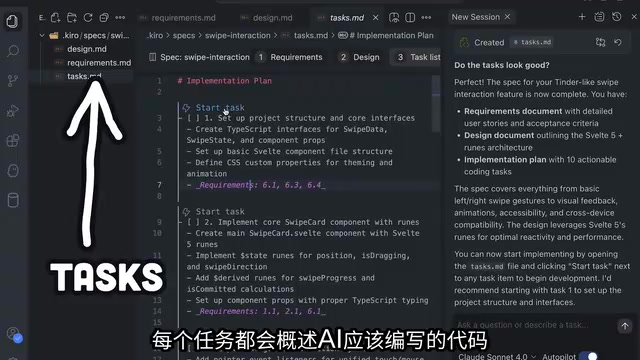
The core philosophy of this approach is to prevent AI from generating large volumes of low-quality code in one shot (known in the industry as "slop"). While the overall process is slower than Cursor, for building production projects or collaborating in teams, this "think it through before you build" approach is clearly more reliable.
Hands-On Experience: Strengths and Weaknesses Coexist
Based on Fireship's actual experience, Kiro's current performance can be summarized as "significant potential, insufficient polish":
What it does well:
- Beautiful UI design; the overall visual experience ranks among the best in AI IDEs
- The spec-driven development workflow is naturally suited for enterprise-level development scenarios
- Currently completely free to use, with zero cost to experiment
- The team has stated that multiple AI models will be supported in the future, not locked to Claude
What needs improvement:
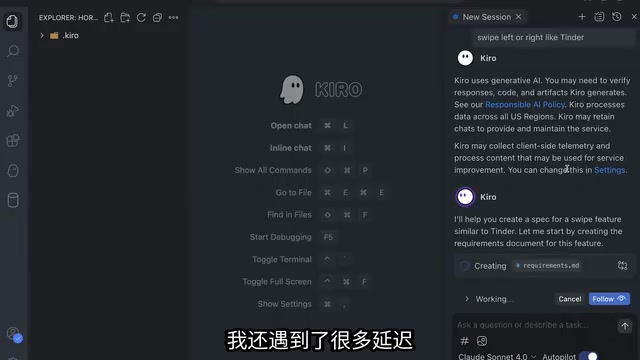
- Overall response speed is sluggish; operational fluidity doesn't match Cursor
- Missing some practical features that Cursor already has, such as chat checkpoints
- Server overload causes frequent delays, which is common for early-stage products
- Still a closed-source product with model selection limited to Claude only
Industry Landscape: Open Source Is Changing the Game
Notably, around the same time Kiro launched, a Chinese team released Kimi K2 — an open-weight agentic coding model whose performance already approaches Claude's level. Kimi K2 was developed by Moonshot AI (月之暗面).
Related articles
 Product Reviews
The Programmer's Desk Setup Guide: Building a Workspace That Feels Like Home
Discover how programmers build productive, comfortable workspaces. From multi-monitor setups to ergonomic design, explore the desk philosophy that drives focus and flow.
 Product Reviews
Qoder vs Cursor Real-World Comparison: Which $20/Month AI IDE Is Better?
Hands-on comparison of Qoder vs Cursor AI IDEs: Agent autonomy, human interaction count, and architecture decisions. Qoder needed only 2 interactions vs Cursor's 8.
 Product Reviews
Cursor Cloud Agent Demo: Eliminating Bottlenecks Across the Entire Software Development Lifecycle
Deep analysis of Cursor's Cloud Agent demo showing how cloud VMs, automated test artifacts, and a full-chain control plane systematically eliminate human bottlenecks across the software development lifecycle.