AWS Local Emulator: AI Agents Wrote 200+ Services, No Human Review

AWS released a free CC0 local emulator covering 200+ services, with all code written by AI agents and no human review, sparking heated HN discussion on reliability.
AWS released a local AWS emulator supporting over 200 services, completely free under CC0. Most notably, its code was written entirely by AWS internal AI agents via a "three-team agent loop," with no human code review. The tool aims to simulate AWS behavior offline or in CI, reducing reliance on and costs of the real cloud. Hacker News discussion focuses on AI-generated code quality, behavioral fidelity, coverage depth, maintenance status, and security risks. The article advises carefully evaluating consistency of error codes, rate limiting, and consistency models before adopting it in CI, and confirming support for services you depend on. Overall, the project shows AI agents' potential to write complex systems and raises difficult questions about code trust and validation.
AWS has released a local AWS emulator that supports over 200 services and is completely free (CC0 license). Most notably, the project's code was written entirely by AWS's internal AI agents, without any human code review. The news sparked widespread discussion on Hacker News.
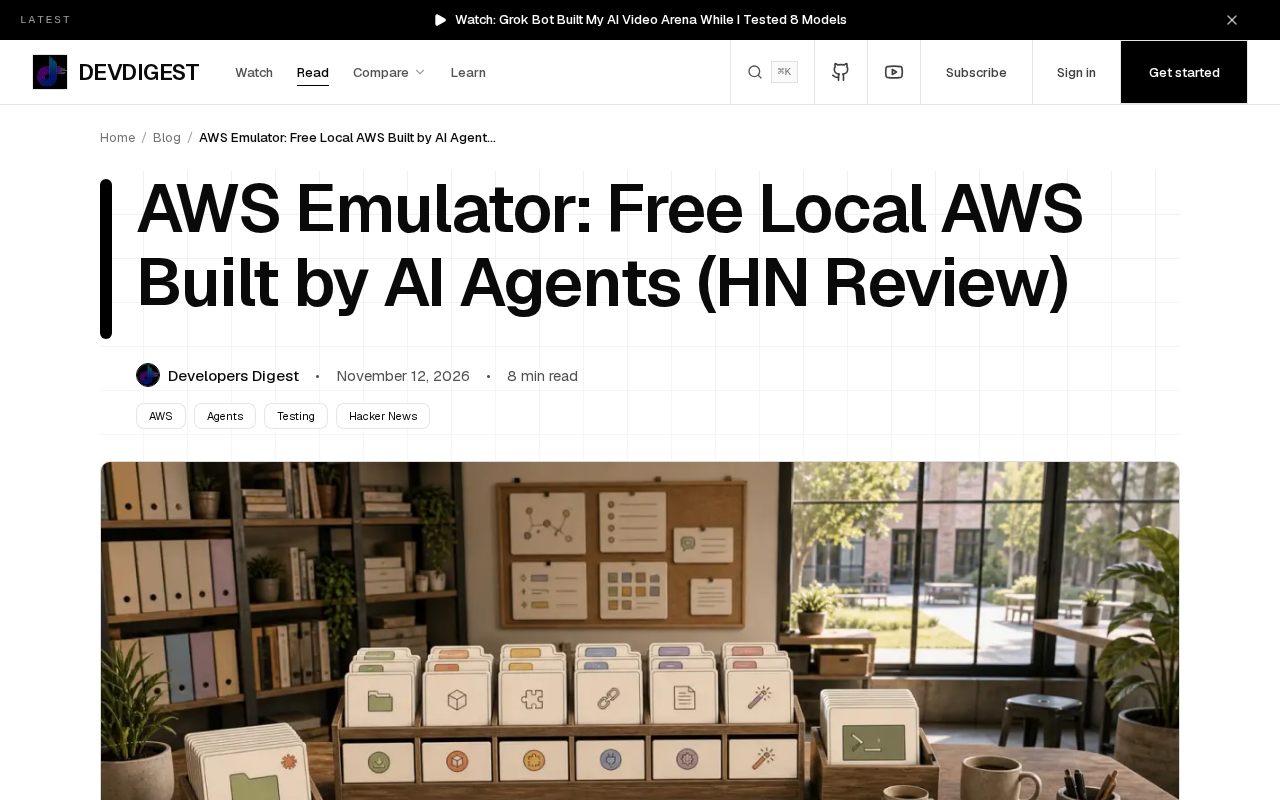
The emulator provides developers with a local environment that can simulate the behavior of a large number of AWS services, allowing applications to be tested offline or in CI environments without connecting to the real AWS cloud. But the "AI-written, no human review" background has made its reliability and applicable boundaries a focal point.
What Is the AWS Local Emulator?
Simply put, it is software that runs locally and attempts to replicate the APIs and behavior of AWS cloud services. Developers can use it to run integration tests, develop prototypes, or validate architectures without incurring cloud costs. According to public information, it covers more than 200 services and is released under the CC0 license, meaning it can be freely used, modified, and even used commercially.
For teams that need to frequently test AWS interactions, a local emulator can significantly improve development efficiency and reduce dependence on the real cloud environment. However, behavioral differences between emulators and real services are common, and this has long been a challenge for such tools.
CC0 license (Creative Commons Zero) is a copyright waiver in which the author voluntarily gives up all copyright in the work and places it in the public domain. Users can freely copy, modify, distribute, and even use it commercially without attribution or any restrictions. For software projects, adopting CC0 means the codebase is fully open, and enterprises can integrate it into internal toolchains without worrying about license compatibility. However, it also means the project has no official support commitment, and maintenance relies entirely on the community or the publisher itself.
How Does the Three-Team Agent Loop Work?
According to the original report, the emulator's code was generated by a "three-team agent loop." Although details are limited, its working method can be inferred: multiple AI agents form teams, divide labor and collaborate, and complete code writing, testing, and correction through iterative loops. The entire process has no human code review step and relies entirely on mutual verification and automated processes among agents.
This model demonstrates the potential of AI agents in complex software engineering—not only can they write code, but they can also be organized into a production pipeline. But the lack of human review also raises questions about quality and security.
AI agent refers to a software entity that can perceive its environment, make autonomous decisions, and take actions to achieve goals. In code generation scenarios, agents are usually assigned specific roles (such as developer, tester, reviewer) and interact with the environment through tool calls (such as reading and writing files, running tests). In multi-agent collaboration, agents can pass messages, assign tasks, and review each other. The so-called "loop" generally refers to an iterative "generate-test-fix" process: one agent writes code, another agent runs tests and feeds back errors, and then the generating agent fixes them, repeating until passing or reaching an iteration limit. This model requires no human intervention, but depends on the agents' ability to identify errors and the completeness of test coverage.
What Should Be Checked Before Using It in CI?
If you are considering adopting this emulator in a continuous integration (CI) pipeline, several aspects need careful evaluation:
- Behavioral fidelity: Does the emulator accurately reproduce the key behavior of the target services? Are details such as error codes, rate limiting, and consistency models consistent?
- Coverage: Although it claims to support 200+ services, the depth of coverage may differ for each service. You need to confirm whether the services you rely on are sufficiently supported.
- Maintenance status: How is the AI-generated codebase updated? Is there a community or official team continuously maintaining it?
- Security risks: Code without human review may contain hidden logic defects or security vulnerabilities, so running it in CI requires caution.
The discussion on Hacker News also reflects these concerns. Some commenters expressed doubt about the quality of AI-generated code, while others expressed interest in the usefulness of a local emulator.
Behavioral fidelity measures how accurately an emulator reproduces the behavior of a real service, including API response formats, error codes, rate-limiting policies, data consistency models, latency characteristics, and more. A high-fidelity emulator allows local test results to credibly predict production behavior; low fidelity may lead to "passes locally, fails online." When evaluating, design comparison tests for the specific services you rely on, for example by running the same request sequence in both the emulator and the real environment and comparing responses. In addition, emulators usually do not implement the full complexity of underlying networks and distributed systems, so scenarios sensitive to consistency require extra caution.
Multi-Source Perspectives and Community Reaction
The news originally came from an RSS feed with the title "AWS Emulator: Free Local AWS Built by AI Agents (HN Review)." Because the material is mainly cited from a single source, we cannot cross-verify more technical details. What is certain is that the project sparked discussion on HN about the reliability of AI-generated code.
Some argue that this is an important attempt by AI agents in the infrastructure field; others caution that the value of an emulator depends on its consistency with real services, and AI-written code may exacerbate deviations.
Conclusion
The AWS local emulator is a project worth watching. It demonstrates the ability of AI agents to write complex systems, and it also raises difficult questions about code quality and trust. For developers, thorough validation and testing are necessary before introducing it into CI.
(Note: This article is based on limited material; some details should be confirmed against official documentation.)
One-line Summary
AWS released a free CC0 local emulator covering 200+ services, with all code written by AI agents and no human review, sparking heated HN community discussion about reliability.
Paragraph Summary
AWS has released a local AWS emulator supporting more than 200 services, completely free under the CC0 license. Most notably, its code was written entirely by AWS's internal AI agents through a "three-team agent loop," without any human code review. The tool aims to provide developers with AWS behavior simulation in offline or CI environments, reducing dependence on and costs of the real cloud. Discussion on Hacker News revolves around the quality of AI-generated code, the emulator's behavioral fidelity, depth of coverage, maintenance status, and security risks. The article recommends carefully evaluating consistency in details such as error codes, rate limiting, and consistency before introducing it into CI, and confirming the level of support for the services you rely on. Overall, the project demonstrates the potential of AI agents to write complex systems, and also raises difficult questions about code trust and validation.
Related articles

FBI and USDA Hit by Cyberattacks: Critical Infrastructure Security Alarms Sound Again
FBI and USDA reportedly hit by cyberattacks; the FBI was breached for the second time in recent months, this time targeting the National Crime Information Center (NCIC). This article analyzes the incident details, NCIC's strategic value, and common security challenges facing government agencies.
How Do UK Grid Battery Storage Systems Make Money?
How UK grid battery storage makes money: stacking frequency response, capacity market, and wholesale arbitrage revenue, plus operational trade-offs and market risks.
Riemann Hypothesis Formally Verified in Lean? Joint Statement Sparks Heated Debate
The Lean community blog published a joint statement on formal verification of the Riemann Hypothesis, sparking heated discussion on Hacker News with 359 points and 263 comments. This article analyzes the background of Lean and mathlib formal verification, polarized community reactions, and why one should not conclude the Riemann Hypothesis has been proven before reading the original text.