Riemann Hypothesis Formally Verified in Lean? Joint Statement Sparks Heated Debate
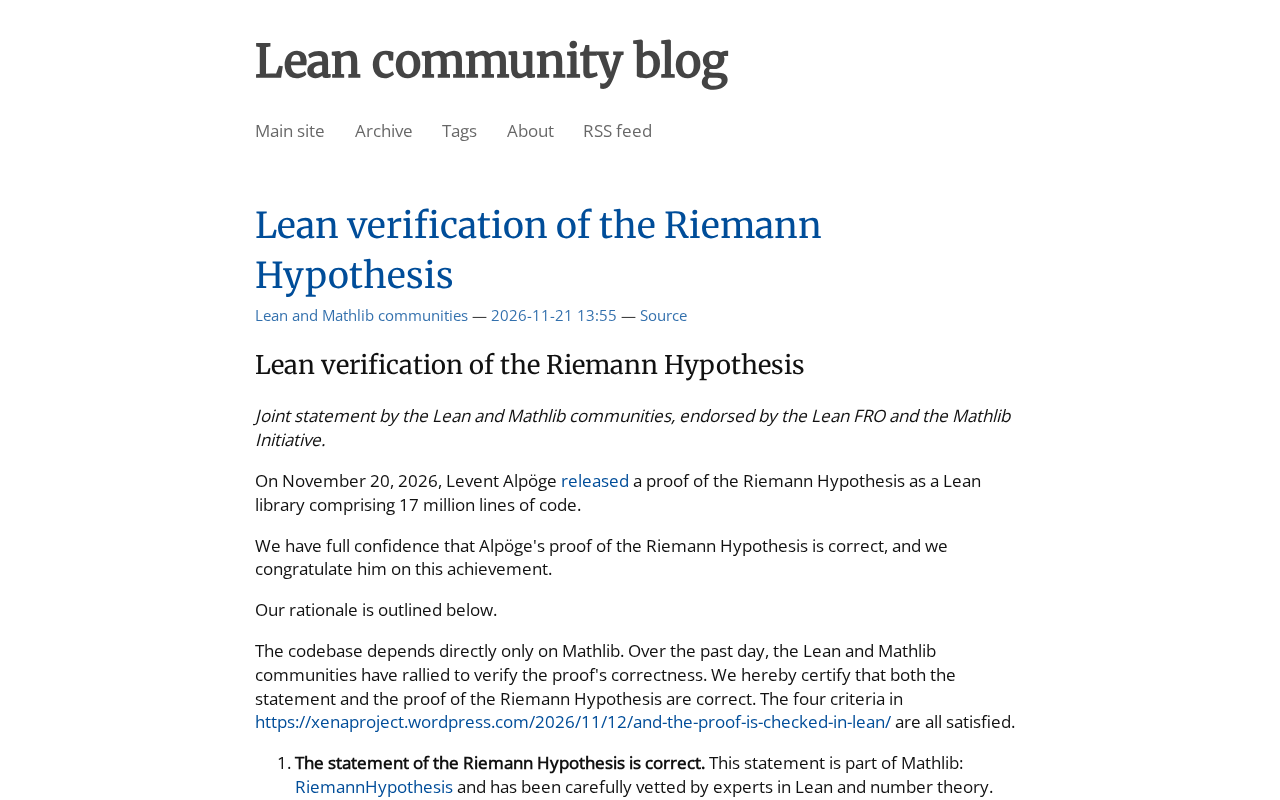
A joint statement on Lean verification of the Riemann Hypothesis on the Lean community blog sparked heated HN discussion, but the original text is missing, so it should be viewed rationally.
The Lean community blog published a joint statement on formal verification of the Riemann Hypothesis, receiving 359 points and 263 comments on Hacker News and attracting widespread attention. The article first clarifies that the original material does not provide the body content, so it does not assert that the conjecture has been proven, but instead analyzes the technical background. Lean is an interactive theorem prover, and its mathlib library is dedicated to the large-scale formalization of mathematical knowledge; formal verification can machine-check proofs step by step and in theory eliminate disputes over proof correctness. The phrase "joint statement" in the title suggests collaboration among multiple researchers, amplifying attention. Community discussion shows polarized reactions: some press on the scope of verification, while others are wary of clickbait. The article points out that the Riemann Hypothesis has seen numerous claimed proofs throughout history; although formal verification offers stronger credibility, it is necessary to confirm what specific proposition the formalization covers (the complete conjecture, a special case, or a conditional result). For the AI field, formal proofs can serve as a rigorous benchmark for evaluating AI reasoning capabilities. Finally, readers are advised to read the original text directly to confirm the issuer of the statement, the scope of the formalized proposition, and the status of third-party checking.
A Message That Shook the Math and AI Communities
The Lean community blog published an article titled "Lean Verification of the Riemann Hypothesis - Joint statement by...", which quickly sparked extensive discussion on Hacker News—the post received 359 points and reached 263 comments. For those familiar with the math world and the formal verification field, this title alone is stimulating enough: the Riemann Hypothesis is one of the most famous unsolved problems in mathematics, and Lean is a mainstream tool that has risen rapidly in formal mathematics in recent years.
What needs to be made clear first is that the original material itself does not provide the specific body content of the article—only the title, link, and engagement data from community discussion remain. Therefore, this article does not attempt to assert that "the Riemann Hypothesis has been proven" or "has been formally verified," but rather analyzes the technical background and community reactions reflected by this piece of information.
What Is Lean, and Why Is Its "Verification" So Closely Watched
The Core Tool of Formal Mathematics
Lean is an interactive theorem prover, also commonly used as a functional programming language. Its most notable project is mathlib—a large-scale mathematics library jointly maintained by the community, with the goal of formalizing undergraduate- and graduate-level mathematical knowledge to a machine-checkable degree. So-called "formal verification" refers to writing mathematical propositions and proofs as code, letting the computer check step by step whether the logic holds. This differs from traditional pen-and-paper proofs: once a formal proof passes checking, the possibility of hidden assumptions and reasoning gaps is eliminated.
Interactive Theorem Prover (ITP) is a class of software systems in which users write mathematical definitions, theorems, and proofs in a formal language, and the system checks in real time whether each step of reasoning is valid. Unlike automated theorem provers, ITPs emphasize human-machine collaboration: humans provide proof strategies and key lemmas, while the machine verifies the details. Lean is based on dependent type theory, and its core logic is a variant of the Calculus of Constructions, which allows "propositions" to be represented as "types" and "proofs" as "terms" of the corresponding type. This Curry-Howard correspondence is the foundation for Lean serving simultaneously as a programming language and a proof assistant. As its mathematics library, mathlib currently contains over a million lines of code, covering a wide range of areas including algebra, analysis, and topology, and is one of the largest community projects in formal mathematics.
The Credibility of the Lean Community
The Lean community blog is one of the most authoritative information channels for the project. The wording "Joint statement by..." in the title suggests that this is not the work of a single individual, but possibly a joint statement by multiple researchers or institutions. This wording itself amplifies attention—if it were merely ordinary progress, a "joint statement" format would typically not be needed.
What the Community Discussion Heat Indicates
Polarized Reactions on Hacker News
Judging from the data, 359 points and 263 comments indicate a highly engaged post. The intersection of mathematical conjectures, formal verification, and AI-assisted proving naturally attracts math enthusiasts, programmers, AI researchers, and skeptics all at once. It is predictable that the comment section will present sharply different voices: some will press on what exactly this statement proves and how broad the scope of verification is; others will be wary of "clickbait"—any stir around the Riemann Hypothesis is easily overinterpreted.
Why Such News Requires Caution
Since the Riemann Hypothesis was proposed, there have been numerous works claiming to prove it, but none has been generally accepted by the mathematical community. The value of formal verification lies precisely in the fact that it can in theory eliminate disputes over "whether a proof is correct"—as long as the code and axiom system are trustworthy, the checking result is definitive. But this also raises new questions: what exactly is being formalized? Is it the complete conjecture, or some special case, some equivalent formulation, or some conditional result? Without reading the body of the article, any assertion is premature.
Conditional result in mathematics refers to a theorem of the form "if A holds, then B holds," where A itself may not yet be proven. In the context of the Riemann Hypothesis, a common situation is that some conclusion depends on the Riemann Hypothesis or the stronger Generalized Riemann Hypothesis (GRH). Formal verification can rigorously check the derivation "from A to B," but cannot verify A itself. Therefore, even when seeing a headline like "the Riemann Hypothesis has been formalized," one needs to distinguish: is it the statement of the conjecture itself that has been formalized, or some conditional proof, or some proposition equivalent to the conjecture? In addition, equivalent formulations are also a common pitfall: the Riemann Hypothesis has many equivalent forms (such as bounds on the growth of the Mertens function, error terms in the prime number theorem, etc.), and verifying a special case of one equivalent form does not amount to verifying the original conjecture.
Significance for AI and Mathematical Research
Formal Verification Is Becoming New Infrastructure for Mathematics
Whatever the specific content of this joint statement may be, it reflects a trend: formal tools are moving from the margins to the center of mathematical research. The maturity of Lean and mathlib has allowed an increasing number of important results to be machine-checked. For the AI field, this route also has direct value—formal proofs can serve as a rigorous benchmark for training and evaluating AI reasoning capabilities, because correctness can be determined by machines rather than relying on the subjective judgment of human reviewers.
AI-assisted proving is a hot direction at the intersection of formal mathematics and artificial intelligence. Because Lean's proof checking is deterministic, it is naturally suited as a benchmark for evaluating AI reasoning capabilities: proof steps generated by a model can be automatically judged correct or incorrect by a machine, without the need for human review. Several systems that have emerged in recent years (such as proof search tools based on large language models) attempt to let AI automatically generate proof scripts in the Lean environment, and progress has been made on subsets of mathlib. This closed loop of "AI generation + machine verification" makes formal mathematics not only a verification tool but also a source of training data and an evaluation platform. For top-tier problems like the Riemann Hypothesis, AI currently cannot tackle them independently, but the formal environment provides infrastructure for gradually accumulating verifiable intermediate results.
Changes in Community Collaboration Patterns
The "joint statement" format also reveals another layer of information: the formalization of major mathematical results is often not something a single person can accomplish; it requires collaboration among proof authors, formalization experts, and library maintainers. This differs from the authorship model of traditional mathematics papers, and also means that attribution of results and verification responsibilities require new conventions.
Suggestions for Viewing This News Rationally
For readers following this matter, a pragmatic approach is to read the original Lean community blog post directly and focus on confirming three things: who the statement is issued by, what specific proposition the formalization covers, and whether there is third-party checking independent of the authors. The 263 comments on Hacker News can serve as an entry point for understanding community concerns, but cannot replace reading the original document.
In the history of mathematics, progress on major conjectures often requires time to settle before it can be confirmed. Lean verification provides a stronger credibility tool, but it does not change one basic fact: judging the weight of a mathematical claim ultimately still comes back to the content of the claim itself.
One-line Summary
A joint statement on Lean verification of the Riemann Hypothesis on the Lean community blog sparked heated HN discussion, but the original text is missing, so it should be viewed rationally.
Paragraph Summary
The Lean community blog published a joint statement on the formal verification of the Riemann Hypothesis, receiving 359 points and 263 comments on Hacker News and attracting widespread attention. The article first clarifies that the original material does not provide the body content, so it does not assert that the conjecture has been proven, but instead analyzes the technical background. Lean is an interactive theorem prover, and its mathlib library is dedicated to the large-scale formalization of mathematical knowledge; formal verification can machine-check proofs step by step and in theory eliminate disputes over proof correctness. The phrase "joint statement" in the title suggests collaboration among multiple researchers, amplifying attention. Community discussion shows polarized reactions: some press on the scope of verification, while others are wary of clickbait. The article points out that the Riemann Hypothesis has seen numerous claimed proofs throughout history; although formal verification offers stronger credibility, it is necessary to confirm what specific proposition the formalization covers (the complete conjecture, a special case, or a conditional result). For the AI field, formal proofs can serve as a rigorous benchmark for evaluating AI reasoning capabilities. Finally, readers are advised to read the original text directly to confirm the issuer of the statement, the scope of the formalized proposition, and the status of third-party checking.
Related articles

FBI and USDA Hit by Cyberattacks: Critical Infrastructure Security Alarms Sound Again
FBI and USDA reportedly hit by cyberattacks; the FBI was breached for the second time in recent months, this time targeting the National Crime Information Center (NCIC). This article analyzes the incident details, NCIC's strategic value, and common security challenges facing government agencies.

How Do UK Grid Battery Storage Systems Make Money?
How UK grid battery storage makes money: stacking frequency response, capacity market, and wholesale arbitrage revenue, plus operational trade-offs and market risks.
Anthropic Goes Public: AI Bubble or Buying Opportunity?
Anthropic lists on Nasdaq, opening about a third above its IPO price. We break down the $81.3B raise, $1.5T offering valuation, and $2T market valuation, plus Claude's growth and $567M quarterly operating loss.