AWS MCP Lets AI Debug Your Lambda: Why Real Backend Context Matters

AWS MCP Server lets coding agents connect to running AWS backends and aggregate real evidence — but humans keep the final call.
The article explains how AWS MCP Server uses the Model Context Protocol to let AI coding assistants break past the code repository boundary and connect to running AWS backends, inspecting Lambda and associated services like API Gateway and databases. The agent compares current error signals against a 7-day baseline to identify genuine anomalies, then checks configuration state, latency metrics, and recent changes — ultimately aggregating deployment timestamps, error rate curves, and configuration diffs as evidence rather than drawing conclusions. This design preserves a human-in-the-loop constraint: developers must review diagnostic results before approving fixes, since fault attribution in distributed systems is inherently uncertain. The article argues this marks a shift in AI coding tools from "code completion" to "runtime awareness," and the key question isn't whether it can fix bugs for you, but whether it can present a more complete evidence chain faster.
When AI Coding Assistants Start Reading Your Production Environment
Most AI coding tools can only see as far as the code repository. They can help you write functions, add tests, and explain stack traces — but the moment a problem occurs in a running cloud environment — Lambda cold start anomalies, API Gateway timeouts, database connection pool exhaustion — they can only guess.
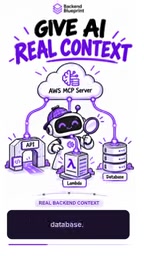
AWS MCP Server changes that boundary. Through the Model Context Protocol, coding agents can connect to a running AWS backend and directly inspect Lambda functions and their associated services (API Gateway, databases, etc.), rather than just staring at local code.
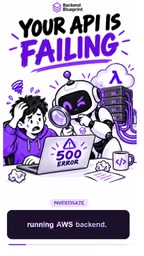
The core value of this capability isn't "AI automatically fixes bugs" — it's giving AI access to real backend context. As the original video emphasizes: AI debugging needs real backend context, not just your code.
Model Context Protocol (MCP) is an open protocol spearheaded by Anthropic in late 2024, designed to establish a unified communication standard between AI applications and external data sources and tools. It's often compared to a "USB-C port for the AI world": before MCP, every AI assistant that wanted to connect to a database, code repository, or cloud service needed its own custom integration layer, resulting in severe fragmentation. MCP abstracts these integrations into standardized Server and Client roles — data sources or tool providers implement an MCP Server that exposes resources, tools, and prompt templates, while agents act as MCP Clients to discover and invoke them. The protocol is typically built on JSON-RPC and supports local stdio or remote HTTP/SSE transport. AWS MCP Server is precisely the encapsulation of AWS's various services into an MCP Server, allowing coding agents to access running cloud resources through a standard protocol — without writing one-off adapter code for each AWS service. This is the key to its ability to rapidly expand its inspection coverage.
How It Actually Works
Comparing Error Signals Against a 7-Day Baseline
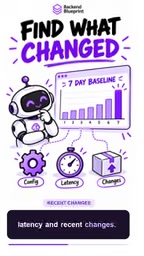
The agent doesn't look at an error in isolation. It compares the current error signal against the past 7 days' baseline to determine whether this is a "known issue that's always been there" or "an anomaly that just appeared."
The baseline comparison mechanism is crucial. Without a baseline, every error looks severe; with a baseline, the agent can identify signals that genuinely deserve attention — like "this error rate suddenly jumped from 0.1% to 5%."
Baseline in the observability domain refers to the typical distribution of values for various metrics during normal system operation, usually characterized by statistics over a sliding time window (such as 7 or 30 days), including median, P95/P99 percentiles, variance, and so on. The 7-day window is common because it covers a complete weekday/weekend cycle, absorbing intra-day traffic fluctuations and periodic business peaks — preventing "a normal Monday morning surge" from being misidentified as an anomaly. The value of a baseline is that it upgrades "absolute threshold alerting" to "relative deviation detection": fixed thresholds (e.g., alert when error rate exceeds 1%) are prone to false positives or missed detections under business growth or seasonal fluctuations, whereas baseline comparison can identify deviations that are "anomalous relative to the system's own history" — for example, an error rate that was stable at 0.1% suddenly jumping to 5%. This also explains why the agent needs to compare current signals against the 7-day baseline — it's effectively performing automatic outlier detection rather than simply reading a number.
Checking Configuration, Latency, and Recent Changes
After identifying anomalous signals, the agent further examines three dimensions:
- Configuration state: Have Lambda's environment variables, memory allocation, or timeout settings been modified?
- Latency metrics: Is function execution time or API Gateway response time degrading?
- Recent changes: Have there been new deployments, configuration updates, or dependency upgrades?
These three checks form a basic causal investigation framework.
Change management is a core topic in SRE and operations practice. Google SRE's statistical experience shows that roughly 70% of production incidents are triggered by some kind of change — new deployments, configuration pushes, dependency upgrades, and scaling policy adjustments all count. This is why incident investigation often follows the principle of "first look at what changed recently," and why change audit logs (such as AWS CloudTrail) exist. The "trio" mentioned in the article — configuration state, latency metrics, and recent changes — is essentially correlation convergence: the fewer variables, the more reliable the attribution. Among these, "latency" is one of the most sensitive probes in distributed systems, because connection pool exhaustion, downstream dependency jitter, and cold starts all leave traces in P99 latency first — often before error rates spike. Aligning these with the error rate timeline helps people quickly determine whether a problem is "newly introduced" or "chronically accumulating."
Connecting the Evidence, Not Drawing Conclusions
Consider a typical scenario: after a deployment, the error rate spikes.
The agent aggregates the deployment timestamp, error rate change curve, configuration diff, and latency fluctuations, and presents them to you. Note the wording — it "helps you investigate," not "tells you the cause."
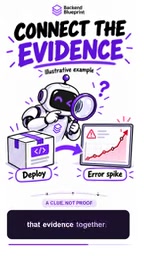
This isn't false modesty. Fault attribution in distributed systems is inherently full of uncertainty. An error spike after a deployment could be caused by new code, but could also be a concurrent traffic surge, downstream dependency jitter, or a chain reaction from some configuration item. What the agent provides is evidence aggregation, not causal proof.
Humans Are Still in the Loop
There's an explicit constraint in this tool's design: you need to review the diagnostic results before approving a fix.
This constraint isn't a technical limitation — it's product philosophy. Letting AI autonomously modify production environment configurations carries extremely high risk, while having AI organize evidence and humans make judgments is a more pragmatic collaboration model.
From an engineering practice perspective, this positioning is reasonable. AI excels at: rapidly pulling from multiple data sources, automatically comparing timelines, and discovering correlations humans might miss. Humans are bad at: quickly completing all of the above operations after being woken by an alert at 3 AM. The two are complementary.
Human-in-the-loop is a design pattern in automated systems that preserves human approval or intervention rights at key decision points. It's applied in nuclear power plant controls, autonomous driving, medical AI, and now AI agents. Its core trade-off is: fully automated decision-making is the most efficient, but errors have enormous impact; fully manual is inefficient. The compromise is to position AI as an "evidence organizer" rather than a "decision-maker," with human confirmation gates before high-risk actions (such as modifying production environment configurations or rolling back deployments). Another related concept is "human-on-the-loop," where humans only perform post-hoc oversight while AI executes autonomously — suitable for low-risk, reversible operations. The article's emphasis on "reviewing diagnostics before approving fixes" is a classic human-in-the-loop pattern: the agent handles evidence gathering and aggregation, while humans handle judgment and accountability — leveraging AI's speed while keeping the risk of irreversible operations within human control.
A Reflection on AI Coding Tools
This direction reveals a trend: AI coding assistants are moving from "code completion" to "runtime awareness."
An AI that only understands code is like an architect who's never set foot in a server room — no matter how strong the theoretical foundation, it lacks first-hand knowledge of how real systems behave. But when an agent can read Lambda's runtime metrics, API Gateway's latency data, and database connection states, its suggestions begin to carry engineering weight.
AWS MCP Server is one step in this direction. Its current form is fairly restrained — inspect, compare, aggregate, present, leaving judgment to humans — but this restraint is precisely what makes it usable in production environments.
For teams already using AI coding assistants, the question worth paying attention to isn't "can it fix bugs for me," but "can it help me see a more complete evidence chain in less time."
One-line Summary
AWS MCP Server lets coding agents connect to a running AWS backend and aggregate real evidence to assist investigation — but judgment stays with humans.
Related articles

Felix Rieseberg Personal Homepage
Felix Rieseberg's personal homepage sparks attention on Hacker News. This article covers the Slack engineer's technical background, the rise and fall of nativefier, and the value of a developer homepage as a tech calling card.

@ai-sdk/vue 3.0.306 Patch Release Syncs with [email protected] Update
@ai-sdk/vue 3.0.306 released, synced with [email protected]. A routine patch release for the Vercel AI SDK ecosystem with no public API changes; the Vue adapter layer stays version-aligned with the core package.

Gemini 4 Argon API Launches: The Era of Million-Token Output Begins
Google launches Gemini 4 Argon with sparse MoE architecture, up to 1M output tokens, and a 68.90% Vals Index score, available across API, AI Studio, and the Gemini app.