AWS Targets Trillion-Dollar Revenue as Jassy Says It Will Spend Big Before Dominating AI Cloud

Jassy says AWS will become the first trillion-dollar business, but it requires sustained massive capex—spend first, dominate later.
Amazon CEO Andy Jassy said AWS aims to become the company's first business to surpass $1 trillion in revenue, but achieving this requires steadily escalating capital expenditures. The article argues that in the AI era, cloud competition has shifted from economies of scale to compute reserves; capex itself is the moat, and AWS chooses to spend big first to lock in compute advantages, then exchange that for long-term pricing power and customer stickiness. This strategy will pressure profits and free cash flow in the short term, but Jassy believes missing the AI cloud window is costlier. The trillion-dollar goal may increase cloud market concentration and drive custom chip and energy infrastructure investment; AWS's investment pace is a key bellwether for compute supply and demand.
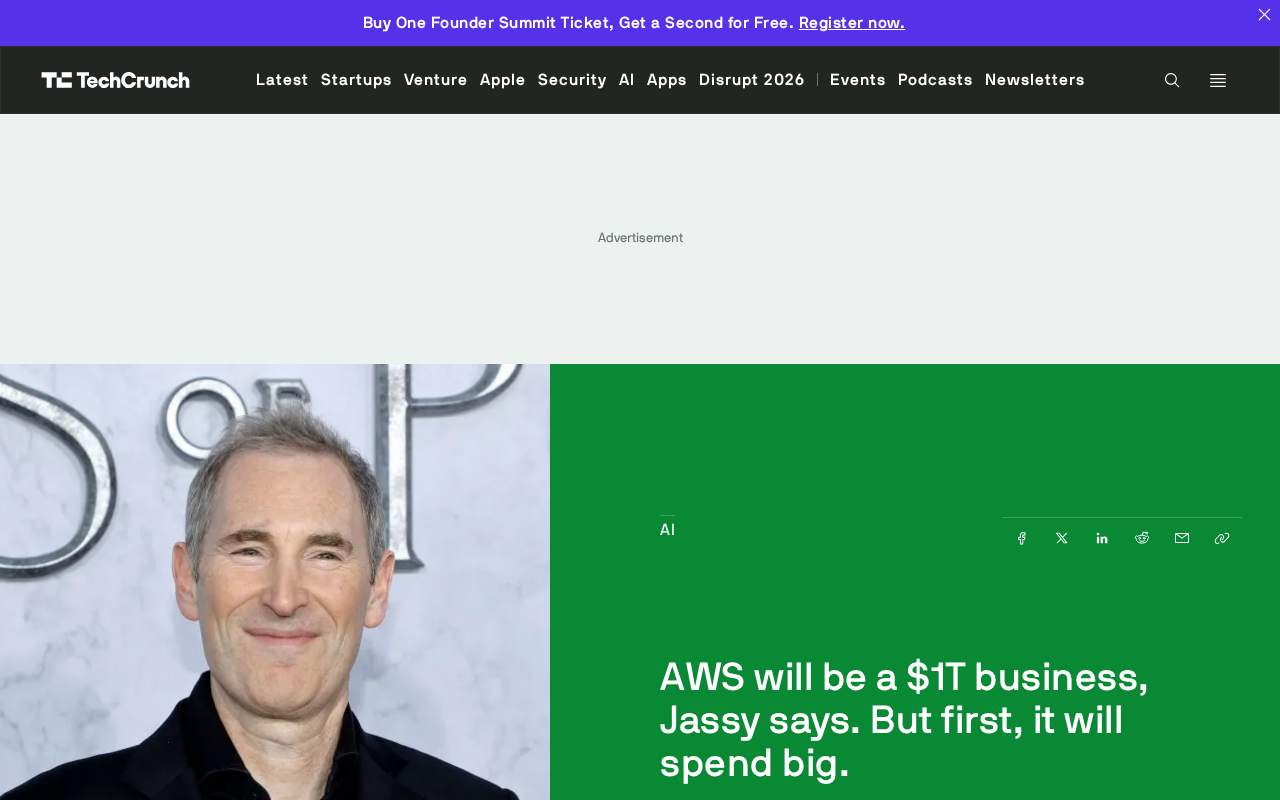
Amazon CEO Andy Jassy recently made a bold claim: AWS will become the company's first business to surpass $1 trillion in revenue. But the road to a trillion is paved with steadily escalating capital expenditures. In the AI cloud arms race, Amazon has chosen to spend big first and dominate later.
The Capital Gamble Behind the Trillion-Dollar Goal
According to the original report, Jassy stated on Thursday that Amazon's goal is to become the king of AI cloud computing and build its first trillion-dollar revenue business. This statement puts AWS's long-term ambition on the table—no longer just a leader in cloud infrastructure, but the monopolist of the compute foundation for the AI era.
But Jassy also acknowledged that achieving this goal requires the company to continue its capital expenditure "spree." This means the income statement will continue to face pressure in the near term, and free cash flow may tighten further. For investors, this is a clear signal: Amazon's growth narrative has switched from "profit release" back to "heavy asset investment."
The destination of capital expenditures is not hard to guess. AI training and inference are driving exponential growth in demand for GPUs, custom chips, data center power, and cooling systems. AWS must lock in capacity in advance, or it will fall behind in the battle for major customers.
Why AWS Must "Spend First, Earn Later"
The competitive logic of cloud computing has fundamentally changed in the AI era. In the past, economies of scale were reflected in server utilization and declining marginal costs; now, AI workloads have highly volatile compute demands, and customers have stringent requirements for latency and throughput. Whoever has more and more advanced compute reserves can take on the core business of large model companies and enterprises.
Jassy's statement actually reveals a harsh reality: in the AI cloud market, capital expenditure itself is the moat. Microsoft and Google are also frantically expanding data centers, and if AWS slows its investment, it is effectively ceding share. The trillion-dollar revenue goal is essentially about using today's massive investment to secure tomorrow's pricing power and customer stickiness.
From a financial perspective, this strategy is not without risk. Capital expenditures take time to convert into revenue, and depreciation pressure will continue to erode profit margins. But Jassy clearly believes that the cost of missing the AI cloud window is far higher than short-term financial pain.
The relationship between capital expenditure (CapEx) and free cash flow deserves elaboration. Capital expenditure refers to spending on acquiring or upgrading fixed assets (such as data centers, servers, and network equipment). Accounting-wise, it is not expensed in the current period but capitalized and allocated over its depreciation life. Therefore, large-scale capital expenditure first appears as cash outflow, compressing free cash flow (operating cash flow minus capital expenditure), and then affects the income statement year by year through depreciation. This is exactly the financial mechanism behind Jassy's remark about "short-term profit pressure": AWS spends money upfront to lock in compute, but revenue is only gradually realized after customers ramp up, during which depreciation expenses continuously erode profit margins. Investors focus on free cash flow because it reflects the cash a company can freely deploy, and cloud providers in heavy-asset investment phases often show "revenue growth but narrowing free cash flow."
Potential Impact on the Industry Landscape
If AWS truly anchors its goal at a trillion dollars in revenue, the competitive intensity of the entire cloud market will be pushed to a new level. Small and medium-sized cloud providers will find it harder to keep up in the compute arms race, and industry concentration may increase further. At the same time, if Amazon's custom chip strategy (such as the Trainium and Inferentia series) can account for a larger share of capital expenditure, it will effectively reduce dependence on Nvidia and improve the long-term cost structure.
Another dimension worth watching is energy. The power demand of large-scale data centers is becoming a new bottleneck, and AWS's capital expenditure plan will inevitably include investment in clean energy and grid infrastructure. This is not just a cost issue, but a prerequisite for delivering compute on time.
The strategic significance of custom AI chips requires background context. Trainium is Amazon's custom chip designed for AI model training, while Inferentia targets inference scenarios; both are part of AWS's custom silicon strategy. The core motivation for cloud providers to develop custom chips is to reduce dependence on Nvidia GPUs—which are expensive and in tight supply. Custom chips can achieve better cost-performance on specific workloads and reduce single-supplier risk. However, custom chips require a supporting software ecosystem (such as compilers and framework support) to be adopted by customers, and ecosystem maturity is key to whether they can truly replace GPUs. If the share of Trainium and Inferentia in AWS capital expenditure increases, it will help improve the unit compute cost structure in the long run, but in the short term, it will still be difficult to completely eliminate procurement dependence on Nvidia.
The power bottleneck of data centers is a hard constraint on AI compute expansion. The power density of large-scale GPU clusters is far higher than traditional cloud computing. A single AI data center can consume tens to hundreds of megawatts, with extremely high requirements for power supply stability. Power supply involves long-cycle processes such as grid connection approval, substation construction, and clean energy procurement, which are often more time-consuming than purchasing GPUs. Therefore, in cloud providers' capital expenditure plans, energy infrastructure investment is as important as compute procurement. Whether sufficient power can be obtained on time directly determines the pace of data center commissioning and compute delivery capability, which is also why AWS, Microsoft, and Google compete fiercely over site selection and energy contracts.
Editorial View
Jassy's trillion-dollar declaration is more like strategic communication: telling Wall Street and customers that Amazon will not play it safe in the AI cloud race. In the short term, capital expenditure will weigh on financial performance; in the long term, this is the only path for AWS to maintain its cloud dominance. The real suspense is not whether AWS can spend the money, but whether, after spending it, it can secure matching customer lock-in and profit returns.
For practitioners focused on AI infrastructure, AWS's investment pace is an important bellwether for observing compute supply and demand. When the world's largest cloud providers are all accelerating capital expenditure, the price war and capacity争夺 in AI cloud will only intensify.
One-line Summary
Jassy says AWS will become the first trillion-dollar business, but it requires sustained massive capital expenditure—spend first, dominate later.
Paragraph Summary
Amazon CEO Andy Jassy said AWS aims to become the company's first business to surpass $1 trillion in revenue, but achieving this goal requires steadily escalating capital expenditures. The article argues that in the AI era, the competitive logic of cloud computing has shifted from economies of scale to compute reserves; capital expenditure itself has become the moat, and AWS has chosen to spend big first to lock in compute advantages, then exchange that for long-term pricing power and customer stickiness. This strategy will pressure profits and free cash flow in the short term, but Jassy believes the cost of missing the AI cloud window is higher. The trillion-dollar goal may increase cloud market concentration and drive investment in custom chips and energy infrastructure. AWS's investment pace is becoming an important bellwether for compute supply and demand.
Related articles

Private Key Set to 4? CA's Elementary Mistake Leaves TLS Exposed
CA eMudra set private keys to tiny values like 4, making TLS certificates brute-forceable. A Computerphile video demonstrates the full process from extracting public keys to forging certificates, and explores the fragility of the PKI trust chain.

How Gen Turns Data into Decisions with ChatGPT Work
In an OpenAI user case, business leader Gen shares how ChatGPT Work turns data into decisions: within hours of launch, teams can judge whether integrations and onboarding flows work, shifting decision iteration from hundreds of trial-and-error attempts to a fast feedback loop.

ChatGPT vs. Claude In-Depth Comparison: Strong at Coding but Weak at Research — How to Bridge the Gap?
A user considers switching from ChatGPT to Claude, finding Claude stronger at coding but shallower at research. We analyze the differences and share tips to make Claude's research deeper.