axel.md: A Multi-Agent Orchestration Tool for the Terminal, Built for Rex

axel.md is a multi-agent orchestration layer in the terminal with durable sessions and cross-machine scheduling.
axel.md is an agent orchestration tool for terminal workflows that eliminates the coordination overhead of manually juggling multiple coding agents. It supports Claude Code, Codex, and OpenCode, giving each session a trackable identity via threads and named agents, and uses durable sessions to preserve state. Cross-machine capability relies on Tailscale to unify agents across laptops, dev machines, and servers. It is explicitly "designed for Rex," open-sourced by Ludo Galabru, and at an early stage on Product Hunt.
Starting With Too Many Terminal Windows
When developers use Claude Code, Codex, and OpenCode at the same time, the common workflow is to open several terminal tabs and manually switch between windows, paste context, and track how far each agent has gotten. This "manual orchestration" quickly spirals out of control as tasks get more complex: which session is waiting for input, which has finished, and which machine still has unfinished tasks—all of it has to be tracked in your head.
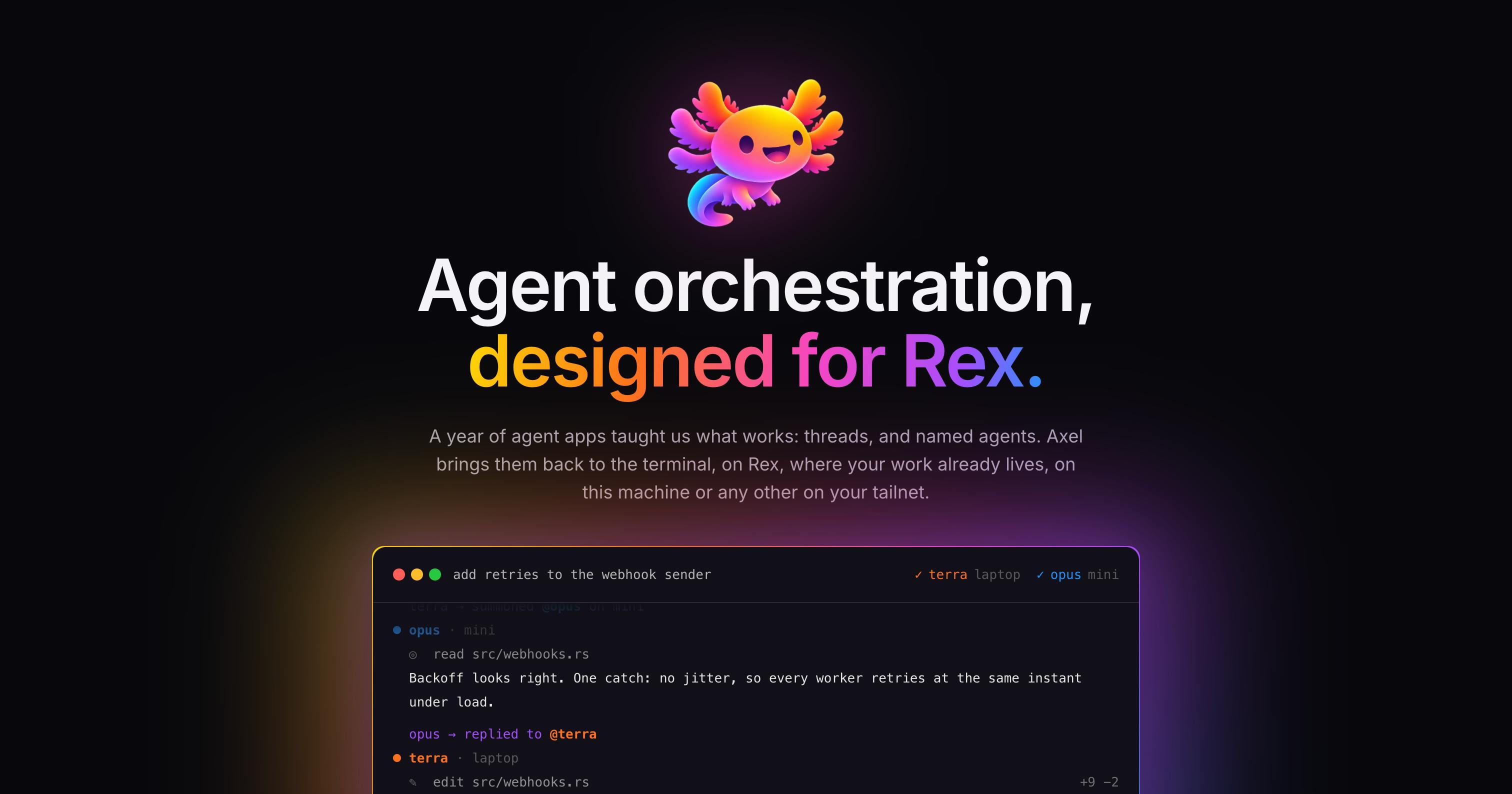
axel.md tries to solve exactly this handoff-layer problem. Its positioning on Product Hunt is clear: agent orchestration in the terminal, and "designed for Rex." That phrase is the key to understanding the product—it is not a general-purpose tool for all terminal users, but a scheduling logic designed around the Rex use case.
Agent orchestration refers to adding a scheduling layer on top of multiple autonomous AI agents that decides who executes when, how context is handed off, and how state is persisted. It doesn't create agent capabilities; it manages the collaboration between agents, much like a container orchestration system manages container instances. In the terminal context, an orchestration layer typically needs to solve three problems: session reuse, state visibility, and cross-process/cross-machine scheduling—which is precisely the core value proposition of tools like axel.md.
Core Capabilities: Durable Sessions and Named Agents
According to the product page, axel.md brings threads and named agents back to the terminal. Combined, these essentially give each agent session a trackable identity: you can name agents for different purposes and let them keep working in their own threads, rather than having every launch be a one-off conversation with a cleared context.
The agents it explicitly supports include Claude Code, Codex, and OpenCode. This means axel.md doesn't produce agent capabilities itself—it sits at the orchestration layer: who is running, what state they're in, and who should take over next are all managed centrally by axel.
The Significance of Durable Sessions
The product emphasizes durable sessions. This is crucial for terminal workflows—once a terminal process closes, an ordinary session is lost. Persisted sessions let the orchestration layer maintain state across multiple agents, avoiding the need to re-explain the background on every restart. The direct benefit is a lower cost of recovering from interruptions on long tasks; the indirect benefit is that handoffs between agents can be more coherent.
"Status the Terminal Understands"
Another notable phrase is "status the terminal understands." Agents generate a lot of state information while running, but a traditional terminal only recognizes text streams and exit codes. axel.md's approach is to present state information in a form the terminal can natively consume, rather than opening a separate web panel. For developers accustomed to working on the command line, this reduces the cost of context switching.
Claude Code, Codex, and OpenCode are three types of coding agents that run in the terminal: Claude Code was launched by Anthropic, Codex is OpenAI's series of coding assistants, and OpenCode is an open-source community terminal coding agent. Each maintains its own session context and typically launches as a one-off process. By bringing all three into a unified orchestration, axel.md means you can mix agents from different vendors under the same scheduling view and divide work by task type, without having to maintain separate switching habits for each agent.
Across Machines: Connecting Other Devices via Tailscale
The product description mentions "your other machines over Tailscale." In other words, axel.md's orchestration scope isn't limited to the local machine—it can bring agents on other machines into the same scheduling view via Tailscale.
This design choice involves a clear trade-off. Using Tailscale instead of building a custom relay means relying on existing peer-to-peer networking capabilities, keeping the deployment barrier low while delegating network-layer complexity to a mature tool. The cost is that users need to already be using Tailscale at the networking layer. For developers who already use Tailscale in multi-machine environments, this is a natural extension; for those who haven't, it adds a prerequisite dependency.
Judging from the use cases, this suits combinations like "laptop + dev machine + server": offload heavy tasks to agents on remote machines, while the local machine only issues commands and checks status.
Tailscale is a peer-to-peer virtual networking tool built on WireGuard that establishes encrypted direct connections between devices across different network environments, without requiring a public IP or manual port forwarding. Once devices join the same tailnet, they can reach each other as if on a LAN. axel.md uses it to expose agents on remote machines to the local orchestration view, letting users achieve multi-machine scheduling without building their own relay or VPN; the prerequisite is that all participating devices have Tailscale installed and logged in.
Positioning and Scope
The designed for Rex subtitle deserves its own discussion. It suggests that axel.md is not pursuing a generalized agent scheduling platform but is tied to Rex's specific way of working. The upside is more focused design and interfaces tailored to a particular workflow; the risk is limited generality—developers outside the Rex workflow may find the feature set narrow.
Based on the Product Hunt data—71 votes, 2 comments, ranking #5—this is a product in an early exposure phase. The author is Ludo Galabru, and the project is categorized under Productivity, Open Source, Developer Tools, and GitHub, released as open source. Open source matters especially for orchestration tools—scheduling logic and state management often need to be adapted to individual workflows, and modifiability is a precondition for real adoption.
The Real Problem It Solves
The bottleneck of running multiple agents in parallel often isn't the intelligence of any single agent, but the coordination overhead between a person and multiple agents. Every additional agent means one more state to track. axel.md consolidates threads, naming, durable sessions, and cross-machine state into one place in the terminal, targeting exactly this hidden cost.
Whether it's worth trying depends on two things: whether you use more than one of Claude Code, Codex, and OpenCode at the same time, and whether you already run tasks across multiple machines. When both conditions are met, the value of the orchestration layer is most obvious; if you use only one agent and work on a single machine, the gains may not offset the learning and configuration costs.
FAQ
Is axel.md free? The product is labeled Open Source on Product Hunt and categorized under GitHub; for the specific license and pricing model, check its GitHub repository.
Which agents does it support? According to the product page, it supports Claude Code, Codex, and OpenCode.
Do I have to use Tailscale for cross-machine use? The product description uses Tailscale as the vehicle for cross-machine capabilities and doesn't mention other networking methods.
How is it different from just opening multiple terminal windows? The core differences are durable sessions, a unified state view of named agents, and cross-machine scheduling—not mere window management.
One-line Summary
axel.md is a multi-agent orchestration layer in the terminal, supporting durable sessions and cross-machine scheduling.
Paragraph Summary
axel.md is an agent orchestration tool for terminal workflows, designed to eliminate the coordination overhead of "manual orchestration" when using multiple coding agents at once. It supports Claude Code, Codex, and OpenCode, giving each session a trackable identity through threads and named agents, and uses durable sessions to preserve state and reduce the cost of recovering from interruptions on long tasks. Cross-machine capabilities rely on Tailscale to bring agents on laptops, dev machines, and servers into a single scheduling view. The product is explicitly "designed for Rex," a focused rather than general-purpose positioning. The project was released as open source by Ludo Galabru and received 71 votes, ranking #5 on Product Hunt—an early exposure phase. Its value is most obvious when you use multiple agents and run tasks across multiple machines.
Related articles
 Tech Frontiers
Gemini Omni 1.2 Flash: AI Video Moves Toward Draft-Style Editing
Google's Gemini Omni 1.2 Flash update enables conversational, draft-style editing of the same video—swap scenes while keeping products, adjust lighting while keeping characters. Clips up to 15s, 720p costs 30% less than the previous Flash—ideal for e-commerce ads, previs, and short-asset production.

Codex Tutorial: One-Command Install and Run Your First Task
Codex tutorial: one-command install and run your first task. Covers the four Codex forms, sandbox and approval guardrails, AGENTS.md and MCP configs, cloud network policy, and the iron rule of human review—everything you need to get started with this autonomous coding agent.
 Tech Frontiers
Localix: An Open-Source Agentic Development Environment with Multi-Model and Local AI Integration
Localix is an MIT open-source Agentic Development Environment (ADE) supporting seamless Claude Code plugin loading, multi-model cloud and local execution, Mini Apps extensions, and agent context management—an open AI collaboration workbench for developers.