Badgey: The Social Power Tool That Turns Your iPhone Into a Rotating Name Badge
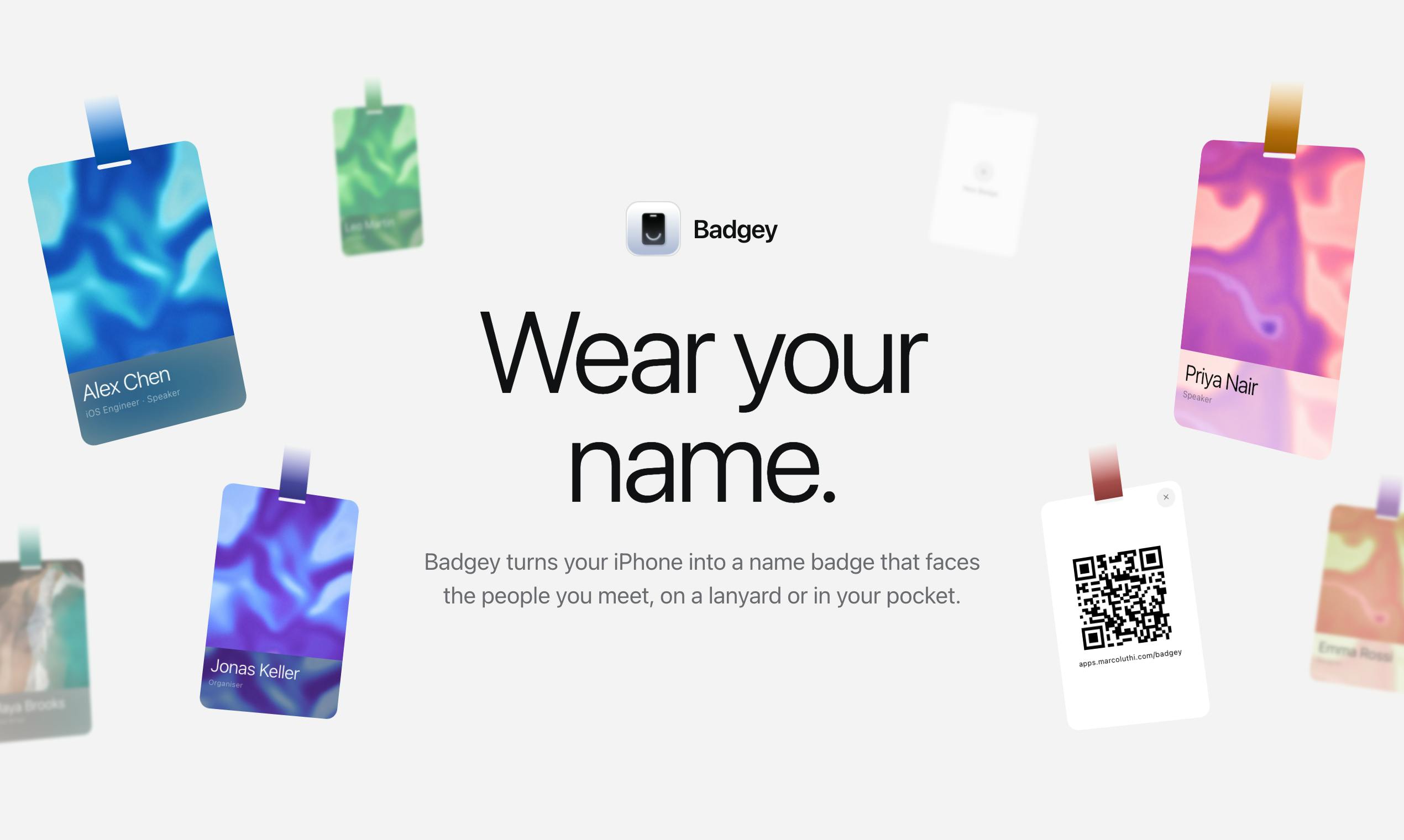
Badgey turns iPhone into a dynamic smart badge that automatically rotates to face others, targeting event social scenarios.
Badgey is an iOS app that turns your iPhone into a smart name badge: on a lanyard, it sways with your body and automatically turns to face the person you're talking to; in a breast pocket, it scales down to show just the edge of your name. It offers five designs, supports switching between badges, and generates QR codes linking to your profile or contact info. The app likely uses iPhone motion sensors to detect orientation, achieving dynamic adaptation through hardware-software integration. Targeting event social scenarios like trade shows and conferences, Badgey received 99 upvotes and third place for the day on Product Hunt. Its advantages include changeable information and QR code integration, but challenges such as iPhone dependency, battery drain from long screen-on time, and readability compared to physical badges remain to be validated.
Badgey: The Social Power Tool That Turns Your iPhone Into a Rotating Name Badge
Have you ever found yourself awkwardly forgetting someone's name at a social event? Badgey, a new product on Product Hunt, might just solve that problem. It turns your iPhone into a smart name badge that you wear around your neck or tuck into your breast pocket, automatically rotating to face others so your name is always clearly visible.
Product Highlights: A Rotating Badge Built for Multiple Scenarios
The core idea behind Badgey is to use the iPhone's screen and sensors to make the name badge intelligent. According to the official description, when worn on a lanyard, Badgey swings with your movements and automatically turns to face the people you meet; when placed in a breast pocket, it scales down so your name peeks out just at the edge. This dynamic, adaptive design transforms the badge from a static placard into a tool that actively displays information.
Badgey currently offers five design styles, supports switching between multiple badges, and can generate a QR code linking to your personal homepage or contact details. For people who frequently attend trade shows, conferences, or social events, this is undoubtedly both a practical and fun solution.
Technical Implementation and User Experience
Although Badgey's specific technical details haven't been made public, the description suggests it may use the iPhone's gravity and orientation sensors to determine direction and adjust the display content through software algorithms. This combination of hardware and software reflects the developer's attention to detail.
In practice, users simply place their iPhone in a lanyard or breast pocket and open the Badgey app. The interface is likely clean and intuitive, making it easy to set up and switch badges quickly. However, Badgey currently only supports iOS, so Android users can't try it yet.
iPhone's built-in accelerometer and gyroscope, collectively known as motion sensors, are the technical foundation for apps like Badgey to achieve automatic orientation. The accelerometer measures linear acceleration along three axes, which can determine the device's tilt angle relative to gravity; the gyroscope measures angular velocity around three axes, sensing rotation and rotational speed. iOS uses the Core Motion framework to fuse raw data from both sensor types and output high-level information such as device attitude and gravity direction. Developers can use this to infer whether the phone is hanging vertically or lying flat in a breast pocket, and which side the badge is facing, thereby driving interface rotation or scaling. This kind of attitude fusion typically combines low-pass and complementary filtering algorithms to suppress sensor noise and drift, ensuring the badge turns smoothly without jitter.
The concern about "long screen-on time affecting battery life" involves iPhone's display and power consumption mechanisms. OLED screens emit almost no light when displaying black pixels, so a badge interface with a dark background is more power-efficient than a white one; but keeping the screen on is still a major power drain. iOS automatically locks the screen after a period of inactivity by default, and third-party apps cannot prevent the screen from sleeping indefinitely like navigation apps do, unless they request specific background permissions or use system features like Guided Access. For Badgey to keep the badge visible for extended periods, it needs to balance keeping the screen awake with power consumption—for example, by lowering the refresh rate, using static images, reducing brightness, or offering a power-saving mode. This is also a key constraint on the reliability of such apps in real-world events.
Market Positioning and Potential Demand
Badgey targets event social scenarios, especially occasions that require quick identification and facilitate interaction. On Product Hunt, it received 99 upvotes and 3 comments, ranking third for the day, indicating a certain level of attention.
From a demand perspective, traditional name badges often need to be custom-made and carry fixed information; Badgey, leveraging the iPhone's flexibility, allows display content to be changed at any time and can even integrate QR codes for more interaction. This dynamic badge concept may attract users who value efficiency and individuality.
Product Hunt is a global community for launching and discovering new products, where entrepreneurs and developers submit products and community users express support through upvotes and comments, with the site generating a daily leaderboard based on the day's vote count. A result of 99 upvotes and third place for the day shows that Badgey gained some exposure on its launch day, but Product Hunt vote counts vary widely: popular products often reach hundreds or even thousands of votes, while dozens of votes fall within the common range for small to medium-sized independent projects. Therefore, this data is better used as a reference for early attention rather than a conclusion about market validation. Product Hunt users are mainly tech enthusiasts, early adopters, and product professionals; their feedback is valuable for refining a product but doesn't fully represent the needs of mainstream consumers.
Competition and Challenges
Despite its novel concept, Badgey also faces some challenges. First, it relies on the iPhone, meaning users must carry their phone and keep it charged; second, long screen-on time may affect battery life; and in noisy social settings, the phone screen's brightness and readability may not match a physical name badge.
Currently, similar products on the market are rare, but Badgey needs to prove its reliability and convenience in real-world use. Developer Marco Luthi hasn't revealed more details yet, but the official website already provides a download link.
Conclusion
Badgey is an interesting experiment that extends the potential of smartphones into the realm of social assistance tools. Whether it becomes a staple of event socializing remains to be seen. But at the very least, it offers a new way of thinking about "how to get people to remember you."
One-line Summary
Badgey turns your iPhone into a dynamic smart badge that automatically turns to face others, targeting event social scenarios.
Paragraph Summary
Badgey is an iOS app that turns your iPhone into a smart name badge: when worn on a lanyard, the badge sways with your body and automatically turns to face the person you're talking to; when placed in a breast pocket, it scales down to show just the edge of your name. It offers five design styles, supports switching between multiple badges, and can generate a QR code linking to your personal homepage or contact details. The product is believed to use iPhone motion sensors to determine orientation, achieving dynamic adaptation through a combination of hardware and software. Badgey targets event social scenarios like trade shows and conferences that require quick identification, and received 99 upvotes and third place for the day on Product Hunt. Its advantages include information that can be changed at any time and QR code integration, but issues such as iPhone dependency, battery life impact from long screen-on time, and screen readability compared to physical badges still need to be validated.
Related articles

Last Week Tonight Exposé: The Dangerous Ties Between Politicians and White Supremacy
Last Week Tonight investigates Georgia Senate candidate Mike Collins and Florida candidate Marshall Rawson, exposing their multiple ties to white supremacists and the Republican Party's silent response.
AI Buzz Weekly: GPT-6.5 Leak, New Claude Model, and MiniMax's Cost-Effectiveness
This week's AI buzz roundup: suspected GPT-6.5 leak, Microsoft configs showing GPT-6.1 Tera, Anthropic's new model that can identify entire classes of bugs, disappointing early Gemini 4 Carbon results, and MiniMax M3.1 Flash beating Claude Opus 5 and GPT-5.6 Sol in benchmarks at extremely low cost.
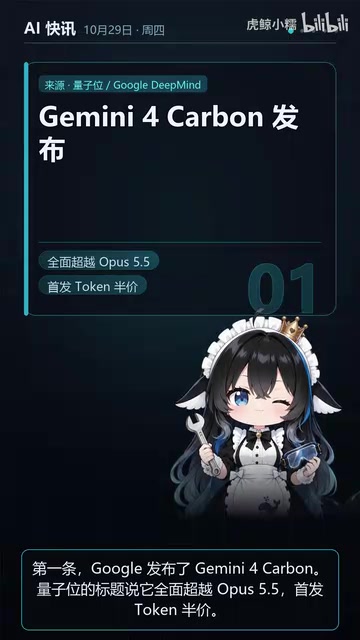
AI Briefing: Gemini 4 Carbon Released, Ant Open-Sources Ling-3.1
AI Briefing: Google releases Gemini 4 Carbon qubit model, claiming to surpass Opus 5.5 with half-price tokens; Ant open-sources Ling-3.1-1019 for real-task Personal Agents; domestic AI drug discovery succeeds in 18 of 19 projects, hitting all 6 GPCR targets; zero-revenue company valued at $20B raises another $1B; Sichuan convenience store robot sales fail.