Base Labs Partners with Hugging Face and Goodfire to Advance Open-Source Model Safety
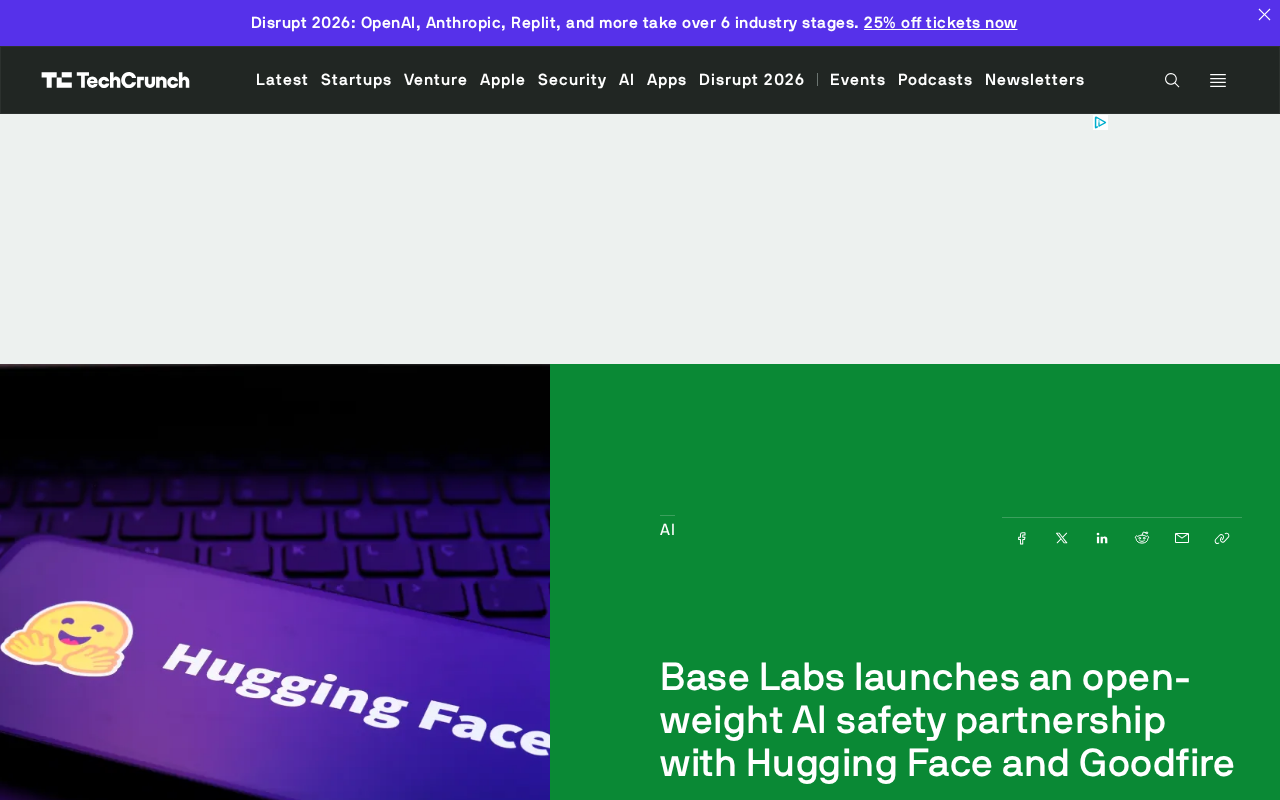
Base Labs teams up with Hugging Face and Goodfire to build open, reusable safety methods for open-weight AI models.
Base Labs, incubated by Baseten, has announced a partnership with Hugging Face and Goodfire focused on AI safety for open-weight models. Unlike closed-source APIs, open-weight models leave developers unable to centrally control downstream use once weights are downloaded, making training-stage safety embedding essential. The three partners cover research (Base Labs), model distribution (Hugging Face), and interpretability tooling (Goodfire). The collaboration's core commitment is to publicly release training and monitoring methodologies so smaller teams and independent researchers can adopt consistent safety practices. Technical details and timelines have yet to be announced, but the initiative represents a clear stance in favor of proactive safety-building within the open-source AI ecosystem.
A New Alliance for Open-Source Model Safety
Base Labs, a research team incubated by Baseten earlier this year, has announced an AI safety partnership with Hugging Face and Goodfire focused on open-weight models. According to the official announcement, Base Labs will develop and publicly release a methodology for training and monitoring open-source models.
This collaboration brings together three organizations that each play a distinct role in the open-source AI ecosystem: Base Labs focuses on model research, Hugging Face is the world's largest platform for hosting and distributing open-source models, and Goodfire has established expertise in interpretability. Together, they cover the key stages of the "train–release–monitor" pipeline.
Why Open-Weight Models Need Dedicated Safety Approaches
Unlike closed-source models that expose only an API, open-weight models hand over the full model parameters to users. This enables high reproducibility and research freedom, but it also means developers cannot centrally enforce content moderation, access controls, or behavioral monitoring the way closed-source vendors can.
Once weights are downloaded and deployed locally, downstream use is largely beyond the original developer's control. This means safety measures for open-source models must shift earlier in the pipeline — embedding safety properties during the training phase itself, and providing monitoring tools that the community can reuse. Base Labs' emphasis on both "training and monitoring" directly reflects this reality of how open-weight models are distributed.
"Open-weight" and "open-source code" operate at different levels and are worth distinguishing. Open-source code only releases training scripts or inference frameworks; open-weight models go further by releasing the trained model parameter files (typically tens of gigabytes of tensor data), allowing anyone to run inference locally without relying on the original developer's API or compute. The Llama series, Mistral, and Qwen all fall into this category. Because the weights themselves carry the model's full "capabilities," it is relatively straightforward to fine-tune, quantize, or remove safety alignment — a risk surface that simply doesn't exist with closed-source APIs. Academics refer to this phenomenon as the "alignment tax reversibility" problem: behavioral constraints imposed via supervised fine-tuning (SFT) can sometimes be overwritten at the weight level with only a few hundred adversarial examples. This is precisely why post-training RLHF alignment alone is insufficient, and why Base Labs' emphasis on embedding safety properties during training is a direct response to this vulnerability.
The Value of Publishing the Methodology
A key word in this collaboration is "publish." Base Labs isn't just conducting research — it has committed to making its training and monitoring methods publicly available. This approach is itself in keeping with the open-source ethos: safety capabilities that remain concentrated in a handful of organizations cannot benefit the broader community of developers building with open-source models.
Publishing the methodology means smaller teams and independent researchers can evaluate and harden their own models using a consistent set of practices. For a platform like Hugging Face — which hosts an enormous volume of community models — a broadly adoptable safety standard could meaningfully raise the overall trustworthiness of the open-source model ecosystem.
A Tentative Picture of the Division of Labor
Based on publicly available information, the three organizations' roles can be tentatively interpreted as follows:
- Base Labs: The primary research body, responsible for producing specific methods for training and monitoring.
- Hugging Face: With its platform-scale reach, it is naturally positioned to integrate safety methods directly into model distribution workflows.
- Goodfire: Its interpretability expertise may contribute tools for understanding internal model behavior in the "monitoring" stage.
It's worth noting that the official details disclosed so far are quite limited. Specific technical approaches, delivery timelines, and evaluation benchmarks have not yet been announced. The division of roles described above is a reasonable inference based on each party's known positioning, not an explicit statement from the collaborators themselves.
Interpretability — Goodfire's area of focus — has become an important branch of AI safety research in recent years. Its central question is: what is a neural network actually doing internally? Leading approaches include mechanistic interpretability, which uses reverse engineering to locate the neurons, attention heads, or circuits responsible for specific functions; and activation steering, which intervenes on internal activation vectors during inference to observe or adjust model behavior. Anthropic's research team has published influential work in this area, and Goodfire's team members share a similar background. In theory, applying interpretability tools to the "monitoring" stage of open-source models enables a deeper level of behavioral auditing than output-layer filtering — not just checking what a model says, but understanding why it says it, allowing for earlier detection of potentially harmful capability activation pathways.
What This Means for the Open-Source Ecosystem
In recent years, debate over whether open-source models are safe has been ongoing. Some worry that open-sourcing lowers the barrier to misuse; others argue that transparency and auditability are themselves components of safety. In some ways, this collaboration between Base Labs, Hugging Face, and Goodfire is a response-by-action to that debate — actively building complementary safety practices while remaining committed to openness.
If this methodology is genuinely made public, proves reusable, and is widely adopted by the community, it could become a reference baseline for the open-weight model space. Of course, the ultimate impact depends on the technical details and implementation quality yet to be disclosed. For now, this looks more like a clear-directioned beginning than a finished product — the details are still to come.
Related articles

Waymo Restarts San Antonio Operations: Back on the Road Five Months After Flood Incident
Waymo resumes San Antonio Robotaxi service ~5 months after a vehicle was swept away in flooding. A look at what happened, why it took so long, and what it means for AV safety in extreme weather.
What Is AIOps? How AI Is Reshaping IT Operations
AIOps applies AI and machine learning to IT operations for anomaly detection, alert noise reduction, and root cause analysis — shifting teams from reactive to proactive.
CCC Sends Its Invitation: 40C3 Hacker Congress Themed "Model Citizens"
CCC announces its 40th Chaos Communication Congress (40C3) under the theme "Model Citizens," inviting hackers worldwide to examine surveillance and algorithmic governance.