Base44-Sponsored Course: AI Agency Business Opportunity or Marketing Gimmick?

Base44-sponsored AI agency course called out as affiliate marketing; exaggerated income promises warrant caution.
Based on Reddit discussions, this article analyzes a free Base44-sponsored AI agency course. It claims to teach hands-on website building and AI agency sales, promising $1,000–$10,000/month. The article notes such courses are essentially affiliate marketing variants: instructors may earn commissions from tool referrals, and income promises are over-glamorized. Community reviews diverge: beginners gain basic skills, but actual income falls far short, with sales difficulty and competition underestimated. It advises verifying sponsorships, seeking independent reviews, treating income claims rationally, and testing small. Conclusion: tools are real, but get-rich-quick shortcuts are rare—stay critical.
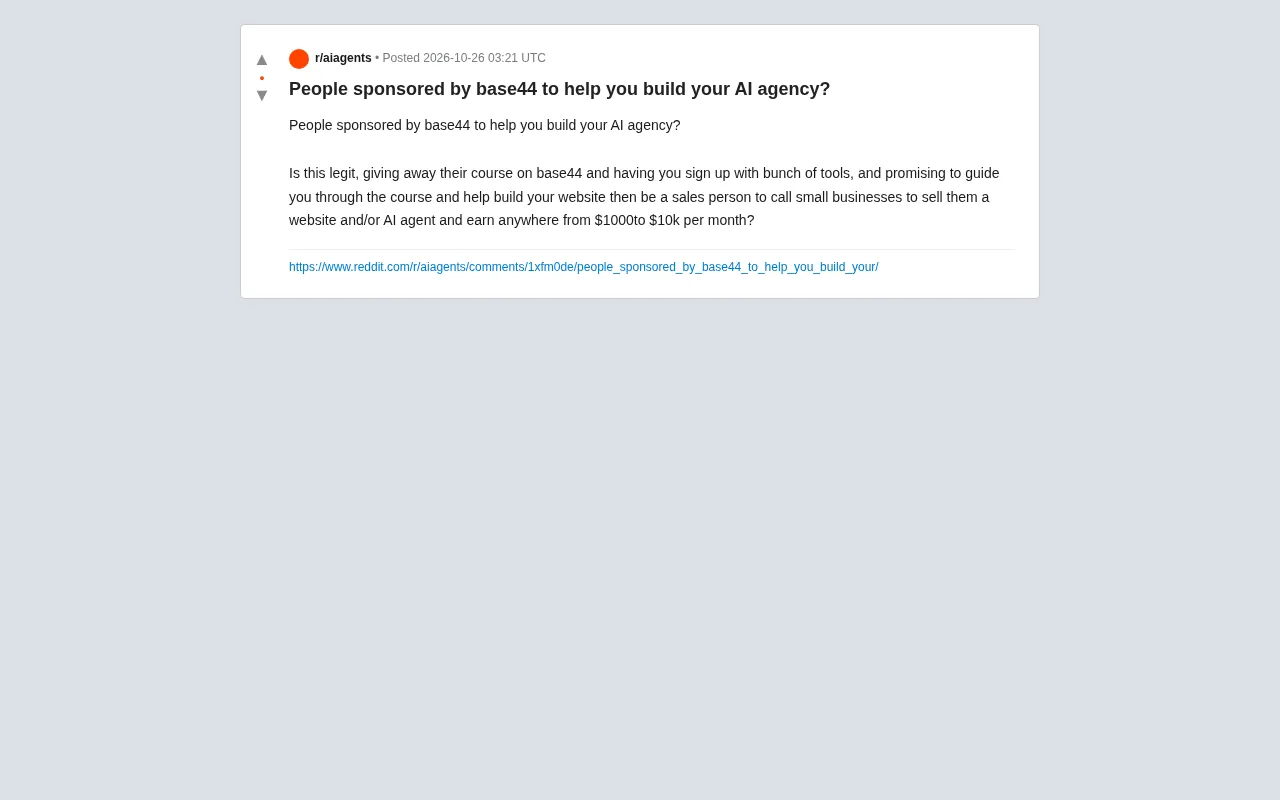
Recently, a striking discussion appeared on Reddit: someone claims to be sponsored by Base44 to offer a free course teaching you how to build an AI agency, promising hands-on guidance to help you build a website, sell, and even guaranteeing $1,000 to $10,000 in monthly income. It sounds like a shortcut to financial freedom, but is there a marketing gimmick behind it? This article dives into this phenomenon based on the original Reddit post and community discussions.
What Is Base44?
Base44 is a no-code AI app-building platform where users can generate complete web applications—including databases, user authentication, and payment integration—by describing them in natural language. It lowers the development barrier, enabling non-technical people to quickly build AI-driven products. This is precisely why Base44 has become an ideal vehicle for many "AI entrepreneurship" courses.
According to the original Reddit post, the sponsored course claims it will teach you to use Base44 and other tools (such as Bubble, Zapier, etc.) to build an AI agency website, then guide you in selling websites or AI agency services to small businesses. The course promises "hands-on guidance" and paints a picture of $1,000 to $10,000 in monthly income.
No-code/Low-code Platform refers to development tools that let users build applications without writing traditional code, through visual interfaces, drag-and-drop components, and natural language configuration. Its core value lies in encapsulating underlying technical complexity (such as database design, API integration, and authentication) into configurable modules, greatly lowering the development barrier. These platforms generally fall into two categories: no-code platforms target users with no programming experience at all, such as Bubble and Base44; low-code platforms allow custom code to be inserted when necessary and suit users with some technical background. For AI agencies, no-code platforms mean they can quickly deliver prototypes or lightweight products to clients, but they may also limit deep customization and face performance and maintainability challenges at scale.
The Business Model of the Sponsored Course
This kind of "sponsored course" is essentially a variant of affiliate marketing. The course provider acquires users through sponsorship, and may earn commissions when users sign up for Base44 and other tools. Meanwhile, the course itself may be free, but subsequent "advanced coaching" or "certification" may require payment.
Reddit community members are skeptical. Some users point out that such courses often exaggerate income potential and ignore market competition and sales difficulty. Another user commented: "If they really could make $10k a month, why would they spend time teaching you?" This reflects a common suspicion: true experts may be more focused on their own business than on teaching.
Affiliate Marketing is a performance-based promotion model: promoters use dedicated links to drive users to visit and sign up for or purchase a partner's products or services, and the partner pays the promoter a commission at an agreed rate. In the AI tool ecosystem, this model is extremely common, because SaaS products (such as Base44, Bubble, and Zapier) often offer recurring commissions—meaning promoters can continue to earn a share as long as the user remains subscribed. Sponsored courses exploit exactly this mechanism: the course itself may be free or low-cost, but the instructor earns long-term commissions from students signing up for tools, and may even prioritize recommending tools with higher commissions rather than those best suited to students. This conflict of interest is a key point to watch for when evaluating such courses.
How Credible Are the Income Promises?
The promise of $1,000 to $10,000 a month sounds tempting, but it needs rational analysis. First, the AI agency market is indeed growing, and there is demand from small businesses for automation tools. However, selling AI agency services requires technical understanding, sales skills, and client trust—it doesn't happen overnight.
According to some community members, the actual results of similar courses vary widely. Some gained basic skills through the course but earned far less than promised; others believe the course provided valuable introductory guidance, but success depends on personal execution and market positioning. This divergence suggests the course may provide a basic framework, but income promises are often overly glamorized.
AI Agent in this context generally refers to a software entity capable of autonomously executing tasks, invoking tools, or conversing with users—for example, customer service bots, sales lead qualification assistants, or automated workflow agents. Building and selling AI agency services involves requirements analysis, prompt engineering, system integration, and ongoing maintenance. The market does have demand from small businesses for automation tools, but competition is also intensifying: on one hand, large SaaS vendors keep rolling out out-of-the-box AI features; on the other, a large number of freelancers and agencies are flooding in, leading to price wars and service homogenization. Therefore, the promise of $1,000 to $10,000 a month needs to be examined within a specific market context—for beginners without sales channels or industry resources, achieving stable income often takes months or longer, and the success rate is far lower than the course advertises.
Multi-Source Perspectives: Community Consensus and Divergence
Synthesizing multiple Reddit discussion threads and YouTube reviews of Base44 courses, some consensus emerges: Base44 is indeed a useful tool, suitable for rapid prototyping; sponsored courses may offer some learning value, especially for complete beginners; but income promises are widely seen as a marketing gimmick and should be treated with caution.
The divergence lies in the quality and ethics of the courses. Some users see this as legitimate business education, as long as the sponsorship relationship is transparently disclosed; others see it as exploiting the information gap to harvest "suckers." You may not have noticed that the original Reddit poster didn't take a clear stance but instead asked "Is this legit?"—revealing widespread doubt.
Information Gap refers to the asymmetry between different groups in accessing, understanding, and using information. In the AI boom, the information gap manifests as follows: some people possess tool usage, market channels, and pricing strategies, while beginners lack this knowledge and are easily attracted to courses packaged as "shortcuts." Sponsored courses profit precisely from the information gap—instructors package publicly available tool knowledge and basic sales scripts into "secret playbooks" and amplify anxiety with income promises. The divergence in the Reddit community is essentially a debate over the ethics of the information gap: one side argues that as long as the sponsorship relationship is transparently disclosed, using the information gap to provide educational services is legitimate business; the other side argues that exaggerating income and concealing conflicts of interest amount to harvesting. Recognizing the existence of the information gap is the first step toward making a rational decision.
How to Evaluate Such Opportunities
When facing such sponsored courses, consider taking the following steps:
- Verify the sponsorship relationship: Check whether the course explicitly discloses its sponsorship or affiliate relationship with Base44 and other tools.
- Search for independent reviews: Search for the course name and instructor background on platforms like Reddit and Trustpilot, looking for non-sponsored third-party reviews.
- Treat income promises rationally: Regard promised income as marketing talk, not a guarantee. Focus on the course syllabus and actual case studies.
- Take small steps and test the waters: If the course is free, learn the basics first, then decide whether to invest more resources.
Conclusion
The Base44-sponsored AI agency course may offer beginners an entry path, but the promise of over $10,000 a month deserves a question mark. In the AI boom, maintaining critical thinking and distinguishing education from marketing is the only way to avoid becoming a "sucker." As one Reddit user put it: "The tools are real, but get-rich-quick shortcuts rarely are."
One-line Summary
Base44-sponsored AI agency course is called out as affiliate marketing; exaggerated income promises demand caution.
Paragraph Summary
Based on Reddit discussions, this article analyzes a free AI agency course sponsored by Base44. The course claims to teach users hands-on how to build websites and sell AI agency services, promising $1,000 to $10,000 in monthly income. The article notes that such courses are essentially variants of affiliate marketing: instructors may earn commissions by recommending tools like Base44, and income promises are often over-glamorized. Community reviews diverge: beginners may gain basic skills, but actual income falls far short of promises, and sales difficulty and competition are underestimated. The article advises verifying sponsorship relationships, searching for independent reviews, treating income promises rationally, and testing the waters with small steps. The conclusion: the tools are real and useful, but get-rich-quick shortcuts are rare—maintain critical thinking.
Related articles

Vibe Coding Full-Stack in Practice: AI Programming from Beginner to Enterprise Deployment
From Cursor to Claude Code, this Bilibili AI programming course uses four progressive projects to cover full-stack development, open-source secondary development, and team collaboration. The article analyzes the shock to frontend roles, the efficiency shift from 50 people to 5, and the methodology required for enterprise-grade projects.

David Blaine's Global Quest for Real Magic: From South Africa to Japan and India
David Blaine travels to South Africa, Japan, and India in his Do Not Attempt special, documenting Spinning drivers, black mamba rescuers, iaijutsu masters, and ascetics—exploring the boundary between magic and real human极限 challenges.

Is a Touchscreen MacBook Coming? Vergecast Reveals Apple Executive's Response
Vergecast podcast reveals a conversation between a reporter and Apple executive John Ternus about a touchscreen MacBook and Apple Pencil support. Ternus says iPad is the best device for a stylus, while the reporter bets MacBook will eventually support Apple Pencil.