BaseCamp: Automating the Decision Layer of DNA Sequencing Data Pipelines with Agentic AI

BaseCamp uses six local AI agents to automate decision-making in DNA sequencing pipelines without replacing proven computational tools.
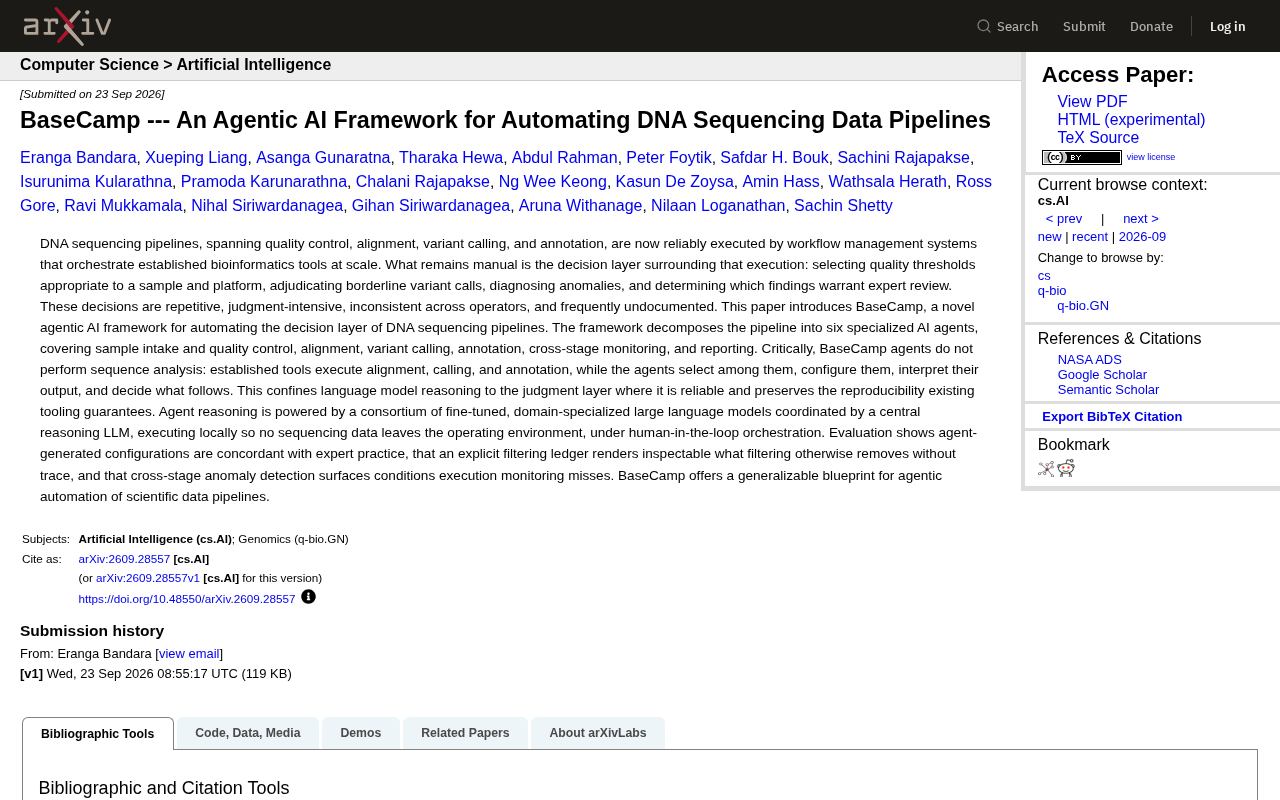
BaseCamp is an agentic AI framework targeting the decision bottleneck in DNA sequencing pipelines. While existing workflows have largely automated the execution layer, judgment tasks like parameter selection, variant adjudication, and anomaly diagnosis still depend on human effort, creating inconsistency and undocumented decisions. BaseCamp decomposes the pipeline into six specialized agents responsible only for selecting tools, configuring parameters, interpreting outputs, and deciding next steps — while actual alignment and variant calling remain with proven tools. The system runs entirely on local models to protect sensitive genomic data, and introduces an explicit filtering ledger and cross-stage anomaly detection to improve auditability. Evaluations show strong alignment with expert practice, and the framework offers a generalizable blueprint for AI adoption in high-reproducibility scientific workflows.
From Execution Automation to Decision Automation
DNA sequencing pipelines have become highly automated over the past decade. From quality control and sequence alignment to variant calling and functional annotation, workflow management systems reliably orchestrate a range of mature bioinformatics tools and execute them at scale. Yet what has truly been automated is only the "execution layer" — the explicitly defined computational steps.
The real bottleneck lies in the "decision layer." A recent arXiv paper introducing the BaseCamp framework targets this exact pain point: selecting appropriate quality thresholds for specific samples and sequencing platforms, adjudicating borderline variant calls, diagnosing data anomalies, and determining which findings warrant expert review — these decisions still rely heavily on human judgment. They are repetitive, cognitively demanding, inconsistent across operators, and rarely documented.
BaseCamp's Core Design Philosophy
BaseCamp is an agentic AI framework for scientific data pipelines that decomposes the entire DNA sequencing workflow into six specialized AI agents, each responsible for: sample intake and quality control, sequence alignment, variant detection, functional annotation, cross-stage monitoring, and final report generation.
The most critical aspect of this design is the explicit demarcation of AI responsibilities: BaseCamp's agents do not perform the sequence analysis itself. The actual alignment, variant calling, and annotation are still carried out by established, proven tools — the agents' job is to select among those tools, configure parameters, interpret outputs, and decide what to do next.
This approach strictly confines large language model reasoning to the "judgment layer" — the stages where models perform reliably and deliver genuine value — while fully preserving the reproducibility guaranteed by the existing toolchain. In other words, AI handles "decisions" and tools handle "computation," each operating within its own domain.
Agentic AI differs fundamentally from traditional single-turn LLM interactions. Agentic AI can autonomously plan multi-step tasks, invoke external tools, dynamically adjust its course of action based on intermediate results, and maintain goal-directed reasoning over extended time horizons. In bioinformatics contexts, this means an agent can not only read a tool's output but also determine whether to switch to a different tool, re-run with modified parameters, or trigger a human review process — a level of flexibility that traditional scripts or rule engines struggle to achieve.
A Local Multi-Model Collaborative Architecture
On the technical side, BaseCamp's agent reasoning is powered by a "model consortium": multiple fine-tuned, domain-specialized large language models coordinated by a central reasoning LLM. This "specialist models + central orchestrator" structure allows different pipeline stages to leverage the model capabilities best suited to each.
Notably, the deployment approach runs all models locally, ensuring that no sequencing data ever leaves the runtime environment. For scenarios involving highly sensitive data such as human genomes, this local-first design directly addresses core privacy and compliance concerns. The entire workflow also operates under a human-in-the-loop orchestration model, preserving necessary human oversight checkpoints.
The privacy sensitivity of genomic data stems from its high identifiability — a human whole-genome sequence is effectively a lifelong biological identifier that, even when anonymized, carries re-identification risks through reference databases. Regulations such as HIPAA (US) and GDPR (EU) impose strict constraints on cross-border transfer and third-party processing of genetic data. Keeping LLM inference entirely local, so data never needs to be uploaded to commercial cloud APIs, is a critical engineering choice for maintaining AI capabilities while satisfying data sovereignty requirements — and a prerequisite for BaseCamp's adoption by healthcare and clinical research institutions.
Evaluation Results and Three Key Capabilities
The paper's evaluation surfaces three noteworthy findings:
- High alignment with expert practice: The parameter configurations automatically generated by the agents matched expert workflows, demonstrating that AI output at the judgment layer is practically usable.
- Auditable filtering ledger: BaseCamp introduces an explicit "filtering ledger" that makes previously silent, untraceable filtering operations visible and inspectable. This is significant for scientific data transparency and traceability — researchers can now know what was filtered and why.
- Cross-stage anomaly detection: Through cross-stage monitoring, BaseCamp can identify anomalies that routine execution monitoring would miss, adding an extra layer of reliability to the pipeline.
The problem addressed by the filtering ledger is particularly acute in bioinformatics. In traditional pipelines, quality filtering steps often discard data silently — low-quality reads, low-confidence variant sites, and samples that fail thresholds leave behind a line-count in the log, but information about why something was filtered, which version of a threshold was applied, and whether it was automatic or manually overridden is rarely recorded systematically. When results need to be reproduced or subjected to peer review, these implicit decisions become blind spots for reproducibility. An explicit ledger transforms each filtering operation into a queryable record — a meaningful step toward bringing "decisions" into the scientific record.
A General Blueprint for Scientific Data Pipelines
BaseCamp's value extends well beyond DNA sequencing. The paper positions it as a generalizable blueprint for agentic automation applicable to a broader range of scientific data pipelines.
The methodological insight is this: when introducing large language models into highly specialized, reproducibility-critical research domains, rather than having AI take over everything end-to-end, the more effective approach is to precisely embed AI into the decision-making junctions where judgment is most needed and consistency is most lacking. This leverages LLMs' reasoning strengths while sidestepping their unreliability on deterministic computation, and it upholds the scientific commitment to transparency and reproducibility.
For teams exploring AI deployment in research settings, BaseCamp offers a pragmatic reference model: define clear boundaries, preserve human oversight, emphasize auditability, and let AI serve as a tool that augments rather than replaces expert judgment.
Related articles

Chain of Thought Isn't Just for AI: How Humans Can Use CoT to Improve Thinking Quality
Chain of Thought isn't just a prompt trick for large models. Starting from a Hacker News discussion, this article analyzes why CoT works for human thinking too, breaks down actionable ways to transfer it, and highlights the key differences between human CoT and machine CoT.
Cloudflare Teams Up with OpenAI: Closi…
Cloudflare Teams Up with OpenAI: Closing the Loop from Vulnerability Discovery to Defense with AI
Cloudflare uses OpenAI Daybreak to investigate security vulnerabilities and generate reviewable remediation plans, while developers use Codex to boost coding efficiency and quality.

Orca Multi-Agent Orchestration in Practice: A Guide to Parallel Collaboration with Claude and Codex
Orca is Stable AI's free open-source agent workbench supporting 34 agents like Claude Code and Codex in parallel. Learn its Git worktree isolation, multi-model orchestration, and mobile management.