Baseus Launches Tracking Spotlight Camera: Proactively Deterring Intruders

Baseus launches a 3K dual-camera security camera with a tracking spotlight, attempting to move from recording to active deterrence.
Baseus has released the Security PrimeSentinel U2 Pro Outdoor 3K dual camera, whose core innovation is a spotlight that can track moving targets and continuously illuminate them, attempting to turn security cameras from passive recorders into active interveners. The product also offers 3K resolution and a dual-camera configuration to improve outdoor monitoring coverage and detail. The article analyzes the psychological logic of active deterrence and the technical support of AI human detection and motion tracking, and points out that tracking accuracy, response speed, and light intensity determine the actual effect. At the same time, the privacy intrusiveness brought by active tracking has sparked discussion, and pricing and specific parameters have not yet been announced, so market performance remains to be tested.
Baseus is redefining the role of security cameras—from passive recorders to active interveners. Its latest Security PrimeSentinel U2 Pro Outdoor 3K dual camera features a movable spotlight that can track and illuminate moving targets, even while they are running. This design aims to proactively deter unwanted visitors, not just record and notify.
From Recording to Deterrence: The Changing Role of Security Cameras
Traditional security cameras mostly stay at the "review afterward" stage: they record footage and send alerts, but cannot influence events as they happen. Baseus's new product attempts to break this pattern. According to the official description, the PrimeSentinel U2 Pro's spotlight shines directly on moving targets and adjusts its direction as the target moves. This "active tracking" capability gives the camera the potential for immediate intervention.
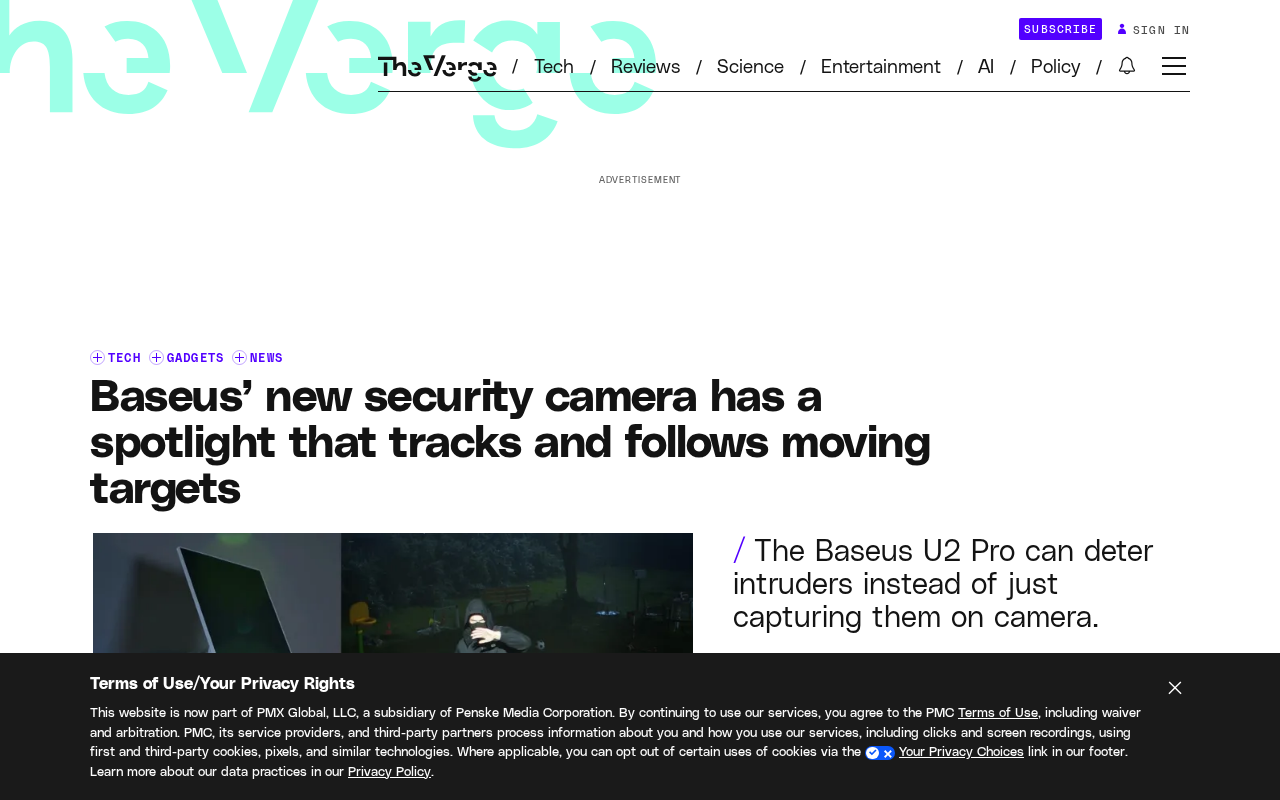
The logic behind this feature is not complicated: most intruders want to act covertly, and suddenly being hit by a strong light that keeps following them significantly increases psychological pressure, potentially causing them to abandon further action. Compared with a simple alarm sound, the visual sense of "being exposed" is often more deterring.
Dual Cameras and 3K Resolution: More Comprehensive Monitoring Coverage
Besides the tracking spotlight, the U2 Pro also adopts a dual-camera design and offers 3K resolution. Dual cameras usually mean a wider field of view or a more flexible monitoring combination—for example, one for a wide panoramic view and the other for detailed close-ups. Although the original information does not detail the specific division of labor between the two cameras, this configuration is becoming increasingly common in outdoor security scenarios.
Compared with mainstream 1080p or 2K, 3K resolution (typically referring to a horizontal resolution of about 3000 pixels) provides clearer image details, which is especially important for recognizing faces, license plates, or distant objects. For outdoor environments, high resolution also helps retain more information in low light.
AI Assistance: From "Seeing" to "Understanding"
Baseus positions this product as an "AI-assisted" security camera. Although the original text does not elaborate on the specific AI functions, given industry trends, AI is usually used for human detection, vehicle recognition, motion tracking, and reducing false alarms. The implementation of the tracking spotlight itself requires computer vision algorithms to identify and track moving targets, which may be the core manifestation of its AI capability.
You may not have noticed that active tracking technology also raises some privacy discussions. When a camera can actively aim a spotlight at moving targets, its surveillance is more "intrusive." How to strike a balance between security and privacy is a problem such products need to face.
The PTZ (pan-tilt-zoom) mechanism is key background for understanding the tracking spotlight. Traditional fixed cameras can only cover a single view, while PTZ cameras use motors to drive the lens or light head to rotate horizontally (pan) and vertically (tilt), and can adjust focal length (zoom). The PrimeSentinel U2 Pro's spotlight can follow moving targets, essentially relying on the coordination of a PTZ gimbal and computer vision algorithms: the algorithm detects and continuously locates the target from the image, calculates the angular offset of the target relative to the camera, and then drives the motor to aim the light head at the target in real time. The smoothness and latency of tracking depend on motor response speed, algorithm frame rate, and target movement speed. When the target is running, the system needs to re-identify and predict its position in every frame, which places high demands on edge computing capability.
Human detection and motion tracking are common focal points of the AI capabilities of such products. Human detection is usually based on lightweight object detection models (such as the YOLO series or vendor-developed models), running on the camera or a local NVR, distinguishing human bodies in the image from swaying trees, pets, vehicles, etc., thereby reducing false alarms. Motion tracking goes further on this basis: the system not only identifies the target but also continuously outputs the target's coordinates in the image, driving the gimbal or spotlight to follow. Compared with simple motion detection (based on pixel changes), human detection can significantly reduce invalid alarms triggered by wind and grass movement. However, such algorithms perform worse at night, in rain and fog, or when the target is partially occluded, which is also an important variable for evaluating the practical usability of the tracking spotlight.
Market Positioning and Competition
The outdoor security camera market is highly competitive, and brands such as Ring, Arlo, and Eufy have already launched multiple products with spotlights and AI features. Baseus's differentiation lies in making the "tracking spotlight" a core selling point and emphasizing active deterrence. For users concerned about backyard, driveway, or doorway security, this "visible" active protection may be attractive.
However, the actual effect depends on tracking accuracy, response speed, and light intensity. If the spotlight tracking lags or misjudges, it may instead cause annoyance. Baseus has not yet announced specific tracking latency, lighting parameters, or pricing information, which will be key to evaluating its actual value.
Active deterrence has been a clear product direction in the security camera industry in recent years, referring to devices actively taking intervention measures when suspicious activity is detected, rather than merely recording and pushing notifications. Common methods include built-in sirens, two-way voice speakers, strobe lights, and the tracking spotlight discussed in this article. Its psychological basis is to increase intruders' sense of "being discovered" and "being watched," thereby increasing the probability that they abandon their actions. Compared with passive recording, active deterrence attempts to move the security time window forward from "post-event evidence collection" to "in-event prevention." But industry practice also shows that the deterrent effect highly depends on the timeliness and accuracy of the response—false triggers or delayed tracking not only weaken deterrence but may also lead to neighbor disputes or privacy complaints.
Conclusion
The Baseus PrimeSentinel U2 Pro Outdoor 3K Dual Camera represents one direction in the evolution of security cameras from "recording" to "intervention." The tracking spotlight is a creative feature, but its actual deterrent effect and privacy impact still need market testing. For users pursuing active security, this product is worth watching; but for the privacy-sensitive, its pros and cons need to be weighed.
Background Supplement
3K resolution in the context of security cameras usually refers to a horizontal pixel count of about 3000 (commonly 2880×1620 or 3072×1728), between 2K (about 2560×1440) and 4K (3840×2160). Compared with 1080p, 3K can provide higher pixel density in the same field of view, which helps identify details such as faces and license plates at a distance; at the same time, its data volume and encoding burden are lower than 4K, making it friendlier for wireless transmission and local storage. In outdoor scenarios, high resolution can also retain more usable detail during digital zoom. However, resolution is not the only factor determining image quality; sensor size, lens aperture, and night vision capability are equally critical, especially in low-light environments when the tracking spotlight is operating.
One-line Summary
Baseus launches a 3K dual-camera security camera with a tracking spotlight, attempting to move from recording to active deterrence.
Paragraph Summary
Baseus has released the Security PrimeSentinel U2 Pro Outdoor 3K dual camera, whose core innovation is a spotlight that can track moving targets and continuously illuminate them, attempting to turn security cameras from passive recorders into active interveners. The product also offers 3K resolution and a dual-camera configuration to improve outdoor monitoring coverage and detail. The article analyzes the psychological logic of active deterrence and the technical support of AI human detection and motion tracking, and points out that tracking accuracy, response speed, and light intensity determine the actual effect. At the same time, the privacy intrusiveness brought by active tracking has sparked discussion, and pricing and specific parameters have not yet been announced, so market performance remains to be tested.
Related articles

Workbuddy for Absolute Beginners: How a Desktop AI Agent Fits Into Real Workflows
A beginner's guide to the Workbuddy desktop AI agent: installation, claiming credits, file management, and building automated workflows—compared with CodeX for fit and cost, helping professionals shift from AI question-askers to AI managers.

OpenAI's New Agent Stack: Computer Use, Decisions API, and Ultra-Fast Workflows
OpenAI Dev Day unveiled a new agent stack: Computer Use outperforms humans, Decisions API delivers ultra-low-latency classification via Luna, Agents API opens the same Computer Use capabilities, and GPT-6.1 Sol costs only one-seventh of Astra. Core updates, benchmark data, and developer insights.

Liang Wenfeng Open-Sources DeepInfo Inference Framework, Takes On U.S. Ban
DeepSeek open-sources its DeepInfo inference framework after its models, featuring GPU/CPU cross-pipelining, small-model prediction with large-model verification, and full Huawei Ascend and NVIDIA chip support—facing the U.S. federal ban head-on. This article analyzes its significance for AI deployment and open-source strategy.