Battle Royale: Analyzing the 16-Agent MARL Competitive League
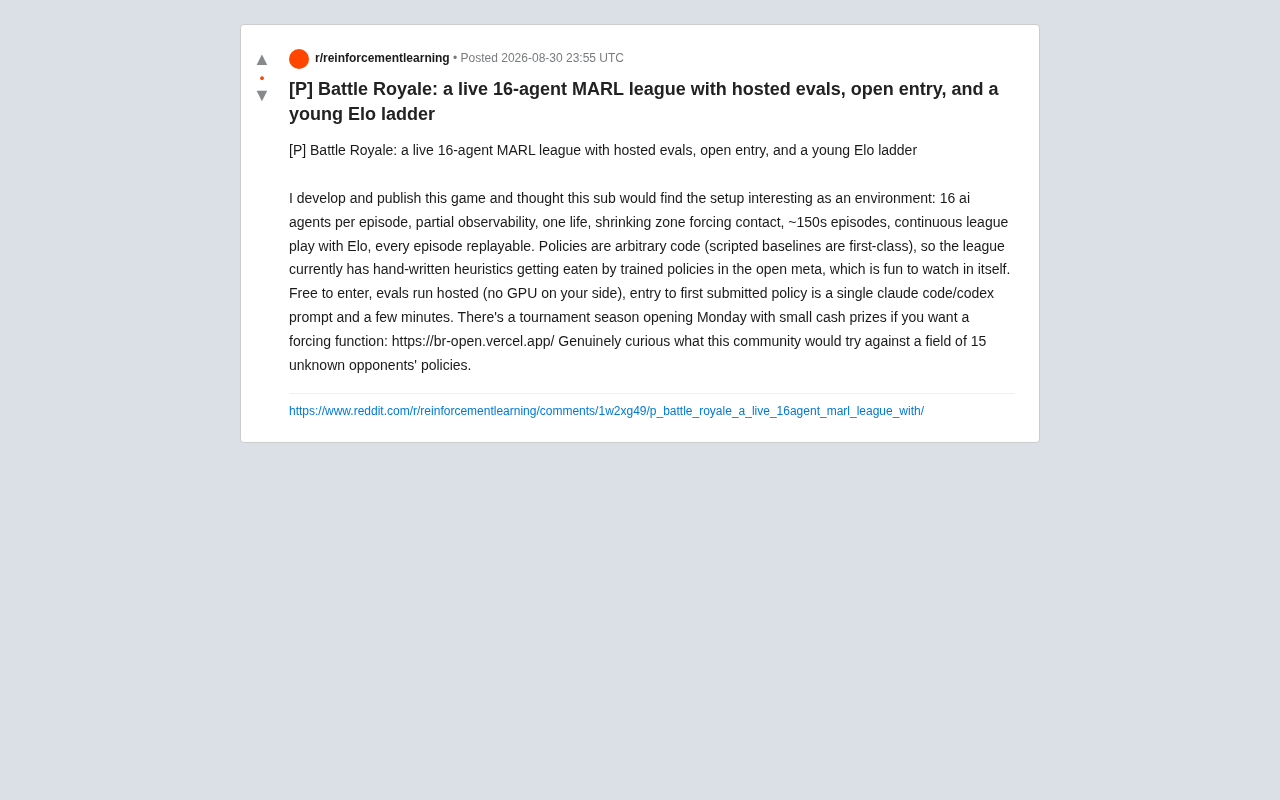
Battle Royale: A 16-agent MARL arena with hosted evaluation, open meta-game, and continuous Elo rankings
Battle Royale brings battle royale game mechanics to multi-agent reinforcement learning with 16 AI agents competing in partially observable environments. The platform features hosted server-side evaluation (no GPU needed), an open meta-game where any strategy can compete, and continuous Elo rankings. It represents a new paradigm in MARL infrastructure—moving from closed lab experiments to open, evolving competitive ecosystems.
When Reinforcement Learning Meets "Battle Royale"
Multi-agent reinforcement learning (MARL) has always been one of the most challenging directions in AI research. Unlike single-agent environments, MARL must handle complex game-theoretic relationships among agents—including cooperation, competition, and adversarial dynamics—making both training and evaluation exceptionally difficult. Looking back at the evolution of MARL, from early matrix games and grid worlds to DeepMind's StarCraft AlphaStar and OpenAI's Dota 2 AI "OpenAI Five," researchers have continuously sought environments that can fully test multi-agent interaction capabilities. Core challenges in MARL include: non-stationarity of the environment (each agent's policy is changing, causing the "environment" faced by other agents to constantly shift), credit assignment problems (in multi-agent collaboration, how to determine each agent's contribution to the final outcome), and exponential explosion of the strategy space. These challenges mean that traditional single-agent RL algorithms—such as PPO and SAC—often perform poorly when directly applied to multi-agent scenarios, leading to the development of specialized multi-agent algorithms like QMIX, MAPPO, and MADDPG.
Recently, a project called Battle Royale has sparked discussion in the Reddit machine learning community—it brings the "battle royale" game mechanics into the reinforcement learning arena, creating a continuously running online league with 16 agents.
The core setup of this project is highly compelling: each match (episode) features 16 AI agents competing simultaneously in a partial observability setting, where each agent has only one life, and a constantly shrinking safe zone forces agents into contact and conflict. Each match lasts approximately 150 seconds, all matches are replayable, and the league runs continuously using an Elo rating system.
The Elo rating system was originally designed in the 1960s by Hungarian-American physics professor Arpad Elo for chess. Its core idea is to dynamically adjust players' scores based on the strength of their opponents—defeating a high-rated opponent earns more points, while losing to a low-rated opponent results in greater point deductions. Its mathematical foundation is built on a logarithmic probability model: the expected win rate between two players is determined by their rating difference, with approximately a 10:1 win probability for every 400-point gap. In AI, the Elo system has been widely used to evaluate agent performance—for example, DeepMind used Elo in their AlphaGo and AlphaStar papers to measure the relative strength of different model versions. For multi-agent scenarios, the advantage of the Elo system is that it doesn't require an absolute evaluation standard; instead, it approximates each agent's true skill level through relative win/loss records from numerous matches. However, traditional Elo was designed for 1v1 competition. In a 16-player "battle royale" scenario, multi-player Elo variants are typically needed (such as converting each match's rankings into pairwise comparisons) for scoring.
Why This MARL Environment Is Worth Attention
True Open Meta-Game
The most interesting aspect of Battle Royale is its "open meta." The project allows submission of arbitrary code as strategies—scripted baselines are treated as "first-class citizens," competing on equal footing with trained neural network policies.
The concept of "metagame" is an important one in game theory, referring to the "game of strategy selection" that forms above a set of available strategies. In competitive scenarios, if strategy A counters strategy B, strategy B counters strategy C, and strategy C counters strategy A, a "rock-paper-scissors"-like meta-game cycle emerges. In traditional closed experiments, researchers typically preset a fixed pool of opponent strategies, making the meta-game structure static. In an open meta-game, anyone can submit new strategies at any time, meaning the meta-game structure evolves dynamically—a once-optimal strategy might be "countered" by newly emerged strategies, triggering chain reactions across the entire strategic ecosystem. This dynamism strongly aligns with the "Red Queen effect" from evolutionary game theory: you must keep running (evolving) just to stay in place (maintain competitiveness). Nash equilibrium in such open environments may be constantly shifting, providing extremely rich experimental material for studying strategic robustness and generalization in MARL.
Developers have observed an intriguing phenomenon: in the open competitive environment, hand-crafted heuristic rule-based strategies are being "eaten" by trained strategies. This itself constitutes a vivid experiment—intuitively demonstrating the evolutionary advantage of learned strategies over manually designed rules in complex game environments. For researchers, this real, dynamic adversarial ecology is far more convincing than static benchmark tests.
Partial Observability and Forced Conflict Mechanisms
From an environment design perspective, several key mechanisms deserve emphasis:
-
Partial observability: Agents cannot see global information and must make decisions under uncertainty, which better reflects real-world problems. In reinforcement learning's theoretical framework, fully observable environments are modeled as Markov Decision Processes (MDPs), where agents can obtain complete environmental state information. However, partially observable environments correspond to Partially Observable Markov Decision Processes (POMDPs), where agents only receive partial observations of the state—similar to humans operating in the fog of war. POMDPs are computationally much more challenging than MDPs because agents need to maintain a "belief" about the environment's true state and make decisions based on this uncertain belief. In practice, common approaches include using Recurrent Neural Networks (RNNs) or Transformers to aggregate historical observation information, thereby implicitly maintaining belief states. In Battle Royale's 16-player environment, partial observability means agents don't know the positions and states of opponents outside their field of view, forcing agents to learn advanced behaviors like active exploration, information gathering, and risk assessment.
-
Shrinking safe zone: This mechanism borrows from the classic design of battle royale games like PUBG and Fortnite, forcing agent contact and preventing degenerate "passive avoidance" strategies, ensuring sufficient game interaction in each match. From a reinforcement learning perspective, the shrinking safe zone is essentially a form of "curriculum design"—as available space decreases over time, agents are forced to transition from a low-conflict "exploration phase" to a high-conflict "decisive battle phase." This natural difficulty progression places higher demands on strategy robustness.
-
Single life: One death means elimination, increasing the weight of each decision and testing strategies' long-term planning capabilities. This contrasts sharply with many RL training environments that allow frequent respawning—with only one life, agents must learn to balance risk and reward, avoiding greedy short-sighted behavior.
-
15 unknown opponents: Facing a field of 15 unknown strategies, agents must possess generalization and adaptation capabilities rather than overfitting to specific opponents. This setup directly challenges a core problem in MARL—opponent modeling. Should agents infer opponent strategy types in real-time during matches and adjust accordingly? Or should they train a general strategy robust to all possible opponent types? These two philosophical approaches have long been debated in MARL research.
These design elements together constitute a high-dimensional, dynamic, adversarial testbed that poses real challenges to current multi-agent reinforcement learning algorithms.
Extremely Low Participation Barrier: MARL Without GPUs
For developers and researchers interested in trying this, the project has done extensive engineering work to lower the barrier:
- Free participation: No payment required to enter the league.
- Hosted evaluation: All evaluations run server-side, so participants don't need their own GPUs, dramatically reducing experimental costs.
- Quick start: According to developers, submitting your first strategy only requires a Claude Code or Codex prompt and can be completed in minutes.
This "zero infrastructure" design philosophy is significant. Traditional multi-agent reinforcement learning experiments often have daunting computational requirements: OpenAI Five's Dota 2 AI training used 256 GPUs and 128,000 CPU cores, consuming hundreds of petaflop-days of compute; DeepMind's AlphaStar also used thousands of TPUs. Even smaller-scale MARL experiments typically require simultaneously simulating multiple environment instances to collect experience data, placing high demands on GPUs and memory. By fully hosting evaluation computation server-side, Battle Royale only requires participants to submit strategy code (either pre-trained model weights with inference code or pure rule-based scripts), enabling more individual developers and students lacking computational resources to participate in MARL research and practice.
This model isn't entirely novel—some Kaggle AI competitions (like Connect X and Hungry Geese) and the Lux AI Challenge have adopted similar hosted evaluation approaches, but Battle Royale goes further in terms of agent count (16) and environment complexity. Compared to traditional multi-agent reinforcement learning experiments that often require large-scale clusters, this hosted competitive platform model undoubtedly lowers the cost of exploration.
Upcoming Tournament
Developers have revealed that a new tournament season is about to begin, with small cash prizes. This kind of incentive-driven "forcing function" often effectively stimulates community participation and strategic innovation. The project is hosted at br-open.vercel.app.
At the end of the post, developers pose an open-ended question: facing a battlefield of 15 unknown opponent strategies, what approaches will the machine learning community try? This is precisely the value of such open competitive platforms—they transform research questions into continuously evolving public experiments where anyone's creative ideas might change the entire meta-game landscape. From a technical approach perspective, methods the community might try include: self-play-based training strategies, borrowing from the successful experience of AlphaGo/AlphaStar by having agents compete against their own historical versions during training to improve robustness; population-based training (PBT) methods that simultaneously maintain a population of multiple strategies competing and evolving against each other; and recently emerging approaches combining large language models (LLMs) with RL, leveraging LLM reasoning capabilities to generate high-level tactical planning executed by lower-level controllers.
Implications for MARL Research Infrastructure
From a broader perspective, Battle Royale represents a new trend in multi-agent reinforcement learning research infrastructure: moving evaluation from closed laboratories to open, continuously running online arenas. The significance of such platforms lies not only in lowering participation barriers but also in generating real, dynamic adversarial data—mutual adaptation between strategies, meta-game evolution, and emergent tactics are all valuable information that static benchmarks cannot capture.
This trend actually echoes a broader paradigm shift in AI evaluation. Traditional AI benchmarks—such as Atari games and MuJoCo physics simulations—provide standardized evaluation environments, but they are static and easily "gamed" through optimization. Researchers increasingly recognize that the true measure of agent capability is not achieving high scores on fixed test sets, but maintaining competitiveness in open, constantly changing opponent ecosystems. This parallels the shift in software engineering from "unit testing" to "production environment monitoring." Similar platform-level evaluation thinking has emerged in other AI subfields: for example, Chatbot Arena uses blind human evaluation to continuously assess large language models' conversational abilities, with its Elo rankings becoming an important reference metric in the LLM field.
Of course, as a project initiated by an individual developer, its long-term activity level, evaluation fairness, and anti-cheating mechanisms remain to be observed. For anti-cheating, since participants submit executable code, the platform needs to consider code security (sandbox isolation), computational resource limits (preventing submissions that consume excessive CPU/memory), and strategy collusion (multiple accounts submitting coordinated strategies to "feed" each other points). Regardless, this "open entry + hosted evaluation + Elo ladder" model provides a valuable template for community-driven MARL research. For researchers wanting to quickly validate multi-agent reinforcement learning ideas without spending energy on infrastructure, this may be an excellent testing ground.
Key Takeaways
Related articles

Cursor Tutorial: Building a Python Student Management System from Scratch with AI
Learn Cursor AI editor's Agent, Ask, and Manual modes with a hands-on demo building a Python student management system using Claude, from tech stack selection to deployment.

NotebookLM Usage Limits Are Here: A Complete Guide to Google's Flexible Quota System
Google introduces flexible usage limits for NotebookLM. Learn how the new quota system affects free and paid users, and what it means for the AI industry's shift toward sustainable operations.

AI Agent Performance Optimization in Practice: Three Key Upgrades That Dramatically Improved Output Quality
Deep dive into three key AI Agent upgrades: eliminating silent failures, setting approval gates, and sub-agent parallel processing. Practical tips for building trustworthy automated workflows.