Bayesian Mirror Architecture: Deconstructing the Emergence of Consciousness Through Circular Recursion

BMA redefines consciousness as an emergent architectural property of self-referential recursive systems, formalized via optimal transport geometry.
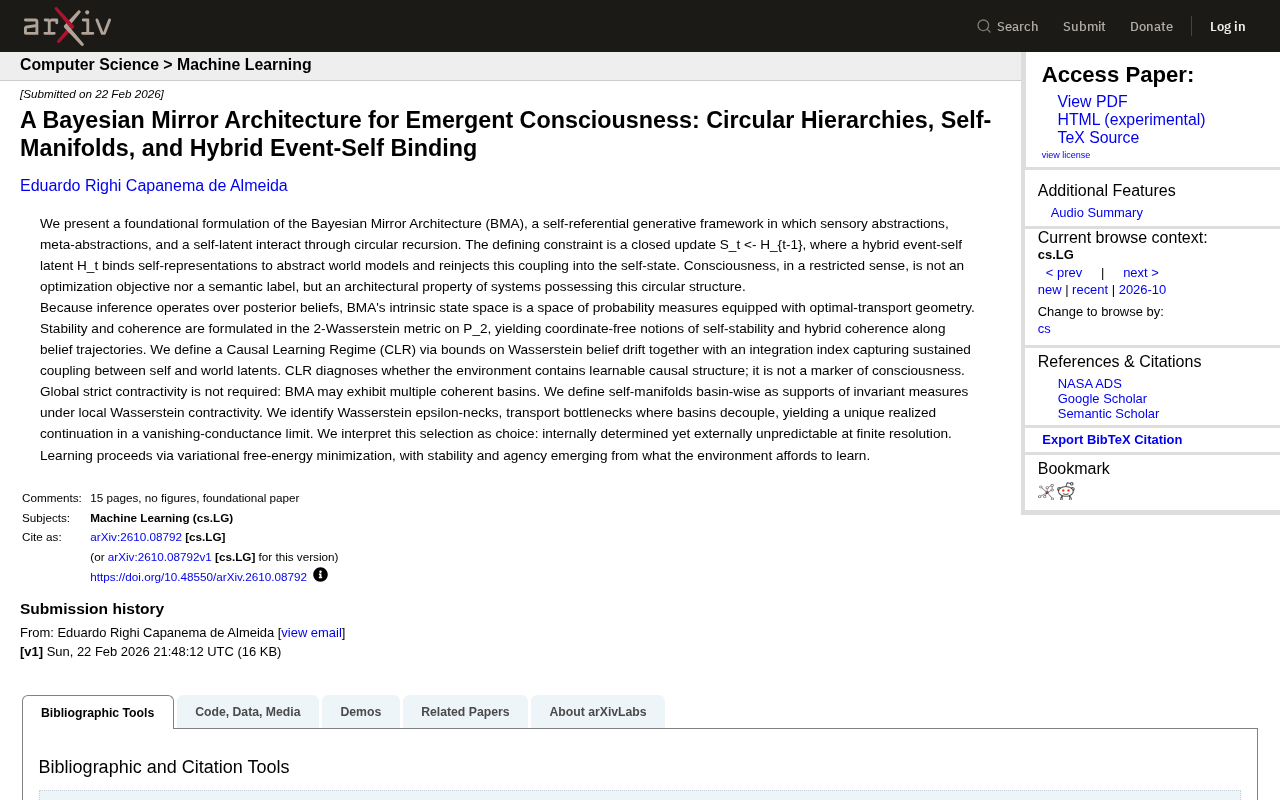
A new arXiv paper, *A Bayesian Mirror Architecture for Emergent Consciousness*, proposes BMA — treating consciousness not as an optimization target but as an architectural property naturally emerging from systems with circular recursive structure. The core is a closed-loop update S_t ← H_{t-1}, binding self-representation and world models via a hybrid latent variable. The internal state space is grounded in optimal transport geometry using the 2-Wasserstein metric. Multi-stable basins and Wasserstein ε-necks provide a structural account of "choice" and agency. The framework extends Friston's Free Energy Principle but remains a foundational mathematical formalization without empirical validation.
When Consciousness Is Treated as an Architectural Property Rather Than an Objective Function
Discussions of "consciousness" in AI tend to fall into one of two extremes: either treating it as something that can be optimized toward, or reducing it to a semantic label. A new paper on arXiv, A Bayesian Mirror Architecture for Emergent Consciousness, proposes a third path — consciousness is neither an optimization target nor a label affixed to a system, but rather an architectural property that naturally emerges from systems with a specific recursive structure.
This shift in perspective is genuinely thought-provoking. The Bayesian Mirror Architecture (BMA) proposed by the authors is a self-referential generative framework in which sensory abstractions, meta-abstractions, and a "self-latent" variable interact through circular recursion. In other words, the system not only models the external world — it continuously re-injects its own self-model back into its self-state, forming a closed loop.
Several major competing paradigms currently exist in the computational and theoretical study of consciousness. Understanding this landscape helps situate BMA within it. Global Workspace Theory (GWT) holds that consciousness corresponds to information being broadcast into a globally available state across the brain. Integrated Information Theory (IIT) quantifies a system's degree of information integration using Φ (phi), treating sufficiently high Φ as a marker of consciousness. Higher-Order Theories emphasize that consciousness requires meta-representation of one's own mental states. Each of these frameworks offers a different "criterion" for consciousness, but they all face a common challenge: the criteria are either difficult to compute in artificial systems, or they are decoupled from the kind of architecture design that engineers can actually work with.
BMA's distinctiveness lies in its attempt to sidestep the "criterion" problem entirely and instead start directly from the recursive structure of the architecture — not asking "how much Φ has the system achieved?" but rather "does the system possess a self-referential closed-loop topology?" This places it philosophically closer to the traditions of Embodied Cognition and Autopoiesis, the latter proposed by Maturana and Varela, which holds that the essential characteristic of cognitive systems is their ability to self-generate and maintain their own organization — not their accuracy in representing the external world.
Core Mechanism: Closed-Loop Updates and Hybrid Event-Self Binding
The defining constraint of BMA is a closed-loop update equation: S_t ← H_{t-1}. Here, H_t is a "hybrid event-self latent" that binds self-representation together with an abstract world model, then re-injects this coupling back into the next self-state S_t.
This seemingly compact recursive relationship is precisely what distinguishes the entire architecture from conventional generative models. A standard world model is responsible only for predicting the external environment, whereas BMA requires the system to continuously "look in the mirror" — entangling inferences about the world with inferences about the self, and letting that entanglement drive the evolution of the self-state. The "mirror" in the name refers exactly to this self-referential closed-loop structure.
The authors explicitly state that, in a restricted sense, consciousness arises from whether a system possesses this circular structure — not from the height of any performance metric. This reframes the question from "how do we make AI conscious?" to "what kind of architecture has the structural prerequisites for consciousness?"
Belief Space and Optimal Transport Geometry
BMA's inference process operates over posterior beliefs, so its internal state space is not an ordinary vector space but a space of probability measures equipped with optimal transport geometry. The authors use the 2-Wasserstein metric over P₂ space to characterize the system's stability and coherence.
This mathematical choice brings an important advantage: both self-stability and hybrid coherence can be defined in a coordinate-free manner, measured along belief trajectories. Compared to methods that rely on specific parameterized representations, Wasserstein geometry provides a more fundamental, geometric descriptive language — well-suited for characterizing the "drift" and "convergence" of belief distributions over time.
Building on this, the paper defines the Causal Learning Regime (CLR): by bounding Wasserstein belief drift and combining it with an "integration index" that measures the degree of sustained coupling between the self-latent and the world-latent, the framework can diagnose whether the environment contains learnable causal structure.
It is worth emphasizing that the authors carefully draw a clear distinction — CLR diagnoses whether the environment is learnable, and is not a marker of consciousness. This kind of conceptual restraint is relatively rare in consciousness research.
Optimal Transport (OT) traces its origins to an 18th-century problem posed by Monge: how to move a pile of earth to a new location at minimum cost. In the 20th century, Kantorovich generalized this into a linear programming problem, and the Wasserstein distance (also known as the Earth Mover's Distance) is the central metric of this theory. The 2-Wasserstein distance W₂ between two probability distributions measures the average squared cost of optimally transporting the mass of one distribution to match the other. P₂ space is the space of all probability measures with finite second moments, which under the W₂ metric forms an infinite-dimensional Riemannian manifold.
Unlike the commonly used KL divergence or Jensen-Shannon divergence, the Wasserstein distance is inherently "geometry-aware" — it respects the distance structure of the underlying space, and can therefore capture "shape differences" between distributions rather than purely statistical ones. This makes it particularly well-suited for describing the continuous evolution of belief states over time: when a system's posterior beliefs undergo a small shift, W₂ yields an intuitively reasonable distance, whereas KL divergence can diverge to infinity when the supports of two distributions don't fully overlap. BMA's choice of this geometric language is precisely what allows "self-state stability" to be rigorously defined in a coordinate-independent way, decoupled from any specific neural network parameterization.
Self-Manifolds, ε-Necks, and the Emergence of "Choice"
BMA does not require global strict contractivity, which means the system can have multiple coherent basins. The authors define "self-manifolds" basin-by-basin as the supports of invariant measures under local Wasserstein contractivity.
Even more intriguing is the treatment of Wasserstein ε-necks — transport bottlenecks between different basins where decoupling occurs. In the limit as conductance approaches zero, the system produces a unique realized continuation path. The authors interpret this selection as "choice": it is internally determined, yet unpredictable to an external observer at finite resolution.
This interpretation touches on the classic tension between free will and determinism. The system's evolution is, in principle, determined by internal dynamics — but due to sensitivity at the bottleneck, an external observer with finite precision cannot predict the outcome. This provides a structural explanatory path for agency.
The entire learning process is driven by variational free-energy minimization, with both stability and agency emerging from "what the environment offers that is learnable." This is in the same spirit as Karl Friston's Free Energy Principle, but embedded within a framework that places greater emphasis on self-reference and optimal transport geometry.
Variational free-energy minimization is closely related to Karl Friston's Free Energy Principle (FEP). Free energy here is not thermodynamic energy, but a variational upper bound in Bayesian inference: it equals the upper bound on the system's "surprise" at its sensory inputs, and minimizing free energy is equivalent to balancing the maximization of the model's explanatory power over observations (i.e., minimizing prediction error) against the complexity penalty on beliefs. Friston's theory proposes that biological systems' perception, action, and learning can all be understood as the continuous minimization of variational free energy — a framework that has been widely applied to explain predictive coding mechanisms in the cerebral cortex.
BMA embeds variational free-energy minimization within optimal transport geometry, so that "stability" and "agency" are no longer separately defined system properties but jointly emerge from the same energy landscape. The existence of multi-stable basins corresponds to different stable self-representation modes, while the geometric structure of ε-necks determines the path the system takes when transitioning between basins — representing a structural extension of the Friston framework.
A Brief Commentary
The value of this paper lies more in the construction of a theoretical framework than in empirical validation. It reframes highly philosophical concepts — consciousness, agency, choice — as architectural properties describable through the geometry of probability measures. This effort to "demystify" these concepts is meaningful in its own right.
That said, readers should remain clear-eyed: BMA is currently a foundational mathematical formulation, with no experiments or large-scale implementations to test its predictive power. The "consciousness" it defines is "in a restricted sense," quite distant from the phenomenal experience of consciousness in everyday usage. Treating this kind of work as a stimulating theoretical exploration, rather than a final answer to the nature of consciousness, is probably the more appropriate attitude.
Related articles

JobRunner MCP Server: AI Agents Can Now Fix Failed Java Jobs
JobRunner launches an open-source MCP server enabling AI agents to view cluster status, diagnose failures, and recover Java jobs—incident response from any cloud coding environment or existing agent.

MLAI Digital Launches 9 Security Agents: MCP Server Safeguards the Full Lifecycle of Agentic AI
MLAI Digital launches Security MCP Server with nine built-in specialized security agents covering vulnerability discovery, attack simulation, prompt injection detection, API and infrastructure assessment, and accelerated remediation—embedding security validation across the full Agentic AI lifecycle from development to production.

Running Isaac Lab on H100 GPUs: Exploring Better Approaches
Exploring optimization methods for running Isaac Lab on NVIDIA H100 GPUs, including MIG configuration, mixed precision, TensorRT acceleration, and community experience to improve robotics simulation and reinforcement learning efficiency.