Beating Meta to the Punch: I DIY'd My Own AI Virtual Pet

Meta turned AI into a charm pet, but DIY players had already built their own versions with open-source hardware.
Meta launched Muse Charm during the holiday season, putting AI models into a plush charm as a consumer electronics and emotional companionship product. The author refused to buy one, since a DIY version already exists at home. The article explains how Raspberry Pi, Arduino, open-source speech models, and local small language models let individuals build a talking, expressive AI pet for tens to hundreds of dollars over a weekend. DIY wins on customization, repairability, and learning, while big-tech AI hardware struggles to standardize personalized experiences. The author sees AI hardware following the PC path: enthusiast assembly, then complete systems, then a tiered market.
Meta Wrapped AI in a Plush Charm — But I Chose Not to Buy One
Meta launched Muse Charm during the holiday season, packaging AI as a soft, adorable little clip-on charm in an attempt to get everyone to carry an AI assistant around like a virtual pet. But the author's choice was unexpected: not buying one, because "we already have a Muse Charm at home." This article is about the logic behind that DIY alternative — before tech giants turn AI hardware into a consumer electronics hit, hands-on users have already pieced together their own AI Tamagotchi using open-source tools.
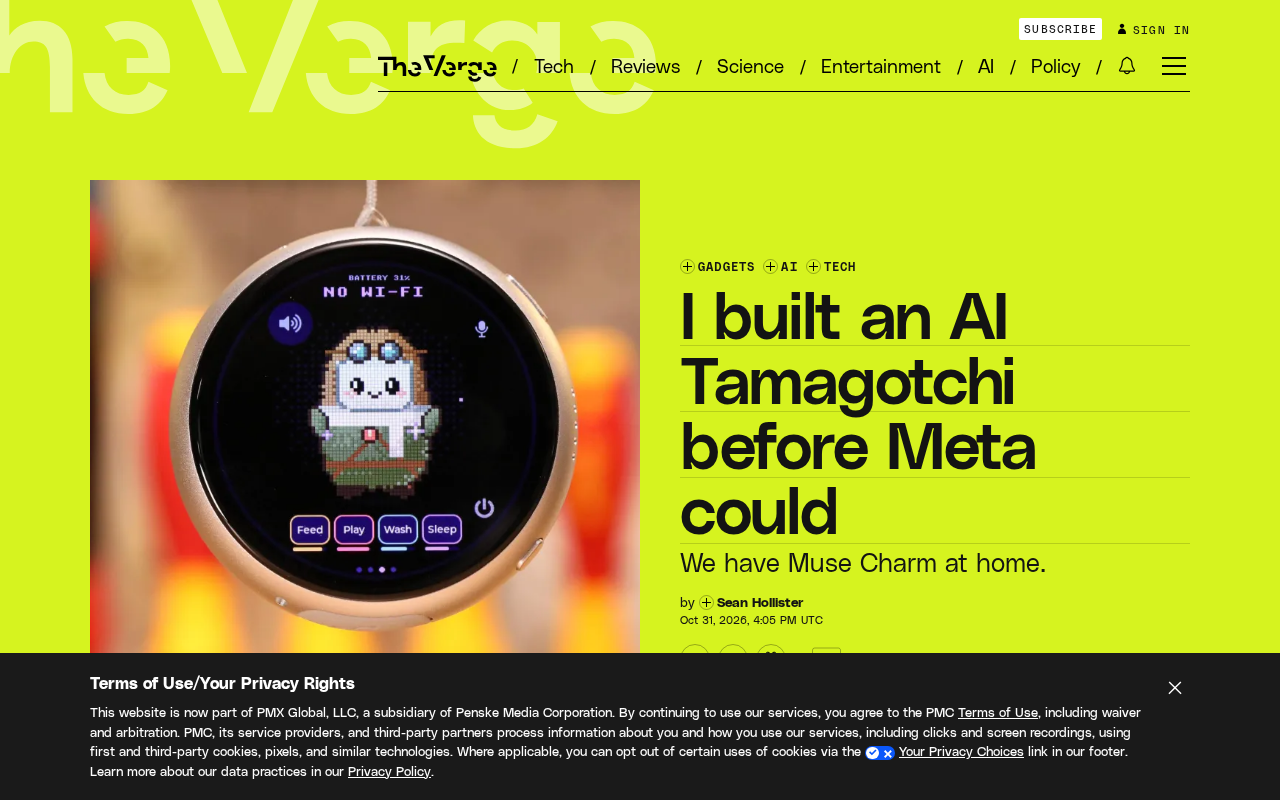
When an AI Assistant Becomes a Pet Hanging on Your Bag
Zuckerberg gave AI a soft little face, stuffing cold model capabilities into a plush-textured body, hoping users would treat AI as a living companion rather than a tool. Muse Charm's positioning is clear: holiday gift, carry it anywhere, emotional companionship. It pulls AI interaction out of the phone screen and turns it into a physical object you can squeeze, hang, and show off.
The product thinking isn't complicated — use a hardware form factor to lower the barrier to AI use, and use anthropomorphic design to create emotional connection. But it also exposes a problem: when AI hardware starts following the consumer electronics playbook, the premium users pay is often not for model capabilities, but for industrial design and brand storytelling.
"We Already Have One at Home": The DIY Alternative
The author's reason for refusing to buy Muse Charm is straightforward — there's already one at home. Behind that statement lies the current state of the DIY AI hardware community: Raspberry Pi, Arduino, open-source speech models, cheap sensors — combine these materials and you have enough to build an AI virtual pet that can talk, show expressions, and even interact.
The barrier to entry for these projects is dropping fast. Open-source speech recognition and speech synthesis models make conversational ability readily accessible, small language models can run on local devices, and 3D printing plus off-the-shelf enclosures mean appearance is no longer a big-company patent. A weekend's time, plus parts costing anywhere from tens to hundreds of dollars, is enough to assemble a prototype that matches consumer-grade products in functionality.
Of course, DIY solutions can't compare with mass-produced products in stability, battery life, build quality, and after-sales support. But their advantage is that they're customizable, repairable, and educational — you know exactly what every part does, and you can modify interaction logic to your liking. For people willing to get their hands dirty, that sense of control is part of the fun.
Raspberry Pi and Arduino are the two most commonly used platforms in the DIY hardware community, and they complement each other. The Raspberry Pi is essentially a complete single-board computer running Linux, with USB, HDMI, GPIO and other interfaces, and enough compute to run small language models or speech processing pipelines locally — suited to playing the "brain" role. Arduino is a microcontroller with extremely limited resources, but good real-time performance, low power consumption, and an easy learning curve; it's often used to drive servos, read sensors, and control LED expressions — the "body" movements. Many AI pet projects adopt a dual-board architecture: the Raspberry Pi handles speech recognition and dialogue generation, while the Arduino handles motion and expression feedback, with the two communicating over serial. This division of labor lets hobbyists quickly build interactive prototypes without designing circuits from scratch.
Locally running small language models are the key that made such projects feasible only in the past two years. In the past, conversational ability almost always depended on cloud APIs, meaning ongoing costs, network dependency, and privacy concerns. But open-source models with parameter counts below the billion level, after quantization and compression, can already perform inference at acceptable speeds on devices like the Raspberry Pi. Combined with open-source speech recognition (such as the Whisper series) and speech synthesis (lightweight solutions like Piper), the entire "listen—think—speak" chain can be completed offline. The trade-off is that model capabilities are weaker than cloud-based large models, with limited depth of answers and breadth of common sense — but for an electronic pet focused on companionship and simple interaction, that's plenty, and there are no subscription costs and it works even when the network is down.
The Dilemma of Big Tech Building AI Hardware
Meta's entry into AI pet hardware shows that this category is being validated by the mainstream market. But big companies face an inherent contradiction with such products: on one hand, they need to control costs, ensure quality control, and mass-produce; on the other hand, the personalized experience of AI hardware is hard to standardize. A talking little charm whose conversations are all the same will get tossed in a drawer once the novelty wears off.
The DIY community fills exactly this gap. Open-source projects can iterate quickly and be modified freely — users are both consumers and creators. This model won't replace big-company products, but it will make some users more picky about "buying a ready-made AI pet" — they'll ask: could I build this feature myself? Is this price worth it?
From a longer perspective, the adoption path of AI hardware may resemble that of the personal computer: first enthusiasts assemble their own, then big companies launch complete systems, and finally a tiered market emerges. Muse Charm represents the step toward complete systems, while DIY players like the author represent the continuation of the enthusiast phase. The two groups don't conflict — they just understand "AI pets" differently.
The premium structure of consumer electronics is worth breaking down here. The price of an AI charm usually consists of several parts: material costs (chip, battery, enclosure, microphone and speaker), R&D and tooling amortization, channel and marketing expenses, brand premium, and possibly cloud inference costs. For DIY players, material cost is the only part they must pay, and they can often buy equivalent components at small-batch retail prices. The reason big-company products seem expensive is largely that you're paying for design, quality control, compliance certification, and after-sales service. Understanding this explains why two things with "similar functionality" can differ several times in price — they're not really selling the same product.
Is DIY Worth It?
If you just want a cute AI charm, a mass-produced product is clearly less hassle. But if you're curious about how AI hardware works, or want an electronic pet customized entirely to your own ideas, DIY is the more cost-effective path. The core skills required include basic programming, simple hardware connections, and the patience to spend time debugging.
The thing really worth noting isn't "I built it before Meta did" itself, but what it shows: AI hardware is moving from the labs of a few companies onto ordinary people's workbenches. When tools are cheap enough, documentation is rich enough, and the community is active enough, creativity and hands-on ability become the only barriers. Muse Charm and its ilk will sell many units, but those hand-soldered, slightly crooked AI pets will probably be remembered longer.
One-line Summary
Meta turned AI into a charm pet, but DIY players had already pieced together their own versions using open-source hardware.
Paragraph Summary
Meta launched Muse Charm during the holiday season, putting AI models into a plush charm and taking the consumer electronics and emotional companionship route. But the author refused to buy one, on the grounds that there's already a DIY version at home. The article explores how the maturity of Raspberry Pi, Arduino, open-source speech models, and local small language models lets individuals assemble a talking, expressive AI electronic pet for tens to hundreds of dollars over a weekend. DIY solutions fall short of mass-produced products in stability, battery life, build quality, and after-sales support, but win on being customizable, repairable, and educational. Big-company AI hardware, meanwhile, faces the contradiction that personalized experiences are hard to standardize. The author believes the adoption path of AI hardware may resemble that of the personal computer: first assembled by enthusiasts, then moving toward complete systems, and ultimately forming a tiered market.
Related articles

Anthropic's IPO Crisis: Why $16.8B in Revenue Can't Buy a High Valuation
Anthropic posted $16.8B in Q3 revenue with 85% gross margin yet faces a cut to its IPO valuation. A deep dive into halved growth, the token price war, circular financing, and the clash between safety ideals and capital reality.

Anthropic Races Toward the Largest IPO in History: Can a $100 Billion Raise Ignite the AI Investment Boom?
Anthropic may file its prospectus as early as October 23, aiming to raise up to $100 billion at a valuation of up to $2 trillion, potentially the largest IPO ever. Q3 revenue hit $16.8 billion, up nearly 50% quarter over quarter, with adjusted profitability, but slowing growth has led some investors to cut valuation to $1.5 trillion. The IPO is a key test of whether the AI investment boom can continue.

Bessemer Partner on Anthropic IPO: The Public's First Direct Investment in AI Software
Bessemer partner Byron Theta on the Anthropic IPO: why it's called the moment everyone's been waiting for, the $650M four-round investment, the LP liquidity bind, and expectations of a 2027 IPO wave—plus open-source model pricing pressure, existential risk disclosures, and what the founders' 50.1% voting structure means for ordinary investors.