Bedrock Robotics Secures $600M Funding as Autonomous Excavators Target Operator Shortage Pain Point

Bedrock Robotics raises $600M for autonomous excavators at a $4.1B valuation.
Bedrock Robotics has completed a $600 million new funding round at a $4.1 billion valuation, making it one of the most watched companies in construction machinery intelligence. Its core logic is not technological showmanship but a direct response to the severe shortage of skilled excavator operators. Funds are expected to expand the fleet, accelerate site deployment, and refine perception and control systems. The article analyzes the focused single-category strategy and its risks—if major OEMs make autonomous excavation standard, independent suppliers could be squeezed. Overall, this marks autonomous driving's migration from public roads to production scenarios, with commercial validation accelerating.
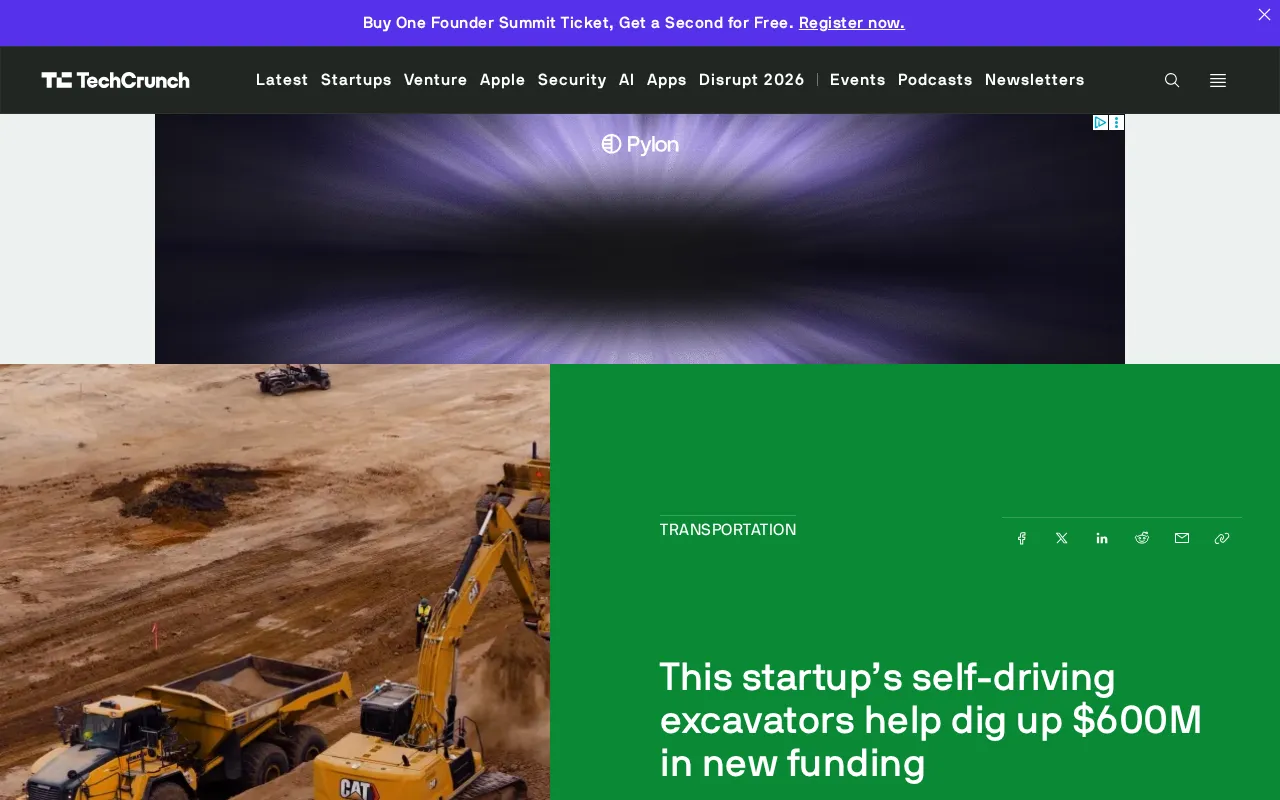
The excavator—the most essential piece of heavy machinery on construction sites—is becoming a new battleground for autonomous driving technology. Bedrock Robotics has raised $600 million in new funding on the strength of its autonomous excavator technology, reaching a valuation of $4.1 billion and becoming one of the most closely watched companies in the construction machinery intelligence sector.
Why Excavators?
Bedrock Robotics has focused its R&D on autonomous excavators, backed by a clear industrial logic: the shortage of skilled operators is intensifying. Excavator operation is a skill that requires long-term training, while young workers' willingness to enter the field continues to decline, and the supply-demand gap keeps widening.
This assessment aligns with broader industry trends. Multiple construction machinery manufacturers and automation startups are betting on the same direction—replacing dependence on human operating experience with software and sensors. Bedrock's choice is not a technological show of prowess, but a direct response to customers' most pressing labor pressures.
Perception and planning in unstructured environments is the core technical challenge that distinguishes autonomous excavators from autonomous driving on public roads. Road scenarios have clear lane markings, traffic signs, and relatively standardized participant behavior, allowing algorithms to rely on high-definition maps and strong priors. Construction sites are completely different: soil pile shapes change in real time as work proceeds, dust can obscure LiDAR and cameras, soft ground causes wheel speed and pose estimation drift, and there are no standardized "lanes" to follow. Therefore, autonomous excavators typically need to fuse multiple sensors (LiDAR, millimeter-wave radar, vision, IMU) for real-time mapping and terrain reconstruction, and complete bucket trajectory planning at centimeter-level precision. Such systems often demand more computing power, calibration accuracy, and robustness than highway cruise scenarios for passenger vehicles.
What $600 Million in Funding Means
A single funding round of $600 million is rare in non-road autonomous driving scenarios. The $4.1 billion valuation indicates that capital markets are willing to pay a premium for the "autonomous driving + construction machinery" combination.
The funds will likely be concentrated in several directions: expanding the fleet size, accelerating product deployment at different construction sites, and continuing to refine perception and control systems. Compared to autonomous driving on public roads, the construction site environment is closed off, but dust, vibration, irregular terrain, and unstructured scenarios pose challenges to perception algorithms in different dimensions.
Competitive Landscape of Construction Machinery Automation
Bedrock is not the only company that has spotted this opportunity. Major construction machinery manufacturers are advancing their own automation solutions, and other autonomous driving startups are also extending into scenarios such as mining, ports, and construction sites. But Bedrock's differentiation lies in focus—it concentrates resources on the single category of excavation rather than spreading out across all categories of construction machinery.
The advantage of a focused strategy is faster product iteration and tighter integration with customer workflows; the risk is that if major manufacturers integrate autonomous excavation capabilities as standard features into whole-machine sales, the生存 space for independent technology suppliers could be squeezed. Whether Bedrock can build sufficiently deep customer stickiness within the window period is a key issue worth watching.
The relationship between original equipment manufacturers (OEMs) and independent technology suppliers is key to understanding the landscape of this sector. Whole-machine manufacturers such as Caterpillar, Komatsu, and Volvo Construction Equipment control hydraulic systems, controllers, and whole-machine sales channels, and in recent years have successively launched semi-autonomous or remote-controlled operation solutions. If independent technology companies only operate at the software layer, they can easily lose bargaining power once whole-machine manufacturers internalize the functionality; therefore, many startups choose to deeply bind with small and medium-sized whole-machine manufacturers, or enter the existing equipment market through "technology licensing + aftermarket retrofit." Bedrock's approach of focusing on a single category is essentially betting on using product maturity and data accumulation to gain negotiating leverage within the window period.
Operator Shortage: The Real Driving Force Behind Automation
In the passenger vehicle sector, the autonomous driving story revolves more around safety and convenience, but in construction machinery, the economics are more direct: the cost of an excavator sitting idle waiting for an operator, the time cost of training new operators, and the wage increases brought about by the scarcity of skilled operators are all pressures that contractors genuinely feel.
This is also the most solid part of Bedrock's funding logic. The technology narrative can be grand, but what really makes customers open their wallets are often concrete problems like being unable to recruit or afford to keep workers. If autonomous excavators can stably complete repetitive earthmoving work, it represents quantifiable cost optimization for contractors.
From a broader perspective, Bedrock's funding is a landmark event in the migration of autonomous driving technology from road scenarios to production scenarios. When capital markets are willing to pay a $4.1 billion valuation for autonomous driving on construction sites, it shows that commercial validation of this sector is accelerating.
The applicability of autonomous driving levels in the construction machinery field requires separate explanation. The L0–L5 classification commonly used for passenger vehicles is based on road driving, while construction site operations focus more on the degree of "operation automation": from assisted steering and semi-automatic excavation, to multi-machine collaboration under remote operator supervision, to fully unmanned continuous earthmoving. Most current commercial solutions are at the stage of "supervised autonomous operation," where one safety officer can supervise multiple machines simultaneously. This in itself can significantly improve the human-machine ratio and is the most direct basis for contractors calculating return on investment.
One-line Summary
Bedrock Robotics raises $600M for autonomous excavators at a $4.1B valuation.
Paragraph Summary
Bedrock Robotics has completed a $600 million new funding round on the strength of its autonomous excavator technology, reaching a $4.1 billion valuation and becoming one of the most closely watched companies in the construction machinery intelligence sector. Its core logic is not technological showmanship but a direct response to the severe shortage of skilled excavator operators. The funds are expected to be used to expand the fleet, accelerate construction site deployment, and refine perception and control systems. The article analyzes the differentiated strategy of focusing on a single category and its risks—if major whole-machine manufacturers make autonomous excavation a standard feature, the space for independent suppliers could be squeezed. Overall, this marks the migration of autonomous driving technology from public roads to production scenarios, with commercial validation accelerating.
Related articles

Anthropic IPO Explained: Fuel for the AI Boom or the Spark for a Bubble?
Anthropic files for an IPO under ticker ANT. Breaking down the prospectus: 80% of revenue from usage-based pricing, $72B of an $80.7B net loss being non-cash charges, 900% net revenue retention, and how past IPOs like SpaceX performed on day one and over three years — answering the AI bubble question.

Will AI Kill the Research Paper? Mathematicians Offer a New Answer
Mathematicians on the Lex Fridman podcast discuss whether AI will kill research papers—from journal review pressure to Lean formal verification, GitHub open source fatigue to Mathlib's crowdsourcing model, exploring the evolution of academic contributions and the future of mathematical knowledge verification.

Enterprise LLM Development: From RAG to Multi-Agent in Practice
A course breakdown of enterprise LLM application development: from prompt engineering and RAG to multi-agent engineering practice and FDE project delivery, helping developers understand why Agent technology is a key focus for enterprise deployment and learn systematically to avoid detours.