Before Opening n8n, Define Your AI Agent with Claude First

Before building an AI agent, define the scope with Claude, then build the n8n workflow.
The article introduces a "define first, build later" AI agent development method: before opening n8n to drag nodes, use Claude to clearly define the agent's scope, required data fields, output format, and exception handling. In an e-commerce customer service example, the agent collects the user's email and order number and outputs order status, estimated delivery date, and tracking link; when no order is found, it should proactively ask for the number. Sensitive requests like cancellations, refunds, and complaints must be escalated to a human. Once the scope is clear, n8n workflow building becomes a mechanical logic translation, greatly reducing trial and error. This methodology can be reused across various agent-building scenarios.
Many people, when building an AI agent, instinctively open n8n and start dragging nodes and connecting APIs. But a short video from the YouTube channel Senyorks proposes a different approach: before building the workflow, use Claude to clearly define the agent's boundaries.
This idea seems simple, yet it directly addresses a common pitfall in current AI application development—tools first, logic patched in later.
Why Scope Definition Matters More Than Workflow Building
According to the video's author, before opening n8n, the key is to first clarify what your agent is actually supposed to do. He uses an e-commerce customer service scenario as an example: users will ask "Where is my order," and the agent needs to know when to respond to such questions and what data it needs to complete the response.
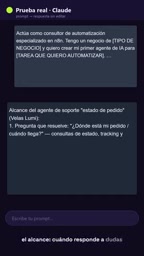
Specifically, this agent needs to obtain two types of information: the user's email address and order number. And the answer it provides should contain three elements: order status, estimated delivery date, and tracking link.

The core value of this "define first, build later" approach lies in separating business logic from technical implementation. When you clearly know what inputs the agent needs, what outputs it produces, and under what conditions it triggers, building the workflow in n8n becomes a mechanical translation process rather than iterative trial-and-error while thinking on the fly.
What Is an AI Agent
An AI agent refers to an AI system capable of autonomously perceiving its environment, making decisions, and taking actions to accomplish specific goals. Unlike traditional single-turn Q&A chatbots, agents typically possess several core capabilities: understanding user intent, calling external tools or APIs to retrieve data, performing multi-step reasoning based on conditions, and triggering follow-up actions when necessary (such as handing off to a human or sending an email). In customer service scenarios, the agent must not only understand natural language questions like "Where is my order" but also proactively determine what information is missing, ask follow-up questions as needed, and ultimately compose a structured response. Precisely because it involves a closed loop of "judgment—action—feedback," the agent's boundaries (what it can do, what it cannot do, and what to do when exceptions arise) must be clearly defined before building, otherwise the workflow will contain numerous branches that cannot be exhaustively enumerated.
Concrete Design of Data Requirements and Boundary Conditions
During the definition phase, the author of Senyorks specifically emphasizes two details that are easily discovered only during building.
The first is the clarification of data fields. The agent needs the user to provide an email and order number to query order status, which means the conversation flow must include an information collection step.
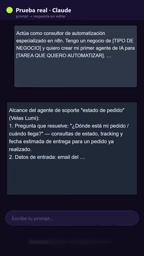
The second is handling of exceptional cases. If the user does not provide an order number, or the system cannot find the corresponding order, the agent should proactively ask for the order number rather than giving a vague or meaningless response.
If these two details are not thought through during the definition phase and are patched in later in n8n, it often means going back to modify the conversation flow, redesign the conditional branches, or even adjust the entire workflow architecture.
Intent Recognition and Slot Filling
In conversational AI design, "intent" refers to the purpose behind a user's utterance, such as querying an order, requesting a refund, or filing a complaint; a "slot" is the parameter that must be collected to fulfill that intent, such as order number or email address. The agent needs to first determine what the user wants through intent recognition, then check whether the corresponding slots are complete. If missing, it enters a follow-up questioning process—this is precisely the mechanism behind what the original text calls "proactively asking for the order number when it cannot be found." Listing intents and slots clearly during the design phase is equivalent to drawing the conditional branch diagram for the workflow in advance: each intent corresponds to a processing path, and each slot corresponds to an information collection action. This way, node connections in n8n no longer rely on improvisation but follow the map.
Human Escalation Mechanism: Things That Should Not Be Handled by AI
One design decision worth noting in the video is that cancellation, refund, and complaint requests are explicitly designated as categories that must be handed off to a human.
This boundary setting reflects a pragmatic product mindset. The advantage of AI agents in customer service scenarios is rapid response to standardized queries, while scenarios involving monetary changes and user emotions are better handled by humans to reduce risk and avoid degradation of user experience caused by AI misjudgment.
In the n8n workflow, such rules can be translated into simple conditional judgment nodes: when a specific intent is detected, directly trigger the human intervention process rather than attempting to let the AI handle it on its own.
Human-in-the-Loop and Confidence Thresholds
Human escalation is a common safety design in AI systems, referring to returning control to a human operator under specific conditions. There are usually two types of triggers: rule-based, such as directly transferring high-risk intents like "cancellation, refund, complaint" to a human as in the original text; and confidence-based, where escalation occurs automatically when the model's confidence in intent recognition or answer generation falls below a certain threshold. In n8n, rule-based escalation can be implemented through IF nodes or Switch nodes, while confidence-based escalation requires the model to output corresponding scores and perform numerical comparisons in the workflow. Regardless of the method, the core value of the escalation mechanism is to delineate a "boundary of responsibility" for AI capabilities: standardized, low-risk requests are quickly closed by AI, while requests involving funds, emotions, or compliance are handed to humans.
From Definition to Building: The Role of the Workflow
Once the scope is clearly defined, n8n's role becomes very clear—it is an execution tool responsible for translating already-thought-through logic into runnable automated processes.
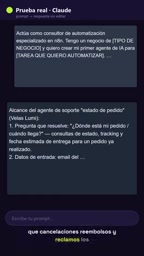
The author of Senyorks mentions that the complete design prompt can be obtained in the video description. This practice itself is also worth learning from: standardizing the step of "defining the agent's scope" into a reusable prompt template that can be directly applied each time a new agent is built.
This methodology is not only applicable to e-commerce customer service scenarios. Any project that needs to build an AI agent—whether an internal knowledge base assistant, an appointment management system, or a data processing pipeline—can start with the step of "using an LLM to define the scope first."
Tools will continue to iterate, n8n's features will update, and new automation platforms will emerge. But the order of "first think clearly about what to do, then choose how to do it" always holds in AI application development.
What Is n8n
n8n is an open-source workflow automation tool with a node-based visual programming interface. Users define how data flows between services by dragging nodes and connecting lines. It supports hundreds of built-in integrations (such as Gmail, Slack, HTTP requests, databases, etc.) and also allows custom logic to be executed through code nodes. In AI agent development, n8n typically plays the role of the "execution layer": receiving decision results from the LLM, calling APIs, reading and writing data, sending notifications, or handing off to a human based on preset conditions. Compared with pure code development, n8n's advantages lie in visual processes, intuitive debugging, and fast iteration; but its prerequisite is that the upstream logic is already clear—if the business rules themselves are vague, no matter how many nodes are connected, it only automates the chaos once.
One-line Summary
Before building an AI agent, define the scope with Claude first, then build the n8n workflow.
Paragraph Summary
The article introduces a "define first, build later" approach to AI agent development: before opening n8n and dragging nodes, use Claude to clearly define the agent's scope, required data fields, output format, and exception handling logic. Using e-commerce customer service as an example, the agent needs to collect the user's email and order number and output order status, estimated delivery date, and tracking link; when the order cannot be found, it should proactively ask for the order number. Sensitive requests such as cancellations, refunds, and complaints must be handed off to a human. Once the scope is clear, building the workflow in n8n becomes a mechanical translation of logic, greatly reducing repeated trial and error. This methodology can be reused in various agent-building scenarios.
Related articles

Chain of Thought Isn't Just for AI: How Humans Can Use CoT to Improve Thinking Quality
Chain of Thought isn't just a prompt trick for large models. Starting from a Hacker News discussion, this article analyzes why CoT works for human thinking too, breaks down actionable ways to transfer it, and highlights the key differences between human CoT and machine CoT.
Cloudflare Teams Up with OpenAI: Closi…
Cloudflare Teams Up with OpenAI: Closing the Loop from Vulnerability Discovery to Defense with AI
Cloudflare uses OpenAI Daybreak to investigate security vulnerabilities and generate reviewable remediation plans, while developers use Codex to boost coding efficiency and quality.

Orca Multi-Agent Orchestration in Practice: A Guide to Parallel Collaboration with Claude and Codex
Orca is Stable AI's free open-source agent workbench supporting 34 agents like Claude Code and Codex in parallel. Learn its Git worktree isolation, multi-model orchestration, and mobile management.