Beginner-Friendly Reinforcement Learning Kaggle Competitions: A Practical Getting-Started Guide

A Kaggle competition selection guide for RL beginners: start with simple environments and public baselines.
Based on Reddit community discussions, this article outlines a practical path for RL beginners to participate in Kaggle competitions. It proposes four principles for choosing competitions: simple environment and action space, public baseline Notebooks, timely evaluation feedback, and active community. It then recommends beginner directions by type, including Gym/Gymnasium-based classic control and board games, simulator-centered policy optimization tasks, and recommender system intersection categories with higher feature engineering requirements. For learning methods, it emphasizes reading the Overview and Evaluation first, reproducing high-voted Notebooks, searching for baselines in discussions, then making small modifications to learning rate, training epochs, and network architecture. The article also advises against blindly chasing popular competitions, prioritizing running through the complete pipeline, and managing local small-scale experiments and Kaggle GPU quotas.
Why Does Reinforcement Learning Need Competition Practice?
Reinforcement learning (RL) is known for its high theoretical barrier and difficult debugging. Simply reading books or running through example code makes it hard to grasp how policies gradually improve through interaction with the environment. Kaggle competitions provide a "training ground with feedback": clear tasks, quantifiable leaderboards, and public discussion forums and Notebooks, allowing beginners to iterate quickly by comparing against others' solutions.
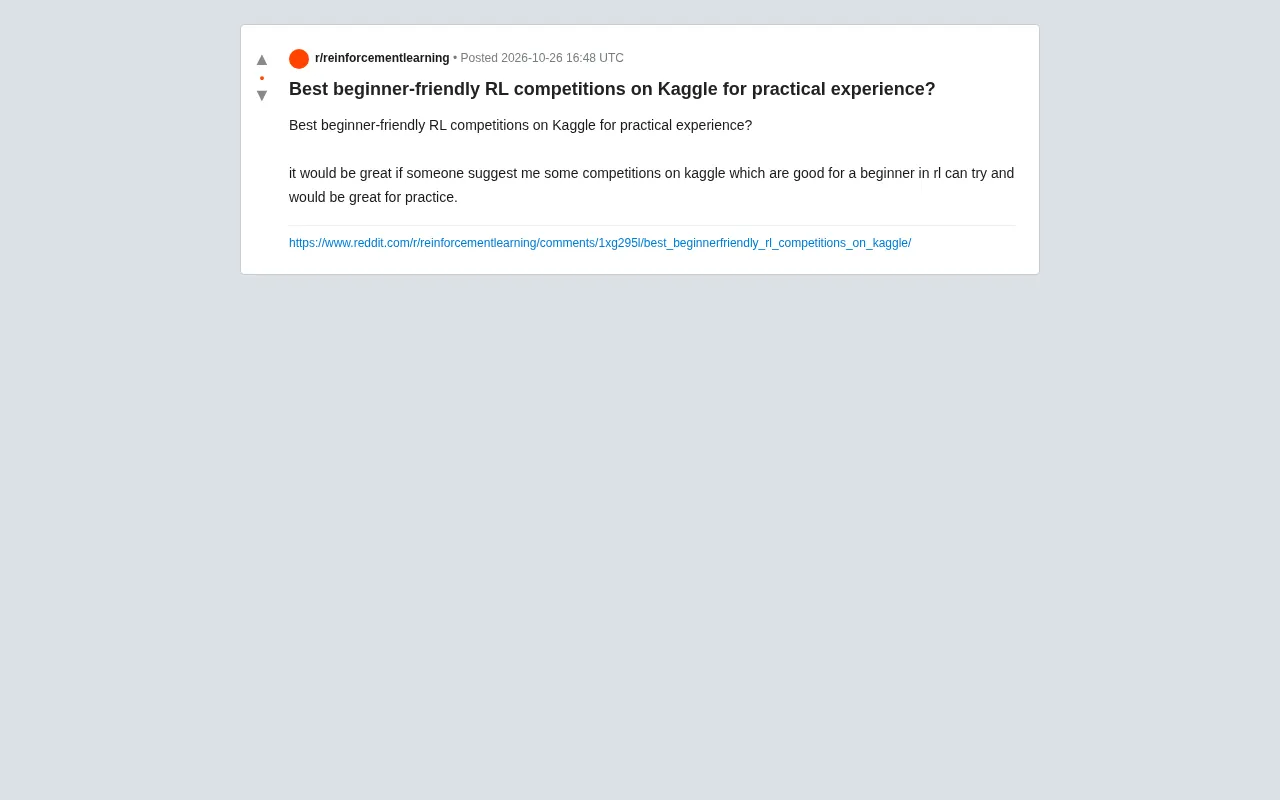
A Reddit user posted asking for Kaggle competitions suitable for RL beginners to build practical experience. This article combines the consensus from that discussion with common community advice to outline how to choose competitions and specific directions to pursue.
Four Principles for Beginners Choosing RL Competitions
Not all RL competitions are suitable for beginners. Based on community discussions, we recommend prioritizing the following characteristics:
1. Simple environment and action space. Tasks with discrete action spaces and low-dimensional states (such as grid worlds and simple control) are easier to get started with than high-dimensional continuous control.
2. Public baseline Notebooks available. Many Kaggle competitions have participants sharing starter code, which beginners can reproduce first and then gradually improve.
3. Timely evaluation feedback. Competitions where you can quickly submit and see your score help establish a "modify—verify" loop.
4. Active community. Discussion forums with continuous Q&A and solution sharing make it easier to find direction when you get stuck.
Competition Types and Representative Directions Suitable for Beginners
Classic Control and Game Categories
These competitions are typically based on Gym/Gymnasium environments with limited action spaces, suitable for understanding basic algorithms like Q-learning and policy gradients. For example, Connect Four or similar board games have controllable state spaces and plenty of public implementations to reference. Community discussions often mention that starting with these tasks quickly builds an intuitive understanding of the "agent—environment" interaction paradigm.
The Difference Between Q-learning and Policy Gradients
Q-learning is a value-based method: it learns an action-value function Q(s,a), representing the expected cumulative reward from taking action a in state s, and then makes decisions by "choosing the action with the highest Q value." It typically works with discrete action spaces and tabular or neural network approximations, with DQN as a representative algorithm. Policy gradients, on the other hand, directly parameterize the policy π(a|s) and maximize expected return through gradient ascent, naturally supporting continuous action spaces and stochastic policies, with REINFORCE and PPO as representative algorithms. For beginners working on discrete action tasks like board games, starting with Q-learning makes it easier to observe the convergence process; policy gradients are better suited for scenarios with continuous actions or requiring stochastic exploration. Understanding the difference between the two helps match the appropriate algorithm family to different competitions.
Simulation and Policy Optimization Categories
Kaggle has historically hosted competitions centered on simulation environments, requiring participants to design policies that maximize cumulative reward. These competitions often provide official simulators, and beginners can first run random policies or simple rule-based policies as baselines before attempting RL algorithms. Some in the discussions point out that the focus of these competitions is understanding reward design and exploration strategies rather than model complexity.
Why Reward Design and Exploration Strategies Are Critical
In simulation environments, the agent's only "teacher" is the reward signal. Reward shaping determines learning difficulty: rewards that are too sparse (only given at the end) make it hard for the agent to obtain effective gradients through random trial and error; rewards that are too dense may lead to gaming behavior. Common approaches include adding intermediate rewards, curriculum learning, or potential-based shaping. Exploration strategies determine how the agent balances "exploiting known good actions" and "trying unknown actions," such as ε-greedy, entropy regularization, and UCB. In Kaggle simulation competitions, many high-scoring solutions' advantages come not from more complex networks but from more reasonable reward decomposition and exploration scheduling—this is also the part most worth prioritizing for beginners.
Recommender Systems and Sequential Decision-Making Intersection
Some competitions, while themed around recommendation or ranking, can be modeled as sequential decision problems and are suitable for practicing value-based methods. However, these competitions have high feature engineering requirements, so it's recommended to attempt them after mastering basic RL.
What Are Gym / Gymnasium
Gym is an open-source reinforcement learning environment library released by OpenAI in 2016, providing a unified interface (reset(), step(), render()) that allows researchers to experiment with different tasks using the same code structure, such as CartPole, Atari games, and MuJoCo continuous control. It greatly reduces the cost of environment setup and has become the "standard interface" in the RL field. After 2022, Gym maintenance was transferred to the Farama Foundation and renamed Gymnasium, with minor incompatible API adjustments (such as step() returning a five-tuple instead of a four-tuple). Most classic-control-based competitions on Kaggle remain compatible with Gym or Gymnasium, and beginners need to be aware of version differences when reproducing Notebooks, otherwise they may encounter env.step() return value unpacking errors. Understanding this interface is a prerequisite for running any RL baseline.
How to Use Kaggle Resources for Efficient Learning
After choosing a competition, don't rush to write code. Do three things first:
- Read the competition Overview and Evaluation to clarify the reward signal and submission format.
- Find the highest-voted public Notebook and understand its environment wrapper and training loop line by line.
- Search the discussion forum for keywords like "baseline" and "starter"—many beginner questions have already been answered.
Another participant in the discussion emphasized that reproducing public solutions and trying small modifications (such as adjusting learning rate, increasing training epochs, or modifying network architecture) is the fastest way to improve. Don't aim for original algorithms from the start.
Common Pitfalls and Advice
Some beginners tend to choose the most popular competitions on the leaderboard, but popular competitions are often highly competitive with complex solutions and can easily discourage confidence. The community consensus is: completing the full pipeline of a simple competition—from understanding the environment and reproducing the baseline to submitting results—is more important than chasing high scores.
Additionally, RL competitions typically have long training times. It's recommended to run small-scale experiments locally or on Colab first, confirm the logic is correct, and then submit. Kaggle Notebook GPU quotas are limited, so planning your experiment pace reasonably is crucial.
Summary
For RL beginners, the value of Kaggle competitions lies in providing structured practical feedback. Prioritize competitions with simple environments, public baselines, and active communities; start with reproduction and gradually add your own improvements. Don't underestimate the cognitive boost from "running through a complete pipeline"—it's more helpful for long-term growth than blindly chasing leaderboard rankings.
(This article is based on Reddit community discussions. For specific competition lists, please refer to the official Kaggle pages.)
Related articles

MEV Dataset: A Multi-Event Video Resource for Long-Take Generation
MEV is a multi-event video dataset for long-take generation, offering precise temporal boundaries and fine-grained event annotations to address temporal inconsistency caused by insufficient supervision in existing text-to-video data.

Should Coding Agents Follow Precedent or Task Intent?
A study of 5,625 trials reveals coding agents prioritize repository precedents over task intent, but written priority rules (59/60) outperform code examples (38/60) when intent conflicts.

Rubricon: Automatically Generating Rubrics to Boost LLM Evaluation and Training Efficiency
Rubricon automatically generates discriminative rubrics for LLM evaluation and training without human annotation, improving alignment by 9% and outperforming RRD by 4.5% on HealthBench.