MEV Dataset: A Multi-Event Video Resource for Long-Take Generation

The MEV dataset uses event-level annotations to supply missing temporal supervision for long-take multi-event video generation.
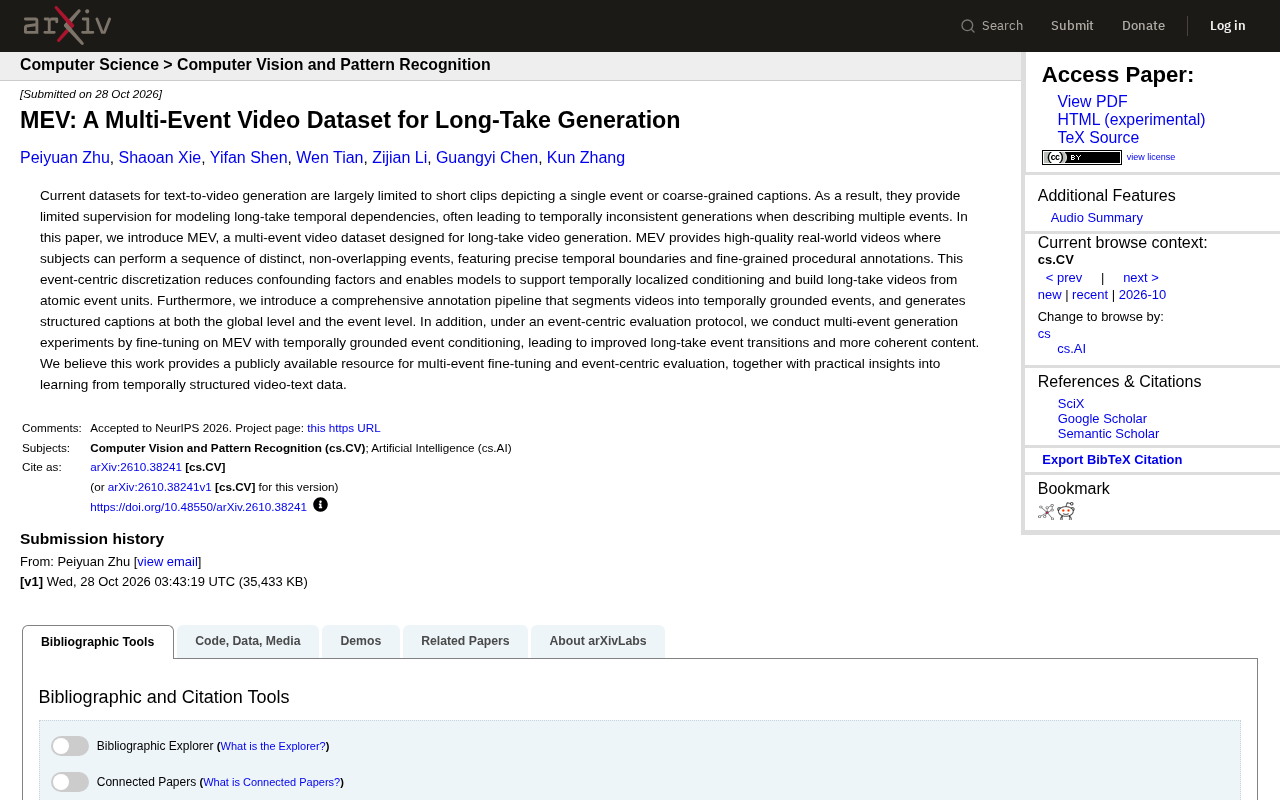
The paper notes that existing text-to-video datasets are mostly single-event short clips with coarse-grained text, leaving models without long-take temporal supervision and causing temporal inconsistency on multi-event prompts. It proposes the MEV dataset, which decomposes long videos into non-overlapping atomic events with precise temporal boundaries and fine-grained annotations, plus global and event-level descriptions. Fine-tuning under an event-centric protocol improves event transitions and coherence.
Text-to-video generation models already produce convincing results on short video clips, but when the task escalates to "telling a whole continuous sequence of events," temporal consistency problems surface. A paper titled MEV: A Multi-Event Video Dataset for Long-Take Generation proposes a dataset-level solution to precisely this bottleneck.
The Supervision Blind Spots of Existing Video Datasets
The paper points out two structural limitations of existing text-to-video datasets: most videos are short clips depicting a single event, and the text descriptions tend to be coarse-grained. This means models rarely see samples during training where "multiple events connect in temporal order," and therefore lack supervision signals for long-take temporal dependencies.
The consequence is direct—when a prompt asks for multiple events to be described, the generated results are often temporally inconsistent. The model doesn't know that event A should end before event B begins, nor where the boundary between the two events lies. This isn't a problem of model capacity; it's that the training data never taught it this.
Temporal consistency in text-to-video models refers to a generated video maintaining reasonable temporal logic between frames and between events: objects don't vanish or deform without cause, actions have coherent causal progression, and the ordering of multiple events matches the prompt's description. Early models (such as diffusion-based video generation methods) mainly optimized single-frame quality and short-range motion naturalness on clips of a few seconds, with temporal consistency typically covering only a few frames to a dozen or so frames. When generation length stretches to tens of seconds and includes multiple semantic events, errors accumulate along the time axis, manifesting as disordered event order, blurred event boundaries, or content drift. This problem is not determined purely by parameter count, but is closely tied to the lack of long-range temporal supervision in the training distribution.
MEV's Core Design: Event-Centric Temporal Discretization
MEV's construction approach is to decompose long videos into atomic event units. The dataset provides high-quality real videos in which the subject performs a series of distinguishable, non-overlapping events, each with precise temporal boundaries and fine-grained procedural annotations.
This "event-centric" discretization has two benefits. First, it reduces confounding factors—the model doesn't need to guess event split points from a vague continuous sequence of frames; the supervision signal directly provides temporal localization. Second, it allows the model to assemble long-take videos from atomic event units, supporting temporally localized conditional control.
The accompanying annotation pipeline is also worth noting: it segments videos into events with explicit temporal grounding and generates structured descriptions at both the global level and the event level. This way, a single video simultaneously has text supervision at two granularities: "what the whole thing is about" and "what each segment is doing."
Atomic event units refer to the smallest semantically indivisible behavioral segments in a video that do not overlap in time with other events—for example, "pick up the cup," "pour water," and "put down the cup" can be regarded as three atomic events. The benefit of discretizing long videos into atomic events is that each unit has relatively homogeneous internal semantics and clear boundaries, making it easy to precisely annotate start and end timestamps; at the same time, multiple atomic events can be composed in temporal order into a longer narrative. This representation explicitly separates temporal structure from the continuous, ambiguous stream of frames, turning it into a target the model can directly learn, and provides the operational basis for temporally localized conditional control (such as generating a certain event only within a specified time segment).
Experiments and Evaluation: Long-Take Generation Under an Event-Level Protocol
The paper conducts multi-event generation experiments under an event-centric evaluation protocol. By fine-tuning on MEV and applying temporally grounded event conditions, the model shows improvements in event transitions and content coherence in long takes.
The methodological significance here outweighs any single experiment's numbers: evaluation no longer looks only at single-frame quality or short-clip realism, but treats "whether events connect in the expected order" as a measurement dimension. The authors position MEV as a publicly available resource serving multi-event fine-tuning and event-centric evaluation, and provide practical insights into learning from temporally structured video-text data.
Event-level evaluation protocols differ from traditional video generation metrics (such as FVD and CLIP similarity) in that they treat "whether events appear in the order specified by the prompt," "whether each event falls within the expected time interval," and "whether event transitions are natural" as independent measurement dimensions. Such protocols typically require event detection or temporal localization models to segment generated videos into candidate event segments, which are then matched and scored against a reference event sequence. Their methodological value lies in shifting the evaluation focus from single-frame quality to temporal structural correctness, thereby exposing long-take failure modes that short-clip metrics cannot reflect.
Significance for Video Generation Research
MEV's value lies in shifting the long-take generation problem from "stacking models" to "supplementing data." Event-level annotation makes temporal structure a learnable object rather than an implicit regularity the model is expected to figure out on its own. For application scenarios requiring the generation of tutorials, narrative short films, or multi-step operation demonstrations, this kind of supervision signal may be more critical than simply scaling up data. The public release of the dataset and annotation pipeline also provides a reusable starting point for subsequent research on temporally structured data.
One-line Summary
The MEV dataset uses event-level annotations to supply the missing temporal supervision signal for long-take multi-event video generation.
Paragraph Summary
The paper points out that existing text-to-video datasets are mostly single-event short clips with coarse-grained text descriptions, leaving models without supervision for long-take temporal dependencies and causing temporal inconsistency when generating multi-event prompts. To address this, it proposes the MEV dataset, which decomposes long videos into non-overlapping atomic event units, each with precise temporal boundaries and fine-grained procedural annotations; the annotation pipeline simultaneously generates global and event-level structured descriptions. After fine-tuning under an event-centric evaluation protocol with temporal conditions applied, the model shows improvements in both event transitions and content coherence. The authors position MEV as a public resource supporting multi-event fine-tuning and event-centric evaluation, emphasizing that the key to long-take generation lies in supplementing data rather than simply stacking models.
Related articles

Fifty Years Studying Power: Robert Caro's Writing and Insights on Power
Robert Caro reflects on 50 years studying power: Lyndon Johnson's persuasion and leverage, Robert Moses's transformation from idealist to ruthless builder, the dilemmas of large-scale construction, and his methods of compressing themes and solitary focus in biography writing.

Can a $20,000 Robot Do Your Chores? The Test Results Are Surprising
A YouTube test video shows how a $20,000 robot responds to commands like washing dishes, turning off lights, taking out trash, and feeding the dog. This article analyzes its real capability boundaries, the state of voice interaction technology, and how far household robots are from mainstream adoption.
The Complete Guide to Running AI Models Locally: Inference Engines and Tool Stack Explained
A systematic breakdown of the complete local LLM tool stack: from PyTorch and GGML compute libraries to llama.cpp, vLLM, SGLang inference engines and Ollama, LM Studio wrapper layers, with benchmark data on performance differences and selection logic.