Beginner's Guide: Legal Boundaries and Practical Introduction to SRC Vulnerability Hunting
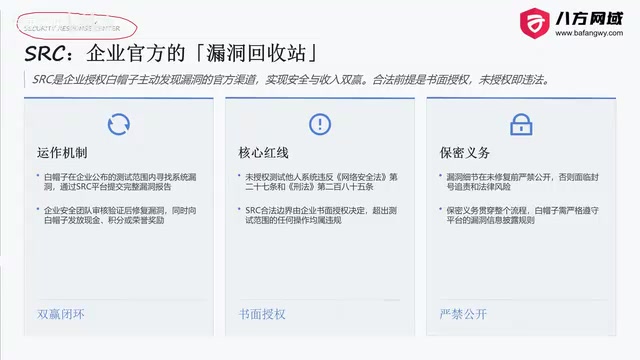
SRC is a company's official vulnerability drop box; beginners must hold the written authorization red line and practice in labs before real targets.
The article systematically introduces the concept and operation of SRC (Security Response Center), noting that it is essentially a company's official vulnerability drop box: white hats submit vulnerabilities, companies verify and fix them and give rewards, forming a win-win loop. It emphasizes that the only passport for legal bug hunting is written authorization—verbal requests do not count—and unauthorized testing may violate Article 27 of the Cybersecurity Law and Article 285 of the Criminal Law. White hats are strictly forbidden from disclosing details before fixes are complete, or they may face account bans or legal liability. For beginners, the article recommends first learning platform rules and testing scope, practicing high-frequency vulnerabilities in self-built labs, then submitting through mainstream SRC platforms such as Butian following standard procedures, while avoiding three common mistakes: weak authorization awareness, premature disclosure, and skipping labs to go straight to real targets.
What Is an SRC? Why Companies Need a Vulnerability Drop Box
Many newcomers to cybersecurity find the term "SRC" both familiar and unfamiliar. Literally, SRC stands for Security Response Center, but in actual corporate operations it functions more like an official vulnerability drop box. Companies run a large number of online application systems or platforms, and these systems inevitably contain business logic flaws or technical defects. The SRC's job is to collect vulnerability reports submitted by white hats and hand them to the security team for verification and remediation.
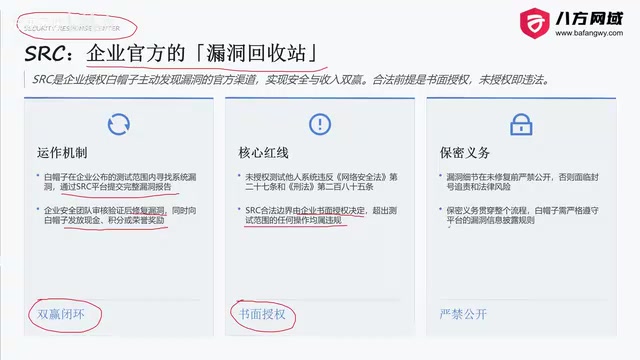
According to an explanation in a tutorial by a Bilibili creator, the SRC operates as a win-win loop: white hats search for vulnerabilities within the testing scope published by the company and submit reports through the SRC platform; the company's security team verifies the authenticity of the vulnerabilities and drives remediation, while rewarding white hats with bounties, points, or recognition. White hats gain income and recognition, and companies gain improved system security.
The core reason this mechanism keeps running is that companies cannot rely solely on internal teams to cover security testing across all business lines. The crowdsourced testing model of external white hats effectively supplements corporate security capacity through market-based means.
White hat is the term used in cybersecurity for ethical hackers—technicians who help companies and organizations improve security by discovering and reporting vulnerabilities. Unlike malicious hackers (black hats), white hats typically operate within the bounds of the law and follow responsible disclosure principles. In the SRC ecosystem, white hats are the primary source of vulnerability reports; they participate in corporate security efforts through crowdsourced testing, gaining both financial returns and industry reputation. The boundaries of white hat behavior are defined jointly by corporate authorization and platform rules, and crossing those boundaries may constitute a legal violation.
The Only Passport for Legal Bug Hunting: Written Authorization
The pitfall newcomers fall into most easily is treating "help me test it" as legal authorization. The video repeatedly emphasizes a core red line: without written authorization, any penetration testing of someone else's system may violate Article 27 of the Cybersecurity Law and Article 285 of the Criminal Law. Verbal requests commonly seen in group chats, such as "can you check whether my platform has vulnerabilities," carry enormous risk—a single sentence cannot substitute for written authorization.
The legal boundaries of SRC testing are determined entirely by the company's written authorization, and any operation beyond the testing scope is a violation. This point has also been repeatedly cross-verified in teaching content across multiple security communities and is an industry consensus.
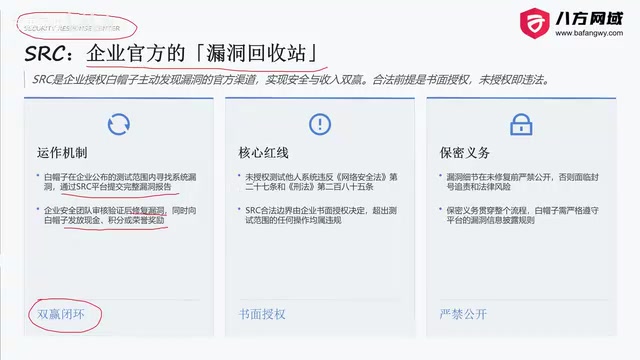
Beyond authorization, confidentiality obligations are equally critical. After submitting a vulnerability report, white hats are strictly prohibited from disclosing details before the vulnerability is fixed. Early disclosure may lead to the vulnerability being exploited maliciously—at best resulting in account bans, at worst in legal liability. The correct approach is to communicate with the company promptly and wait until remediation is complete before disclosing according to the agreed terms.
Article 27 of the Cybersecurity Law explicitly stipulates that no individual or organization may engage in activities that endanger cybersecurity, such as illegally intruding into others' networks, interfering with the normal functions of others' networks, or stealing network data. Article 285 of the Criminal Law provides for crimes including illegal intrusion into computer information systems and illegal acquisition of computer information system data. In SRC bug hunting scenarios, written authorization is the key evidence distinguishing legal security testing from illegal intrusion. Verbal consent or vague invitations in chat logs cannot withstand legal risk; once a dispute arises, testers find it difficult to prove they had valid authorization. Therefore, legitimate SRC platforms require companies to publish clear testing scope announcements, and white hats must operate within that scope.
Mainstream Domestic SRC Platforms and Beginner Entry Path
The video tutorial reviews mainstream domestic SRC platforms and uses the Butian platform as an example to demonstrate the complete vulnerability submission process. For beginners, the entry path can be summarized as: first familiarize yourself with platform rules and testing scope, then choose low-risk targets to practice on, and finally gradually move into high-frequency vulnerability types.
According to the creator, the entire hands-on segment requires preparing an attack machine, penetration testing tools, and a self-built vulnerability lab to demonstrate high-frequency vulnerabilities. This means beginners should not practice directly on real corporate systems, but should first master the methods for discovering and verifying common vulnerabilities in a local lab environment.
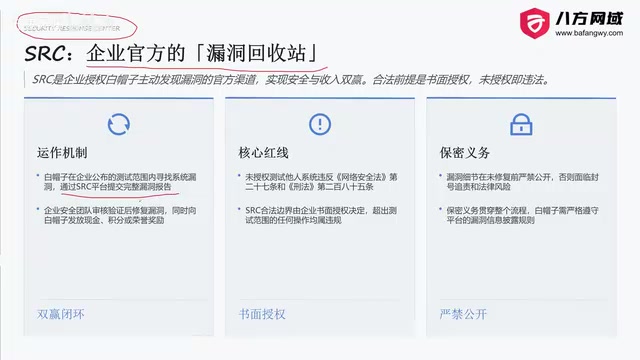
Note that reward mechanisms and review standards differ across SRC platforms. Before submitting, beginners should carefully read each platform's announcements and scope descriptions to avoid having reports rejected or accounts restricted due to misunderstandings of the testing scope.
A vulnerability lab is a practice environment that simulates real application vulnerabilities. Common ones include open-source labs such as DVWA, WebGoat, and Pikachu, as well as various online lab platforms. Labs come preloaded with high-frequency vulnerability types such as SQL injection, XSS, file upload, and command execution, allowing beginners to repeatedly practice the full process of vulnerability discovery, exploitation, and verification without touching real business systems. Self-built labs are usually deployed quickly via virtual machines or Docker, are low-cost, and can be reset at will. After mastering vulnerability principles and exploitation techniques through labs, participating in SRC crowdsourced testing significantly reduces operational mistakes and legal risk while improving the quality and acceptance rate of vulnerability reports.
Pitfall Guide: Three Common Beginner Mistakes
Based on the video content and common community cases, beginners tend to make three types of mistakes in SRC bug hunting. The first is weak authorization awareness—treating verbal requests as authorization, which is the most dangerous red-line issue. The second is disclosing vulnerabilities before they are fixed, violating confidentiality obligations and ruining one's white hat reputation. The third is skipping the lab and going straight to real-world testing, attempting real systems with only a superficial understanding of vulnerability principles—both inefficient and prone to triggering legal risk.
The "18-step guide to submitting" process mentioned in the video essentially emphasizes the importance of standardized operations—from registering on the platform, reading the scope, testing and verifying, to writing the report, every step has a standard action. For beginners, solid process execution has more long-term value than chasing the number of vulnerabilities.
Conclusion
SRC vulnerability hunting is a legal and sustainable path in security research, but it rests on authorization, confidentiality, and standardized operations. Beginners should start by understanding the corporate value of SRC, hold the red line of written authorization, build fundamental skills through labs, and then gradually accumulate practical experience through mainstream platforms to truly establish themselves in this field.
Related articles

After the Right to Vote Was Lost: The Hidden Costs to American Democracy
Exploring how restrictive state voting laws, Supreme Court erosion of the Voting Rights Act, and partisan gerrymandering affect voter participation and fair representation after Democrats failed to pass the John Lewis Voting Rights Advancement Act and the Freedom to Vote Act.

Two Critical PHP Vulnerabilities Nearly Took Down the Internet: A Warning About the Fragility of the Web's Foundation
Two critical PHP vulnerabilities nearly shook the entire internet. This article analyzes why PHP vulnerabilities have such strong leverage effects, what real-world obstacles the patch chain faces, and what lessons infrastructure-level software security governance offers.
Musk Sounds the Alarm for Europe: A Wa…
Musk Sounds the Alarm for Europe: A Wave of US Tech Replacement Is Coming
Steve Blank's blog post sparks Hacker News debate: Musk's actions are prompting Europe to reconsider its reliance on US technology. This article sorts through the core arguments, the feasibility and divisions over replacing the US tech stack, and the practical impact on developers' technology choices.