Beginner's Guide to AI Agents: Core Principles, Technical Architecture, and Application Scenarios Explained

A systematic breakdown of AI Agent core capabilities, technical principles, and evolution
Starting from the fundamental differences between traditional programs and agents, this article explains how agents possess three core capabilities forming a closed loop: perception, decision-making, and action. The perception engine parses user intent through natural language understanding, the decision brain reasons and judges using large language models, and the execution layer calls tools to complete actual operations. The article also traces the technology evolution from rule matching to pre-trained models to modern agents.
Introduction: Why Are Some AI Products Amazing While Others Are "Artificially Stupid"?
With the rapid development of artificial intelligence, our lives are flooded with smart products — intelligent chatbots, autonomous driving, smart healthcare, and more. Yet the user experience varies dramatically: some products make you exclaim "this is real AI," while others make you complain "this is clearly artificial stupidity."
The key factor determining whether a product works well lies in the underlying technology. If it relies on techniques from a decade ago, the experience naturally won't be great; but if it adopts cutting-edge technology from recent years, the product's intelligence level will see a qualitative leap. Agents are one of the most representative AI technologies of recent years.
This article systematically explains AI Agents from four dimensions: the fundamental differences between traditional programs and agents, the core capability loop of agents, the modern agent technology stack, and typical application scenarios with technology evolution directions.
Traditional Programs vs. Agents: What's the Fundamental Difference?
Traditional Programs: Fixed Input, Fixed Output
Traditional programs share a common trait: fixed commands in, fixed results out. Like a vending machine in everyday life — you select a cola, insert money, and the machine dispenses a cola with zero variation.
To understand this through code, a traditional calculator function takes two numbers and an operator, producing a completely predictable output. The program logic is hardcoded — it only follows preset paths and never produces any "unexpected" intelligent behavior.
Agents: AI Assistants with Thinking Ability
Agents are completely different — they're more like personal assistants with thinking ability. The instructions you give can be vague and imprecise, yet they can automatically figure out what you actually need.
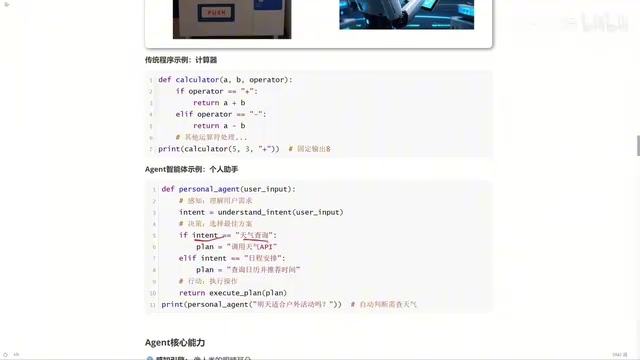
For example: you say "check the weather for me today," or rephrase it as "I want to go traveling the day after tomorrow — see if the weather is suitable." Despite different expressions, the agent can identify that your core intent is weather inquiry, then call the appropriate tool and return results.
This is the fundamental difference between agents and traditional programs:
| Dimension | Traditional Programs | Agent |
|---|---|---|
| Input Method | Fixed commands | Ambiguous natural language |
| Output Results | Fixed, predictable | Dynamic, generated through analysis |
| Processing Logic | Preset rules | Understand → Reason → Execute |
| Adaptability | None | Can adapt to different expressions |
Three Core Capabilities of Agents: Perception, Decision-Making, and Action
What makes agents "intelligent" is that they possess three key capabilities forming a complete capability loop.
Perception Engine: The Agent's "Eyes and Ears"
The perception engine is responsible for understanding user input. Just as humans perceive the world through seeing and hearing, agents parse user needs through Natural Language Understanding (NLU).
Technical Evolution of Natural Language Understanding (NLU): NLU is an interdisciplinary field spanning computational linguistics and artificial intelligence, with the core goal of enabling machines to understand the semantics, context, and intent of language just as humans do. Early NLU relied on rule matching and bag-of-words models, with low accuracy and poor generalization. The emergence of Word2Vec in 2013 gave words vector representations, and the advent of the BERT pre-trained model in 2018 brought a revolutionary breakthrough — by pre-training on massive text corpora, the model could capture subtle differences in word meaning across different contexts. Modern agent perception engines stand on these accumulated technologies, enabling them to precisely decompose colloquial expressions like "book me a cheap hotel" into structured intents and entities.
For example, when a user says "book me a cheap hotel," the perception engine breaks it down into three key pieces of information:
- Action: Book
- Object: Hotel
- Condition: Low price
You might not have noticed, but the perception engine isn't limited to text input. It supports multimodal input — voice, text, and images can all serve as input sources. "Multimodal" refers to a model's ability to support multiple types of input.
Decision Brain: Thinking and Judgment Based on Large Language Models
Once the perception engine completes need analysis, the decision brain kicks in. It leverages the reasoning capabilities of Large Language Models (LLMs) to determine how to respond to the user.
Technical Principles of Large Language Models: Large Language Models are essentially deep neural networks based on the Transformer architecture, learning statistical patterns of language and world knowledge through self-supervised pre-training on hundreds of billions or even trillions of tokens of text data. Their core mechanism, the "Attention Mechanism," allows the model to dynamically attend to other words in the context when processing each word, thereby capturing long-range semantic dependencies. The GPT series uses an autoregressive training objective of "predicting the next token," Claude builds on this with Constitutional AI for safety alignment, and DeepSeekAd significantly improves training and inference efficiency through a Mixture of Experts (MoE) architecture. It is precisely this Emergent Ability acquired from massive data that enables LLMs to complete complex tasks such as reasoning, planning, and code generation, making them ideal choices for the agent's decision brain.
Currently mainstream LLMs include GPT-4, Claude, DeepSeek, Qwen, and others. The core task of the decision brain is: based on user intent, determine which tools to call, in what order to execute them, and what kind of results to return.
Execution Layer: The Agent's "Hands and Feet"
Once decisions are made, the execution layer takes action — calling APIs, querying databases, controlling hardware devices, etc. Like human hands and feet, it's responsible for converting the brain's decisions into actual actions, ultimately feeding results back to the user.
The three capabilities form a closed loop: Perceive needs → Analyze and decide → Execute actions — this is the core working mechanism of agents.
Technology Evolution: Three Generational Leaps from Siri to Modern Agents
Agent technology didn't emerge overnight — it has roughly gone through three generations of core evolution. These three generations align with the broader AI field
Related articles
Deep Dive into AI Agent Skill Design: …
Deep Dive into AI Agent Skill Design: Engineering Practices from Anthropic and Perplexity
A deep dive into Skill design philosophy from Anthropic's Claude Code team and Perplexity's Agent team, covering the Tax Test, Gotchas Flywheel, progressive disclosure, and Eval-First practices for building high-quality AI Agent skill systems.
Deep Dive into OpenAI's Official GPT-5…
Deep Dive into OpenAI's Official GPT-5.6 Prompting Guide: The Shift from Manual to Automatic
A deep dive into OpenAI's official GPT-5.6 Sol prompting guide: conciseness-first, outcome-oriented design, autonomy boundaries, tool routing, and reasoning intensity tuning.
 Deep Dives
Deep Dive into How OpenClaw (Open-Source Crayfish) AI Agent Works
Deep analysis of OpenClaw AI Agent internals: System Prompt, tool calling, SubAgents, Skill system, memory, and Context Engineering explained.