Beginner's Guide to AI Software Testing: From Environment Setup to a Practical Learning Roadmap

A structured roadmap for learning AI software testing, from core concepts to real-world project scenarios.
This article analyzes an AI software testing course series, outlining how AI testing differs from traditional testing: outputs are probabilistic, expected results can't be hardcoded, and model drift monitoring becomes critical. The course covers ML model evaluation, AI-generated test data, e-commerce recommendation testing, and generative API testing across three progressive stages. The article also offers learning advice for different backgrounds and honestly assesses the limits of any single "complete" course.
Software Testing Is Being Redefined in the Age of AI
The software testing profession is undergoing a profound technological transformation. As machine learning models, generative APIs, and intelligent recommendation systems flood production environments, traditional functional and regression testing methods can no longer adequately cover the quality risks introduced by these new systems. A knowledge framework tailored to AI-era software testing has become an essential skill for both practicing testers and career changers.
The author of this Bilibili tutorial series mentions spending a month as an AI testing newcomer, combing through every piece of AI software testing content available online — and concluding that the landscape is "a mixed bag." This observation reflects a genuine pain point: AI testing is an interdisciplinary field that demands both traditional engineering rigor and an understanding of how machine learning systems actually work. Very few courses manage to serve both absolute beginners and experienced engineers making the transition.

Core Differences Between Traditional Testing and AI Testing
Understanding AI testing starts with clarifying how it fundamentally differs from traditional testing. Conventional software is deterministic: given the same input, the output is always the same, and the "expected result" in a test case can be written out explicitly. AI systems — especially machine learning models — produce probabilistic, non-deterministic outputs. The same input can yield different results depending on the model version, training data, or random seed.
This drives several paradigm shifts in testing:
- Expected results can't be hardcoded: You can't simply assert "equals some value." Instead, you evaluate whether outputs fall within a reasonable range or meet statistical thresholds (e.g., accuracy, recall).
- Data becomes a first-class citizen: The quality, distribution, and coverage of training and test data directly determine model behavior. Data testing carries far more weight than in traditional testing.
- Model degradation and drift: Once deployed, a model's performance can decay as the data distribution shifts over time. This requires continuous monitoring rather than a one-time acceptance check.
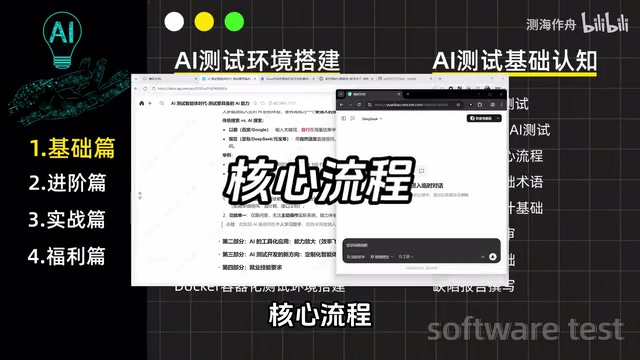
The course places this content in its foundational section, walking learners from environment setup and core concepts to hands-on basics with common AI testing tools — aiming to establish a first layer of understanding for beginners. For engineers who already have testing experience, this section's value lies in "recalibrating your mental model" rather than starting from scratch.
Model Drift is one of the defining quality risks that sets AI systems apart from traditional software and deserves a closer look. It comes in two forms: Data Drift refers to changes in the statistical distribution of input data over time, causing the model to encounter patterns it never saw during training; Concept Drift refers to a change in the real-world relationship between inputs and outputs — for example, seasonal shifts in user behavior preferences. Both types of drift cause model performance to quietly degrade without triggering any errors or exceptions — which is exactly where traditional monitoring approaches (error logs, crash rates) completely fall short. Testing for drift requires building a continuous statistical monitoring pipeline that regularly compares production data distributions against training data, with alerting thresholds set on key performance metrics. This extends the testing function from "pre-launch acceptance" to "ongoing post-launch assurance."
Advanced Topics: From Test Case Design to Automation Frameworks
The advanced section of the course focuses on several modules that represent the real technical depth of AI testing:
AI Test Case Design
When dealing with probabilistic outputs, test case design moves beyond simple equivalence partitioning and boundary value analysis. It requires distribution-based sampling strategies, adversarial example construction, and stress testing for model robustness.
Adversarial Examples are a key concept in AI test case design. They are specially crafted inputs where imperceptibly small perturbations are applied to the original data, causing the model to produce incorrect outputs. The classic example comes from image classification: a photo of a panda that looks completely normal to a human eye, when overlaid with imperceptible noise, causes a model to confidently misclassify it as a gibbon. For language models, adversarial examples take many forms — synonym substitution, character-level perturbations, semantic reversal, and more. The goal of constructing adversarial examples isn't just to find bugs; it's to systematically evaluate model robustness — the model's ability to maintain correct behavior on out-of-distribution inputs. This is a testing dimension that traditional equivalence partitioning and boundary value analysis simply cannot reach, and requires dedicated tooling (such as TextAttack or Foolbox).
Machine Learning Model Testing Methods
This section covers selecting the right model evaluation metrics, confusion matrix analysis, detecting overfitting and underfitting, and more advanced quality dimensions such as fairness and explainability. Test engineers need to understand the internal logic of models, not just treat them as black boxes.
AI-Generated and Optimized Test Data
Using AI to generate test data is a highly practical approach. Generative models can batch-produce edge cases and anomalous inputs, significantly improving test coverage and offsetting the shortage of real-world data.
These modules form the technical backbone of AI testing. The course emphasizes a "theory + tools + practice" approach throughout. From a practical standpoint, the value of the advanced section depends heavily on how concrete the tool demonstrations are — this is also the part where courses most commonly "water down" the content.
Practical Application: Real-World Project Scenarios Are the True Test
The hands-on application section covers several business-relevant scenarios, which are the key indicator of a testing course's real value:
- E-commerce AI recommendation testing: Validating the relevance, diversity, and real-time performance of recommendation results
- App intelligent interaction module testing: Accuracy and error-tolerance testing for voice and conversational interfaces
- AI generative API testing: Output quality, stability, and safety testing for large language model APIs
- AI-automated test report generation: Using AI to assist in organizing and producing test conclusions
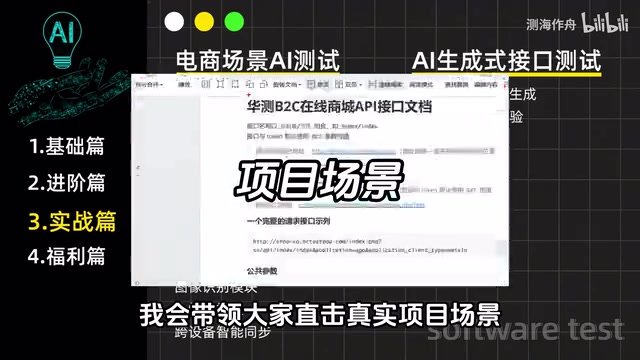
Among these, generative API testing and recommendation feature testing represent the most in-demand areas in enterprise hiring right now. Courses that cover these two scenarios in depth will deliver significantly more value to job seekers than those that stay at the conceptual level.
Generative API Testing targets services like the OpenAI API and Claude API — and its testing challenges go far beyond those of traditional REST APIs. The core difficulties are: outputs are natural language text with no fixed schema, making field-matching assertions impossible; outputs are non-deterministic, so the same prompt can return different content across multiple calls; and testers must also evaluate hallucination rate (how often the model fabricates facts), the effectiveness of harmful content filtering, and defenses against Prompt Injection attacks. Common testing strategies in practice include: building a "golden test set" and scoring outputs using semantic similarity metrics; using another large language model as a "judge" to rate output quality (the LLM-as-Judge pattern); and statistically analyzing multiple calls to assess output consistency and stability. This area is currently seeing the fastest growth in enterprise demand, and represents the most worthwhile specialization for testing engineers to pursue.
Learning Path and Companion Resources
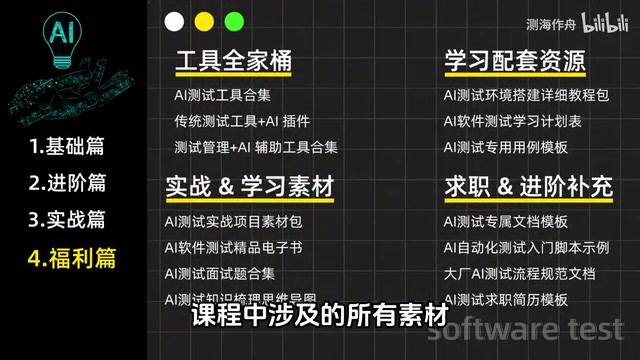
The full course is structured in three progressive stages — foundational, advanced, and practical application — which aligns well with how skills are actually developed: first build understanding, then tackle the technical challenges, and finally convert knowledge into capability through real projects. The author also provides a companion resource pack, including materials for setting up an AI testing environment, tool installers and user guides, industry e-books, project source code, and course slides.
The recommended focus areas differ depending on your background:
- Complete beginners: Thoroughly master the foundational section. Build a complete picture of testing concepts and tool proficiency before rushing ahead to advanced topics.
- Experienced traditional test engineers: Skim through the general content in the foundational section and focus on AI-specific skills like ML model testing and test data generation.
- Students entering the job market: Concentrate your energy on the hands-on project scenarios in the practical section. Being able to clearly explain one or two complete projects in your resume and interviews is far more valuable than memorizing definitions.
A Realistic Take on "Complete Tutorial" Courses
A word of caution: any course that claims to be "the most comprehensive on the internet" should ultimately be judged by the quality of its specific tool demonstrations and the depth of its project content. AI testing is a rapidly evolving field — toolchains and best practices change quickly. Video courses are valuable for building a structured knowledge framework, but real capability still requires repeated refinement through actual projects. Treating a course as a systematic entry-point map — not a job guarantee — is the more pragmatic mindset.
For those looking to enter or transition into this field, the greatest value of these courses lies in reducing the cost of filtering information — helping you build a learning framework that won't lead you astray, amid a sea of uneven resources.
Related articles

MCP Security Primer: OWASP Top 10 Risks and the Lethal Trifecta Defense
A systematic breakdown of MCP security risks: from the Postmark backdoor to the OWASP MCP Top 10, how the Lethal Trifecta reveals AI Agent fragility, plus shadow servers and missing audits.

DeepCell: One-Click AI Generation of Documents, Spreadsheets, and Slides
DeepCell tops Product Hunt with one-click generation of documents, spreadsheets, and slides, using the .deepcell format for linked updates, designed for System 2 tasks like modeling and sales reviews.

Doneas: 15-Minute Daily Accountability Calls That Keep Indie Developers From Procrastinating
Doneas is a daily accountability tool for indie developers: plan tasks on Monday, join a 15-minute call with five builders each day, and log deliveries on a public progress page. This article analyzes its core mechanics, effectiveness, and potential issues around retention and matching.