Behind Anthropic's $42B Loss: The Real Risk Is a $518B Infrastructure Bet

Anthropic's real risk isn't its paper loss — it's $518B in locked-in infrastructure costs and looming price wars.
Anthropic's $42B loss headline is misleading — most of it comes from accounting charges, not real cash outflows. The deeper risk lies in $518B of infrastructure commitments, roughly 80% non-cancelable. This creates structural fragility: customer spending is flexible, but costs are locked in. The analysis also surfaces a counterintuitive paradox: AI's success could still mean investor losses as competition drives prices down and value flows to users rather than model companies. Meanwhile, chip vendors and cloud platforms — the shovel sellers of this gold rush — enjoy far more predictable returns through those same long-term contracts.
A Misread Headline
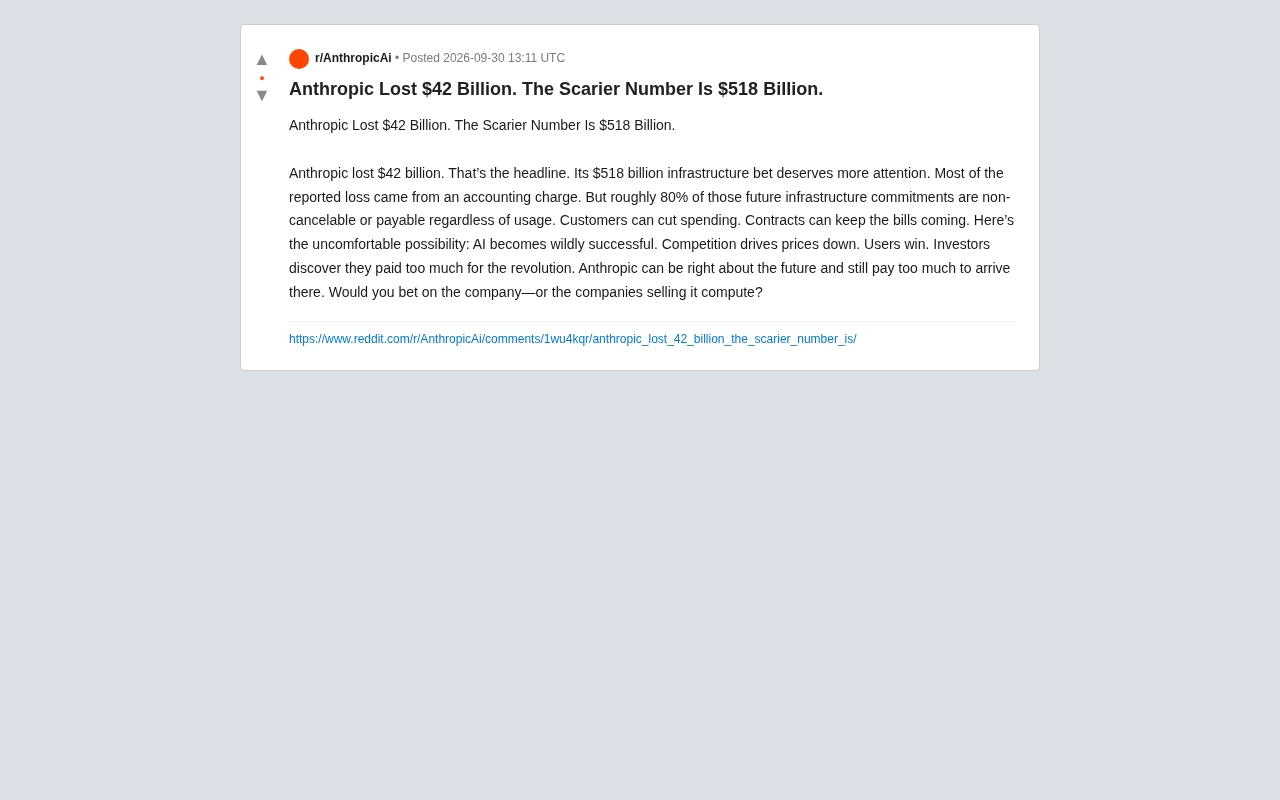
Anthropic's $42 billion loss dominated tech media headlines, but the number that should actually raise alarm isn't the loss figure — it's the $518 billion in infrastructure commitments buried beneath the financials.
On the surface, a $42 billion loss sounds staggering. But a significant portion of it stems from accounting charges rather than real cash outflows. Accounting charges are typically one-time balance sheet adjustments and shouldn't be conflated with actual operational bleeding. What truly determines Anthropic's long-term financial health is that $518 billion commitment to compute and infrastructure.
Why the $518B Commitment Is the Scarier Number
According to a widely discussed analysis, roughly 80% of that $518 billion consists of "non-cancelable" or "pay-regardless-of-use" contracts. This means that even if market conditions shift or demand declines, Anthropic is still on the hook for the compute costs.
This creates a classic structural risk: customers can cut their own spending at any time, but the long-term contracts Anthropic has signed with cloud providers and chip suppliers will keep generating bills. When revenue is elastic but costs are locked in, a company's financial cushion gets squeezed from both sides.
In other words, customers can reduce consumption — but the contracts don't stop billing. This asymmetry between revenue and cost is the most unsettling part of these financials.
This type of contract arrangement is common in cloud computing, typically structured as Committed Use Discounts or Reserved Instances. Vendors offer lower unit pricing in exchange for long-term usage guarantees — customers lock in favorable rates, suppliers lock in predictable revenue. For large customers like Anthropic, agreements with AWS, Google Cloud, and similar platforms often take the form of multi-year, fixed-scale Capacity Reservations. Once signed, the fees must be paid on schedule regardless of actual usage. This model was especially prevalent during the period of acute AI compute scarcity: to secure scarce GPU resources — particularly NVIDIA H100/H200 clusters — AI companies had little choice but to accept stringent contract terms. But as supply gradually catches up with demand and compute becomes less scarce, those expensive long-term contracts signed during the resource grab become a heavy fixed burden.
A Counterintuitive Paradox
The original analysis raises a genuinely insightful hypothetical: AI could achieve unprecedented success, and investors could still lose money.
The logic goes like this — AI technology succeeds spectacularly, competition intensifies, and prices get driven down relentlessly. The ultimate winners are users, who gain increasingly powerful capabilities at increasingly lower prices. Investors, meanwhile, discover they paid too much for the privilege of funding that revolution.
As the original piece puts it: "Anthropic could be completely right about the future and still have paid too high a price to get there."
This exposes a trap that's easy to overlook in AI investing: being correct about the direction of a trend doesn't guarantee a reasonable return. There's no necessary correlation between the validity of a technology thesis and the investment returns it generates.
Who Benefits in a Price War
As model capabilities converge and compute supply grows more abundant, pricing on large language model APIs will inevitably face downward pressure. Over the past two years, per-token pricing for leading models has already gone through multiple rounds of cuts — a boon for users, but a strain on heavily capitalized model companies.
When infrastructure costs are locked in and product prices keep falling, the margin gets squeezed from both ends. This is the real-world mechanism behind what the analysis calls "paying too high a price."
This dynamic has a historical parallel in economics: the early 20th-century railroad boom. Railroad technology undeniably transformed the American economy, but many early railroad investors ultimately lost money — while the real beneficiaries were the farmers and manufacturers who thrived on cheap transportation. Economists call this the "technology spillover effect": the value created by technological progress isn't necessarily captured by the technology provider, but diffuses across society. The same logic is playing out in AI: models keep getting more powerful and cheaper, giving businesses and individuals unprecedented productivity tools, while per-unit margins for model providers compress. When evaluating AI companies, investors must judge not only whether the technology will succeed, but whether the company has the ability to "capture" sufficient profit in the value chain — which typically depends on the width of its moat, switching costs, and whether it controls any exclusive resources.
The Shovel Sellers May Laugh Last
The piece closes with a question that cuts to the heart of the matter: would you bet on the AI company, or on the companies selling it compute?
This is essentially a restatement of the classic "sell shovels during a gold rush" logic. In the AI gold rush, no matter which model company ultimately wins, the chipmakers and cloud providers supplying the underlying compute — the shovel sellers — can lock in predictable revenue through those non-cancelable long-term contracts.
For Anthropic, the $518 billion commitment is a high-stakes gamble. For the compute suppliers on the other side of those contracts, it's a guaranteed cash flow regardless of market conditions.
The original "sell shovels" case study comes from the California Gold Rush of 1848: the ones who consistently profited weren't the miners, but the merchants selling tools, food, and services to miners — most famously Levi Strauss, who went on to found the Levi's denim brand. In the current AI boom, NVIDIA is the most archetypal shovel seller — no matter who wins the large model race, demand for GPUs will persist, which explains why NVIDIA's profit margins and valuation far exceed those of most model companies. Meanwhile, AWS, Azure, and Google Cloud, as the compute intermediary layer, use long-term contracts to transfer revenue certainty to themselves while leaving market uncertainty to AI application-layer companies. This risk distribution structure across the supply chain deserves serious consideration from every AI investor allocating capital.
Implications for the AI Industry
The value of this analysis isn't in talking down any particular company — it's in prompting the market to reassess the investment logic underlying the AI boom:
- Accounting losses and real operational risk need to be treated differently; headline numbers are often misleading
- Long-term non-cancelable infrastructure commitments are the most vulnerable link for capital-heavy AI companies
- Technological success and investment returns can decouple entirely; price wars redistribute who captures the gains
- In competitive landscapes with uncertain outcomes, upstream supply chain players often hold more predictable positions
None of this is a rejection of AI's long-term prospects. It's a sober reminder amid today's frothy valuations. AI may well change the world — but in the process of changing it, who actually makes money remains an open question.
Related articles

Workbuddy for Absolute Beginners: How a Desktop AI Agent Fits Into Real Workflows
A beginner's guide to the Workbuddy desktop AI agent: installation, claiming credits, file management, and building automated workflows—compared with CodeX for fit and cost, helping professionals shift from AI question-askers to AI managers.

OpenAI's New Agent Stack: Computer Use, Decisions API, and Ultra-Fast Workflows
OpenAI Dev Day unveiled a new agent stack: Computer Use outperforms humans, Decisions API delivers ultra-low-latency classification via Luna, Agents API opens the same Computer Use capabilities, and GPT-6.1 Sol costs only one-seventh of Astra. Core updates, benchmark data, and developer insights.

Liang Wenfeng Open-Sources DeepInfo Inference Framework, Takes On U.S. Ban
DeepSeek open-sources its DeepInfo inference framework after its models, featuring GPU/CPU cross-pipelining, small-model prediction with large-model verification, and full Huawei Ascend and NVIDIA chip support—facing the U.S. federal ban head-on. This article analyzes its significance for AI deployment and open-source strategy.