Behind India's 5% AI Hiring Dip: Core Skill Demand Structure Remains Rock Solid

India's AI hiring dipped 5% this week, but core skill demand—Python, ML, SQL—stays rock solid.
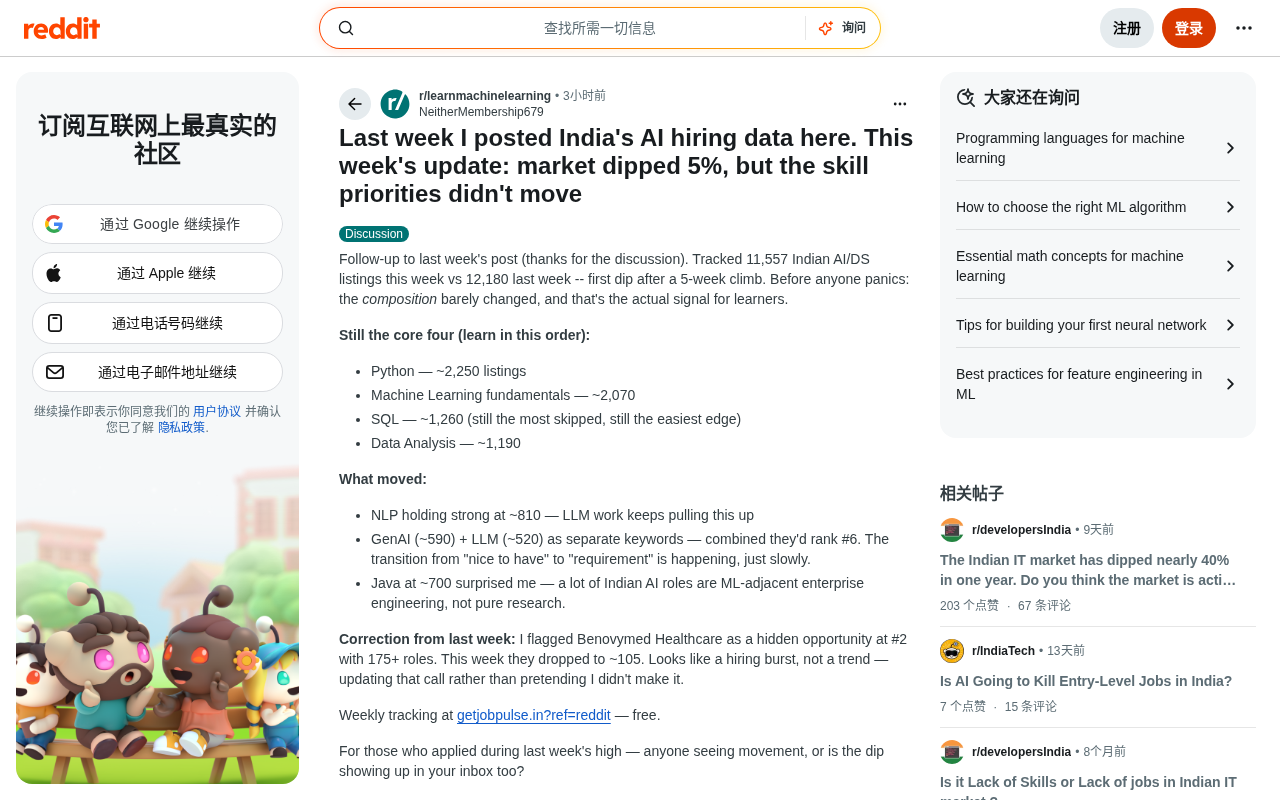
India's AI/DS job market recorded 11,557 postings this week, down 5% from last week's 12,180. Yet the skill demand structure barely shifted: Python, machine learning, SQL, and data analysis remain the top four, while GenAI/LLM demand keeps climbing and Java reveals strong ML-integration engineering needs.
India's AI Job Market Sees Its First Decline
A Reddit user who continuously tracks India's AI/data science hiring data published this week's update. The data shows a total of 11,557 AI/DS positions in India this week, down about 5% from last week's 12,180 — the first decline after five consecutive weeks of growth.
Notably, India's AI job market itself carries significant reference value on a global scale. According to a report from NASSCOM (the National Association of Software and Service Companies), India has the world's largest IT workforce, exceeding 5 million people, with AI/data science roles expanding at 30%-40% annually in recent years. As the authoritative think tank of India's tech industry, NASSCOM's data is widely used by global investors and multinational corporations to assess the capacity and maturity of India's talent market, and serves as a key basis for multinationals making outsourcing and R&D deployment decisions. Cities like Bangalore, Hyderabad, and Pune have formed mature AI industry clusters, taking on substantial outsourcing and R&D business from Western tech giants.
This cluster effect did not form by chance. Top institutions such as the Indian Institutes of Technology (IITs) and the Indian Institute of Science (IISc) produce a large volume of STEM talent each year, and combined with relatively low engineer costs, this has made India the top choice for global tech outsourcing and R&D centers. As the crown jewel of Indian engineering education, the IITs have an acceptance rate below 1%, and their graduates populate top tech companies worldwide, ranking alongside MIT and Stanford as the most sought-after engineering schools for recruiters. IISc, meanwhile, is India's strongest comprehensive research institution, with deep academic roots in AI and machine learning. Bangalore, known as "India's Silicon Valley," hosts the global R&D centers of multinational giants like Google, Microsoft, Amazon, and IBM. Hyderabad has some of the largest global campuses for Microsoft and Google, while Pune is a major base for domestic service giants like Infosys and Wipro. This dual-track structure of "local demand + global business intake" means India's AI hiring data reflects not only local demand but also multinationals' real judgments about AI skill priorities, making it a unique window into the AI strategic priorities of global enterprises — and offering leading-indicator reference value for job seekers worldwide.
However, the author particularly emphasizes: for those learning and preparing to enter the field, the truly meaningful signal is not the short-term fluctuation in total hiring volume, but rather that the skill demand structure has barely changed. Market size will ebb and flow with seasons and corporate budget cycles, but employers' skill preferences are the stable, long-term signal.
The Four Core Skills Remain Unchanged
The author recommends that job seekers master four core skills in the following order, as they remain the most in-demand foundational abilities for AI roles in India:
- Python — about 2,250 positions, firmly in first place
- Machine Learning Fundamentals — about 2,070 positions
- SQL — about 1,260 positions
- Data Analysis — about 1,190 positions
Python's dominant position is no accident; it rests on a decade-long history of ecosystem accumulation. In the early 2010s, R dominated in statistics and MATLAB was widely used in engineering, while Python existed more as a general-purpose scripting language. The turning point came between 2012 and 2015: the maturation of Pandas dramatically improved data processing efficiency, and Scikit-learn provided a unified machine learning API, wrapping more than a dozen mainstream algorithms into a consistent fit/predict interface that greatly lowered the barrier to entry for machine learning. The arrival of the deep learning wave then cemented Python's status entirely — both TensorFlow (open-sourced by Google in 2015) and PyTorch (released by Facebook AI Research in 2016) adopted Python as their primary interface, and the research community rapidly formed a complete toolchain around Python. After 2022, with the arrival of the large-model era, frameworks like LangChain and Hugging Face Transformers further reinforced Python's moat. Hugging Face's model hub now hosts over 400,000 pretrained models, almost all offering Python interfaces, creating an ecosystem-scale advantage that is extremely difficult for other languages to replicate. Today, Python is not just a tool but the "common language" among AI researchers — nearly all mainstream AI research papers prioritize providing Python implementation code, and this community inertia has created a powerful positive flywheel effect. Python is not just a tool; it is a passport into the AI community.
Worth noting is that SQL remains the skill most overlooked yet easiest to build a competitive edge with. SQL's remarkable staying power is nothing short of a miracle in the history of computer technology: it originated from the relational model theory proposed by IBM researcher Edgar Codd in the 1970s. Its core insight was to use mathematical set theory to describe data relationships, shifting data querying from procedure-oriented to result-oriented — users only need to describe "what data they want" without specifying "how to obtain it." SQL became an ANSI standard in 1986, and after the open-source popularization of MySQL and PostgreSQL, and the full rise of cloud data warehouses like BigQuery (Google), Snowflake, and Redshift (Amazon) in the 21st century, SQL has always been the universal language of enterprise data management. The rise of cloud data warehouses not only failed to replace SQL but instead greatly extended its capability boundaries: modern SQL supports complex analytical queries on petabyte-scale data, and query engine parallelization optimizations make its performance competitive with dedicated analytics tools. It is underestimated by job seekers because it lacks the "new technology halo" — compared to neural networks and Transformer architectures, SQL seems mundane. Yet the reality is that the vast majority of enterprise AI/ML workflows begin with SQL: extracting, cleaning, and aggregating training data from relational databases (MySQL, PostgreSQL) or data warehouses (BigQuery, Snowflake, Redshift) is the first step in the feature engineering phase of every real AI project. Mastering advanced SQL skills such as window functions (for computing moving averages, time-series rankings, and other complex features), CTEs (Common Table Expressions), and query execution plan optimization is an important watershed distinguishing junior from senior data practitioners, and can create a significant differentiation for job seekers as early as the resume screening stage. While many job seekers flock to hot directions like large models and generative AI, solid SQL skills instead become an underestimated differentiating advantage. This viewpoint holds reference value for job seekers everywhere: the stable demand for foundational skills is often more reliable than chasing trends.
Large-Model-Related Skills Continue to Heat Up
The most notable change in this week's data is the demand for positions related to large language models (LLMs):
- NLP (Natural Language Processing) — about 810 positions, continuously driven by LLM-related work
- Generative AI (GenAI) — about 590 positions
- LLM — about 520 positions (as an independent keyword count)
Understanding this set of data requires knowledge of the technological evolution of NLP and large language models. NLP is an important branch of AI, and its technical paradigm has undergone three fundamental leaps over the past decade: the first stage was dominated by statistical methods, with TF-IDF (Term Frequency-Inverse Document Frequency) measuring the relative importance of words in documents, and Naive Bayes and support vector machines used for text classification — these methods relied on manually engineered features, with semantic understanding limited to word frequency statistics. The second stage was ignited by Word2Vec, proposed by Google researcher Tomas Mikolov in 2013; word embedding technology allowed machines to capture semantic relationships in dense vector form for the first time, and "king - man + woman ≈ queen" became the most famous demonstration in NLP history, with technologies like GloVe and FastText subsequently pushing word embeddings to industrial-scale applications. The true paradigm revolution came in 2017, when Google proposed the Transformer architecture in the paper "Attention Is All You Need," replacing RNN/LSTM for handling sequential dependencies with the self-attention mechanism — the former needed to pass information step by step, causing long-range dependencies to decay, while self-attention allows any two positions in a sequence to interact directly, and the leap in parallel computing capability made ultra-large-scale models possible. BERT (Google, 2018, bidirectional encoder, good at understanding tasks) and the GPT series of models (OpenAI, post-2020, autoregressive decoder, good at generation tasks) represent the two technical routes of "understanding" and "generation" respectively, pushing NLP into the large-model era of "pretraining + fine-tuning." Large language models (LLMs) are precisely the latest product of this evolution — at their core are ultra-large-scale neural networks pretrained on massive text (with parameters ranging from billions to trillions), possessing broad capabilities in text generation, summarization, translation, code completion, and more. This also explains why hiring demand for NLP and GenAI/LLM shows a highly correlated growth trend — enterprises' demand for deploying LLMs directly drives the thirst for talent with both NLP theoretical foundations and engineering capabilities.
If GenAI and LLM are counted together, the total would rise to 6th place on the demand ranking. This confirms a slowly unfolding shift: large-model-related skills are evolving from a "bonus" into a "hard requirement" — only this process is gradual, not sudden.
For learners, now is the window of opportunity to position themselves in GenAI/LLM skills: demand has clearly risen, but it has not yet become a threshold everyone must meet, so preparing a step ahead can still yield a first-mover advantage.
An Unexpected Finding: Java's Presence in AI Roles
One surprising point in the data is that there are about 700 Java positions, exceeding the author's expectations. His explanation is quite insightful: many AI positions in India are actually "ML-adjacent" enterprise engineering roles, rather than pure research positions.
Java's presence in AI engineering reveals the important but often-overlooked domain of "AI engineering deployment." Since its release by Sun Microsystems in 1995, Java has long dominated the backend systems of industries like finance, telecommunications, and e-commerce, thanks to the JVM (Java Virtual Machine) ecosystem's "write once, run anywhere" cross-platform capability: the Spring Boot framework has become the de facto standard for enterprise microservice architectures; Apache Kafka, originally developed by LinkedIn, now processes trillions of messages daily and is the core infrastructure for real-time data stream processing; and while Apache Spark provides a Python interface (PySpark), its underlying compute engine is written in Scala (running on the JVM), giving Java engineers a natural advantage in tuning and scaling Spark clusters. These infrastructures form the backbone of most enterprises' digital systems, carrying decades of accumulated business logic. When these enterprises advance AI transformation, they face a real constraint: they cannot tear down and rebuild decades of accumulated Java codebases, but must incrementally embed ML capabilities into existing architectures. Typical implementation paths include: wrapping Python-trained models as REST API services via Flask/FastAPI to be called by Java systems, achieving a "Python training, Java deployment" hybrid architecture; using Java-native deep learning libraries like Deeplearning4j (DL4J) for direct inference in the JVM environment; or embedding feature engineering logic into Kafka stream processing pipelines to achieve millisecond-level real-time predictions. In India, the four major software service giants — TCS, Infosys, Wipro, and HCL — collectively employ over a million engineers who maintain and upgrade legacy systems for thousands of enterprises worldwide, with their core tech stacks primarily built on Java. AI transformation requires incremental integration atop existing architectures rather than building from scratch. Such "ML integration engineer" roles are especially common in India, which is the fundamental reason Java demand exceeds expectations.
This reminds us that the real picture of the AI job market is far more complex than imagined. Beyond algorithm research and model training, an even larger share of demand comes from the engineering practice of integrating machine learning capabilities into enterprise systems. Mastering enterprise development languages like Java still has a stable role to play in AI deployment scenarios.
An Honest Correction: Benovymed's Hiring Was Just a Short-Term Burst
In this week's update, the author also made a public correction. Last week he had flagged Benovymed Healthcare as a "hidden opportunity," when it ranked second with 175+ positions; this week, the company's positions plummeted to about 105.
The author candidly stated: "This looks like a hiring burst, not a trend. I chose to update this judgment rather than pretend I never said it." This case also highlights the core methodology for interpreting hiring data: distinguishing "noise" from "signal." Noise in hiring data typically comes from several sources: a single employer batch-posting jobs in a short period (such as budget-burn hiring before quarter-end), stage-specific demand generated when a particular project enters an intensive expansion phase, or duplicate counting caused by hiring platform algorithms. Signal, by contrast, exhibits entirely different characteristics: it manifests as a sustained trend across multiple weeks rather than a single peak; as a consistent preference across multiple employers rather than the anomalous behavior of a single company; and can be cross-validated across multiple data sources such as LinkedIn Talent Insights, Indeed trend charts, and Glasshire. Best practices for distinguishing the two include: tracking at least 4-8 weeks of data before drawing conclusions, calculating the change in the market baseline after removing the single largest employer's contribution, and focusing on the co-occurrence frequency of skill keywords in job descriptions rather than the raw number of positions. A single week's hiring peak does not necessarily represent a long-term trend; continuous observation is needed to distinguish noise from signal — and the author's public correction is precisely an embodiment of this rigorous data literacy.
Four Takeaways for Job Seekers
Synthesizing this week's data, several key conclusions emerge:
- No need to panic over the total decline: A 5% dip is normal fluctuation; the stability of the skill demand structure is the core signal.
- Building a solid foundation never goes out of style: The combination of Python, machine learning, SQL, and data analysis remains the absolute mainstay, with SQL's value being severely underestimated.
- Position yourself early in large-model skills: GenAI/LLM is moving from bonus to necessity, and there is still a timing advantage to entering now.
- Don't ignore engineering capabilities: The demand for enterprise skills like Java reminds us that AI roles are not just about research — engineering deployment matters just as much.
The author's tracking data comes from the free platform getjobpulse.in, updated weekly. Although the data only covers the Indian market, the skill evolution trends it reveals — solid foundational skills, rising large-model demand, and underestimated engineering capabilities — hold universal reference value for AI job seekers worldwide.
Key Takeaways
Related articles
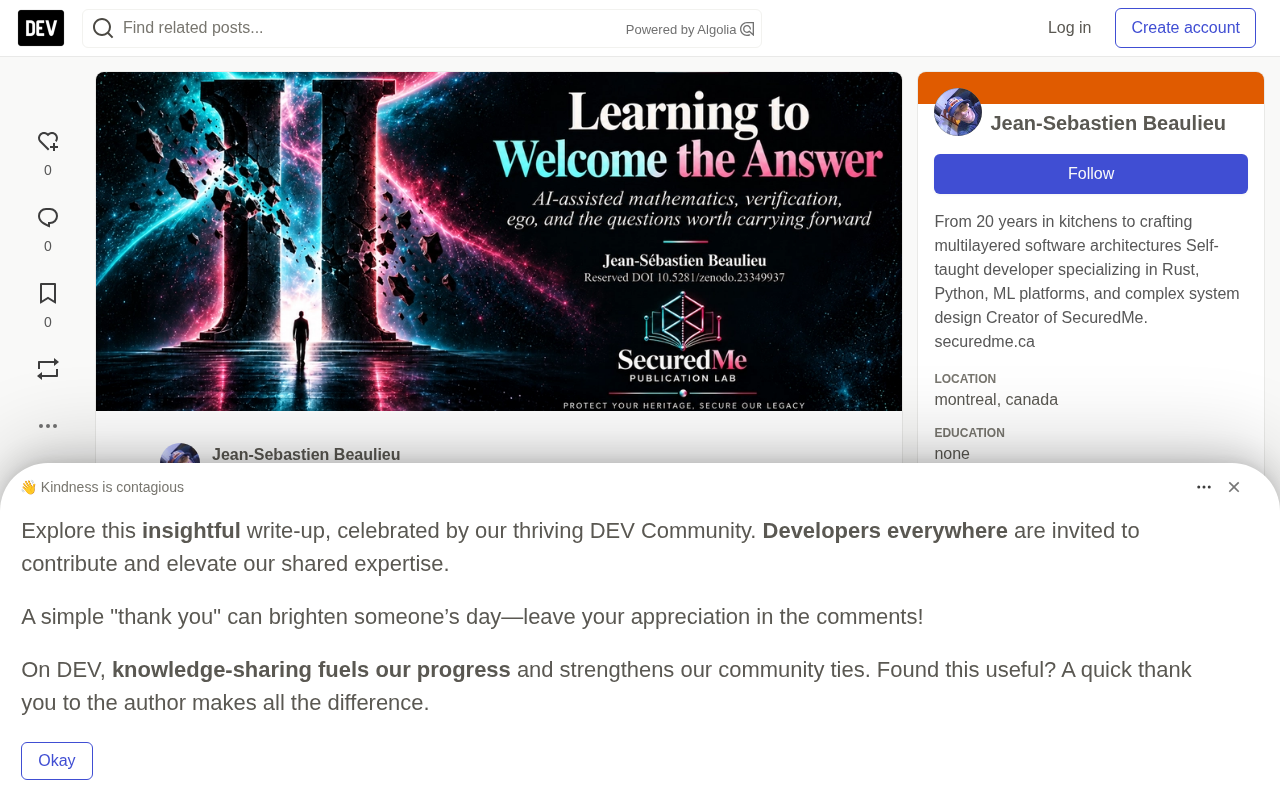
After the AI Math Breakthrough: Learning to Welcome the Answer, Not Feel Threatened
After OpenAI released 719 mathematical results and 300 Lean formalizations, one researcher reflects on the real challenge of AI math: not replacement, but learning to welcome answers and turn them into reliable knowledge.

HowToLiveBetter Open-Source Project Tested: Is a 60K-Star Life Guide Worth Using?
HowToLiveBetter, an open-source project with 62,020 stars, covers longevity, disease prevention, saving money, finance, medical insurance, social security, unemployment, and work injuries. This article tests its speed, quality, and cost, and analyzes three usage methods and potential limitations.

Git Worktree's Three Big Pitfalls: .env, node_modules, and Port Conflicts Fully Solved
Solve git worktree's three pitfalls for parallel AI agents with one post-checkout hook: copy .env, share dependencies fast, and assign a port block.