After the AI Math Breakthrough: Learning to Welcome the Answer, Not Feel Threatened
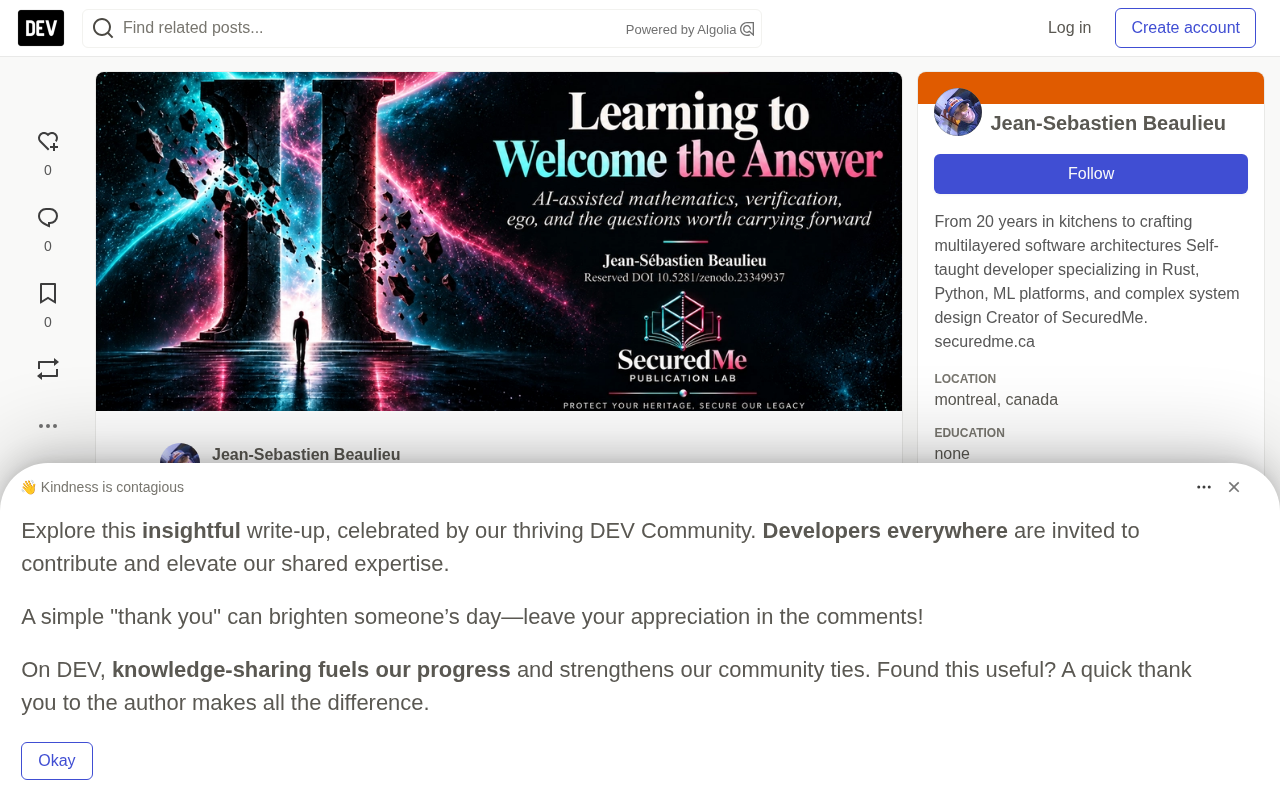
Faced with AI-generated math answers, researchers should treat results as starting points and continue progress through understanding and verification.
Starting from the author's anger at OpenAI's mathematical results, the article argues that the key challenge is not replacement but transforming received answers into understanding. It cites William Thurston on proof and progress, examines the 719 results with 300 Lean formalizations, proposes a five-step methodology, designs a small experiment on fractals and information, and closes with open access and shared participation.
When a machine starts producing answers to mathematical problems, how should human researchers position themselves? This is the core question explored in a long-form article by Jean-Sébastien Beaulieu on Dev.to. The piece originated from a very specific trigger: OpenAI released a collection of mathematical results produced by its internal frontier models.
The author admits that on the first day he saw these results, he felt angry. For four years, he had been pushing his own problems forward through his own research, code, revisions, and continuous learning. A project, as it advances, takes up part of your life. And when a large-scale external body of results suddenly appears, it creates a complicated emotion—both awe at its scale and a temporary inability to find the right way to understand it.
But in the end, he chose a different stance: to welcome everything this progress might bring, while seriously considering what it means for people who have already invested twenty, thirty, or even forty years in mathematics. As he writes: "The years spent immersed in a problem become part of our judgment when we receive the answer."
The People Who Live With a Problem
Four years of his own research give the author reason to approach other people's lifelong investments with humility. Someone who has spent decades studying a certain difficult problem may feel an impact far beyond the addition or deletion of a paper when facing an unexpected answer. That problem may have shaped their reading habits, their teaching, their friendships, and their sense of their own contribution.
The author wants to leave room for this "human adjustment." People need time to examine the mathematics itself, and they also need time to understand what this moment means for them personally.
The accumulation of those years is equally precious. A researcher with deep understanding of a problem may identify assumptions that need attention, difficult steps hidden behind elegant phrasing, or connections that give the result broader meaning. Their experience can help a new answer become reliable knowledge. What is truly hopeful is this continuity—people who have explored for years in the face of obstacles may find a path through them, bring their understanding into the next problem, or discover possibilities the original authors overlooked.
Answers Become More Valuable Through Understanding
The article cites William Thurston's classic essay On proof and progress in mathematics, returning to a core question: how does mathematical work advance human understanding?
The author uses a minimalist example to illustrate. For the function f(x) = x², the derivative at x = 3 is 6. You can memorize this answer, or you can understand why it holds: (3 + h)² = 9 + 6h + h², and when h is small, the change in the function is close to 6h, while the remaining h² term explains the nature of the approximation. This number therefore belongs to a relationship you can explain and apply.
This example is basic, but the movement it reveals holds at every level of learning: receive a result, go deeper into its meaning, build understanding, and then take it somewhere useful. When a machine helps produce a difficult answer, the author wants to make the same movement. The result is only a starting point; understanding grows through the work done with it.
William Thurston and On proof and progress in mathematics
William Thurston (1946–2012) was an American mathematician who won the Fields Medal in 1982 for his revolutionary work in three-dimensional manifold topology. He was known not only for profound results such as the geometrization conjecture, but also for his reflections on the nature of mathematics. In 1994, he published On proof and progress in mathematics in the Bulletin of the American Mathematical Society, responding to contemporary debates about "what counts as a rigorous proof."
Thurston's central argument was that mathematical progress cannot be measured solely by "whether a theorem has been proved." True progress lies in changes in human understanding—how we organize concepts, how we build analogies between different fields, how we turn a problem into an operable object. He distinguished between "formal proof" and "mathematical understanding": the former is a logical chain written on paper, while the latter is a knowledge structure in a mathematician's mind that can be transferred, explained, and further developed.
This essay is often cited in discussions of the relationship between AI and mathematics because it responds in advance to a question that is increasingly urgent today: when a result is produced by a machine and formally verified, has human understanding also advanced in step? Thurston's answer tends toward: understanding is the final product of mathematical work, and proof is only one tool on the way to understanding.
Taking Mathematics Itself Seriously
Here the author provides a key fact-check. The batch of mathematical results released by OpenAI contains 719 top-level results, of which 300 were formalized in Lean, about 42%. The same version history also records retractions, proof repairs, and clarifications of assumptions.
These numbers themselves are a reminder: a result has a statement, assumptions, and an argument that needs scrutiny; a formalization has a precise scope, including the correspondence between its formal statement and the mathematical problem; and an application brings another set of conditions that need to be established. The author writes that there is room for celebration in this release—the people who find gaps help us understand where the argument needs repair, the people who explain assumptions make the next reader's reading more effective, and the people who reproduce results give others firmer ground.
Lean and formalized mathematics
Lean is an interactive theorem prover and also a functional programming language, originally initiated in 2013 by Leonardo de Moura at Microsoft Research. Its core purpose is to let mathematicians write definitions, theorems, and proofs as formalized code that a computer can check line by line. Unlike traditional numerical computation or symbolic computation, Lean is not concerned with "computing a number," but with "verifying whether a proof of a proposition is valid." In Lean, every inference step must be supported by logical rules or already proved lemmas, and any skipped step, undeclared assumption, or circular argument will cause compilation to fail.
"Formalization" refers precisely to this process: translating a mathematical argument written in natural language into precise code that Lean can accept. A formalized result has machine verifiability—as long as the code compiles, it means the proof holds within the given axiom system. But formalization also has boundaries: it verifies "the statement in the code," not "the correspondence between the code and the original mathematical problem." Therefore, the article emphasizes that "a formalization has a precise scope," reminding readers not to equate formalization with the whole of mathematical understanding.
Of the 719 top-level results released by OpenAI, about 42% were formalized in Lean, meaning that nearly 60% remain at the stage of natural-language argument and require human readers to judge for themselves whether the logical chain among assumptions, steps, and conclusions is complete.
My Responsibility Is to Push Understanding Further
The turning point of the article becomes personal here. If these tools are to be welcomed into one's own work, then one also accepts the effort required to use them well. The author proposes a concrete path:
- State the problem in your own words. Identify the objects, assumptions, and conclusion.
- Do a small example. Connect the symbols to something computable or checkable.
- Follow the evidence. Read the argument, check the scope of the formalization, and record versions.
- Compare fairly. Define what a new method should contribute and evaluate it against simple baselines.
- Explain what you learned. Make the result, remaining questions, and next steps clear enough for others to scrutinize.
Curiosity gives you the desire to begin, while responsibility requires you to stay with the problem long enough to understand it better.
From a Large Result to a Small Experiment
The author's interest lies in the relationship between fractals and information. He proposes a concrete research design: assuming a baseline model uses feature set z, he will compare the performance of the same learning method when using z plus geometric descriptor D, under matched evaluation periods, budgets, and metrics. The question is precise: for this task, what information does D add?
Such a comparison may help him understand a useful contribution, or it may show which part of the idea needs a different route. Either outcome will give a better basis for the next decision. This is exactly the kind of progress the author finds exciting: a large body of new work can lead to a small, serious experiment that he can explain.
A Future We Build Together
The author hopes we enjoy the possibilities these machines bring, and also hopes curiosity becomes shared participation. Experienced mathematicians, students, developers, and people from other disciplines can contribute different kinds of understanding. We can value these contributions, give recognition seriously, and make it easier for the next person to join the conversation.
This is why open access matters to the author. A paper becomes useful to more people when it comes with clear explanations, reproducible examples, and conditions that let people continue learning. UNESCO's Recommendation on Open Science links knowledge sharing with skills, infrastructure, cooperation, and equitable participation.
Through the SecuredMe project, the author hopes to help people protect what is entrusted to digital systems, and through atmospheric research, he hopes to explore whether better descriptions can support useful decisions. These aspirations give this discussion a purpose beyond the excitement of new capabilities.
UNESCO Recommendation on Open Science
In November 2021, the 41st session of the UNESCO General Conference adopted the Recommendation on Open Science, the first global standard-setting instrument on open science. It defines open science as an open access movement covering publications, research data, source code, methodologies, and peer review, while emphasizing that openness is not unconditional sharing, but must be combined with fairness, inclusion, and capacity building.
The Recommendation proposes seven areas of action, including: promoting open science infrastructure, investing in open science skills training, advancing knowledge sharing, encouraging collaborative research, ensuring equitable participation, developing open science policies, and monitoring and evaluation. It particularly notes that developing countries and under-resourced research institutions should not merely be recipients of knowledge, but participants in knowledge production.
The article cites this framework to show that "open access" is not just about putting papers online for free, but about sharing explanations, reproducible examples, and the conditions for continued learning together. In other words, the ethical goal of open science and the author's claim of "making it easier for the next person to join the conversation" are the same thing: the value of mathematical progress depends on how many people can understand it, test it, and continue working on that basis.
Giving the Past Years a New Place
The article returns at the end to the emotion from the beginning. The author admits that his self-esteem needs time to catch up with his curiosity. But he chooses to acknowledge this honestly, while choosing what to do next: welcome an answer that can withstand scrutiny, learn from those who understand it, and push himself to understand what can be built on top of it.
The years already invested are part of this effort. They taught patience, gave him questions worth pursuing, and helped him recognize how much care a useful contribution requires. He writes that today, he is ready to welcome the answer and do the work of understanding what comes next.
Behind this reflective article is a complete illustrated paper with nine chapters, a conclusion, a glossary, and thirty references, available in English and French. The author also openly states that he used Codex as a research partner for source comparison, evidence organization, consistency checks, drafting, and editorial preparation, while retaining full responsibility for the final text.
One-line Summary
Faced with mathematical answers produced by AI, human researchers should treat results as starting points and continue mathematical progress through understanding, verification, and open participation.
Paragraph Summary
Starting from the author's anger and discomfort upon seeing OpenAI's mathematical results, the article proposes a core stance: in the face of machine-produced answers, the key is not being replaced, but completing the transformation from receiving results to building understanding. The author cites William Thurston's views on proof and progress, emphasizing that understanding why a number holds, whether an argument is complete, and whether the scope of a formalization corresponds to the original problem is the true product of mathematical work. The article fact-checks the data that 300 of 719 top-level results were formalized in Lean, reminding readers that formalization is only part of a precise scope. The author further proposes a five-step methodology—state the problem in your own words, do a small example, follow the evidence, compare fairly, and explain what you learned—and uses it to design a small experiment on fractals and information. The ending returns to open access and shared participation: experienced mathematicians, students, developers, and interdisciplinary contributors can each bring different kinds of understanding, and the UNESCO Recommendation on Open Science provides a global framework for this.
Related articles

Apple HomeView Hands-On Review: Is the $300 Smart Home Hub Worth It?
Apple HomeView hands-on: a $300 smart home hub with facial recognition for quick account switching, but no App Store or voice recognition. Is the wall-mounted version worth it? Should you buy the first generation?

Meta Muse Wonder Launch: What It Means for Meta's Return to the Frontier AI Race
Meta releases Muse Wonder and WonderFull, benchmarks reach the frontier, community feedback is polarized. An in-depth look at Meta's return to the frontier AI race, its personal agent strategy, and Zuckerberg's different path.

Apple Home Smart Home Lineup Leaked: LG and Schneider Team Up, UWB Door Lock on Board
Apple Home ecosystem gains new LG and Schneider devices: UWB smart lock with proximity unlock, 2.5K dual-camera doorbell, privacy indoor camera, and AirPods-like seamless pairing.