Behind Persuasion Lies Power: Robert Caro on LBJ's Manipulation Tactics | In-Depth

Caro's analysis of LBJ reveals that persuasion is essentially power leverage, not mere charisma.
Robert Caro's analysis of Lyndon Johnson reveals that persuasion is often mistaken for personal charisma or a contest of ideas, but is actually rooted in power relationships. Johnson's persuasiveness combined personal charm with institutional leverage—the latter more fundamental. By controlling committee assignments, bill advancement, and key resources, he made senators unable to refuse his requests. This principle extends to the AI era: recommendation, ranking, and permission allocation are essentially leverage positions. When evaluating influence strategies, examine the power structure behind them rather than focusing solely on communication skills.
The Illusion of Persuasion: When Power Stands Behind Charisma
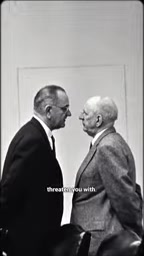
In his analysis of Lyndon B. Johnson (LBJ), Robert Caro proposed a classic framework for understanding influence: Johnson's persuasiveness consisted of two layers. The first was face-to-face personal charisma—he was indeed extraordinarily persuasive. The second was more fundamental: he placed himself in a position of leverage, holding things he could promise you and things he could threaten you with.
Caro's insight is that people often mistakenly believe persuasion is a contest of ideas, but with Johnson, the essence of persuasion was a power relationship. When you spoke with him, the reason his requests were hard to refuse wasn't that his arguments were unassailable, but that you knew: your success depended on his favor.
How Power Underwrites Persuasion
Caro illustrates this mechanism with a concrete scenario. Suppose Johnson is canvassing a senator who disagrees with his position and is unwilling to cast the vote. But the senator knows full well: he wants a committee seat, and Johnson has the power to grant it or not; or he hopes a certain bill will pass, and Johnson has the ability to let it pass or let it die.
In this situation, persuasion is no longer persuasion itself. The senator faces not an argument but a choice: compliance may bring rewards, defiance may incur costs. Caro emphasizes that when Johnson puts his arm around your shoulder and leans in close to speak, the tool he wields to exert influence isn't just the force of his personality—behind that personality is the power you know all too well that he holds to reward or punish you.

Lyndon Johnson and the Senate's "Leverage": During his tenure as Senate Majority Leader in the 1950s, Johnson was renowned for his mastery of Senate rules and his interpersonal skills. He controlled committee seat assignments, bill scheduling, and the flow of resources—these institutional powers formed the solid foundation of his persuasiveness with colleagues. Caro's biography details how Johnson used these levers, combining personal charisma with institutional power to exert enormous influence in the Senate.
Committee Seats and Bill Advancement: In the U.S. Congress, committee seat assignments directly affect a legislator's participation in legislation on specific issues and access to political resources. The Majority Leader typically has significant influence over these assignments. Similarly, whether a bill reaches a vote often depends on leadership's arrangements. Thus, when Johnson spoke with a senator, behind him stood an entire institutional power structure, giving his requests weight beyond mere words.
The Leverage Position: The True Source of Influence
Caro's analysis reveals a more universal principle of influence: persuasive skill matters, but whether a person can truly influence others depends largely on whether he occupies a leverage position. Johnson's brilliance lay in his deep understanding of the power nodes within the institution—committee assignments, bill advancement, procedural control—and embedding himself within these nodes.
This means that when he persuaded you, he was actually mobilizing the entire institutional structure to exert pressure on you. Your refusal was not just saying no to him personally, but a reassessment of your own interests. Caro points out that a senator might not agree with Johnson's position, but he could not ignore the power in Johnson's hands.

Implications for Influence Design in the AI Era
Caro's dissection of LBJ, though drawn from political history, offers direct inspiration for today's AI products and organizational design. In AI systems, recommendation, ranking, permission allocation, and resource scheduling are essentially leverage positions. A system can influence user behavior often not because its prompts are cleverly written, but because it controls what users want—visibility, efficiency, opportunity.
Similarly, in team collaboration, influence often comes from control over key resources and processes rather than mere communication skills. Caro's framework reminds us: when evaluating an influence strategy, first ask—what power structure stands behind the persuasion?

Leverage Positions in AI Systems: In AI products, recommendation algorithms determine what users see, ranking mechanisms affect information visibility, permission allocation controls feature access, and resource scheduling governs the distribution of computation and attention. These design choices are essentially leverage positions—the system influences behavior by controlling resources users value (such as exposure opportunities, efficiency gains, scarce information). For example, social media recommendation algorithms influence user engagement by determining content ranking—this is not just technical optimization but a manifestation of power structure. Designers need to recognize that these seemingly neutral mechanisms actually embed the ability to influence users.
Conclusion: The Dual Perspective of Persuasion and Power
The core of Caro's analysis of Johnson is to break a common illusion: equating influence with eloquence or personal charisma. True influence, especially in high-stakes institutional environments, is the combination of persuasive skill and power leverage. Understanding this not only helps us see political operations more clearly, but also enables us to think more responsibly about how power is embedded in seemingly neutral "persuasion" when designing organizations, products, and AI interactions.
Related articles

Altman Says Local Deployment Can't Beat Data Centers: The Open-Source AI Debate Reignites
Altman says local deployment of open-source models can't match centralized data-center computing. Bilibili creator Guashu Diluola breaks down the technical roadmap debate and China-US AI industry differences behind the remark, asking whether local deployment should really be abandoned.

MiniMax H3 Open-Source Workflow: Breathing-Skin Results Even on Low VRAM
This article introduces a MiniMax H3 dual-sampling workflow shared by a Bilibili creator, using fused models, a line-breaking LoRA, and low-VRAM nodes to fix greasy AI character faces and run on 12GB VRAM devices. Includes model pairing, dual-sampling logic, and parameter details.

On-Device LLM + ESP32: Build a DIY Calorie Reminder
A Bilibili creator open-sourced a calorie intake reminder: a phone app uses the open-source miniCPM model to locally recognize food photos and estimate calories, while an ESP32 mini screen syncs data and shows intake status with green/yellow/red rings — magnetically attachable to the fridge door for constant reminders.